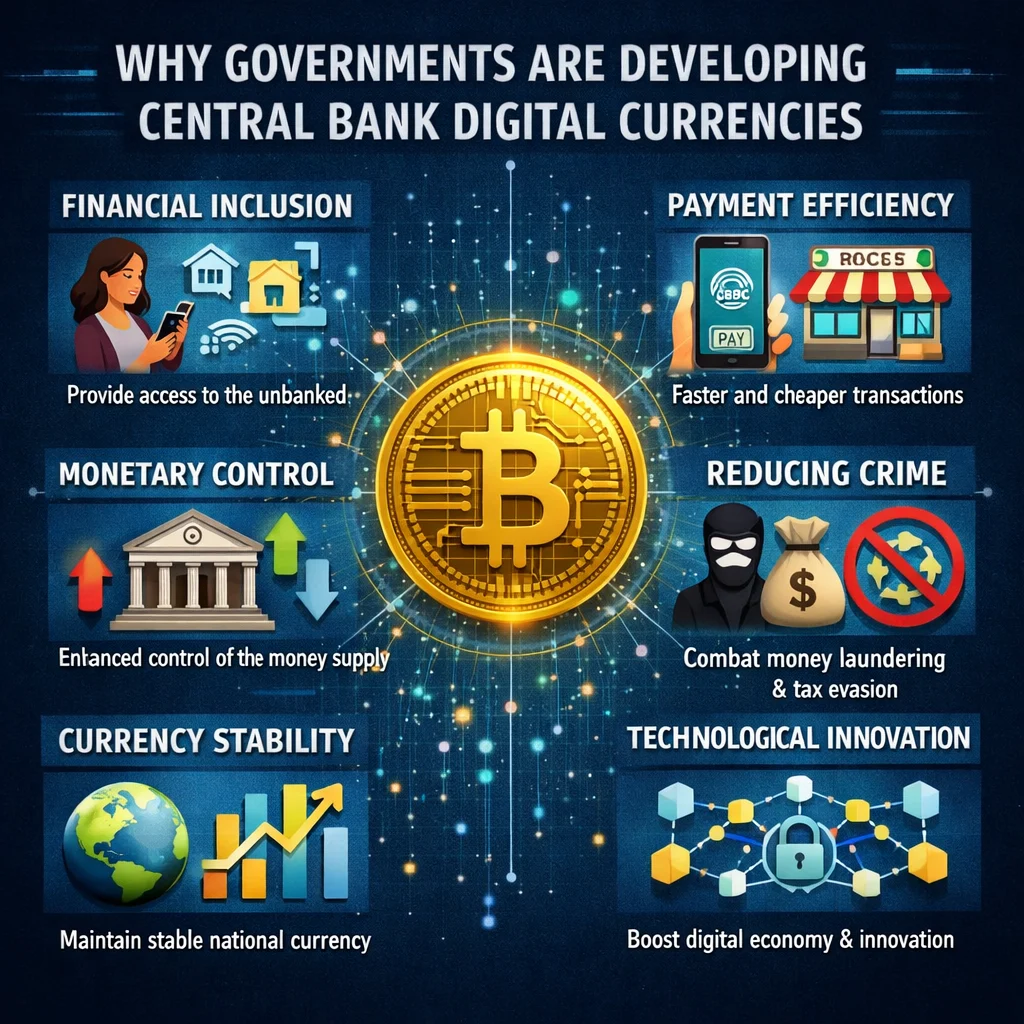
Governments are investigating new kinds of digital money, which is causing a significant shift in the global financial scene. The emergence of Central Bank Digital Currencies (CBDCs) is one of the most important trends in this field. These are digital equivalents of sovereign currencies that are controlled and issued by central banks. In contrast to cryptocurrencies like Bitcoin, CBDCs are government-backed, centralized, and intended to serve as legal cash.
Governments are realizing the need to update their monetary systems as digital payments gain traction and financial technology develops. The creation of CBDCs is part of a larger initiative to improve financial efficiency, preserve economic stability, and address the expanding impact of private digital currencies.
Understanding Central Bank Digital Currencies
A digital version of a nation's fiat currency is called a Central Bank Digital Currency. It is purely electronic but has the same value as actual cash. Similar to cash or digital bank transfers, CBDCs can be used for routine transactions with improved traceability and efficiency.
CBDC systems are being investigated and tested by central banks, including the European Central Bank and the People's Bank of China. There are already a number of trial schemes in place, and several nations are getting closer to implementing them fully.
CBDCs can be created in a variety of methods, such as wholesale CBDCs for interbank transactions and retail CBDCs for public use. Regardless of the methodology, their primary goal is to offer a state-backed, safe, and effective digital payment system.
The Shift Toward Digital Payments
The sharp drop in cash usage is one of the main reasons governments are creating CBDCs. Consumers are moving toward digital payment options including internet banking, contactless cards, and mobile wallets in various nations.
Central banks run the risk of losing direct access to the public's daily financial activities if cash becomes less prevalent. Governments can continue to play a part in the changing payment ecosystem thanks to CBDCs.
Key drivers of digital payment adoption include:
✔ Convenience and speed of electronic transactions
✔ Growth of e-commerce and online services
✔ Increased smartphone and internet usage
✔ Changing consumer preferences toward cashless systems
CBDCs help ensure that central banks remain relevant in a digital economy.
Enhancing Payment Efficiency
Traditional payment systems can be slow and expensive, especially for cross-border transactions. CBDCs have the potential to streamline these processes by enabling faster and more cost-effective payments.
Transactions can be completed nearly instantly with CBDCs without the need for numerous middlemen. For both people and companies, this lowers transaction costs and boosts productivity.
Benefits of CBDC-based payment systems include:
✔ Real-time transaction processing
✔ Lower fees for domestic and international payments
✔ Reduced reliance on intermediaries
✔ Improved financial infrastructure
These improvements can significantly enhance the overall efficiency of national and global payment systems.
Strengthening Financial Inclusion
Another important reason governments are looking into CBDCs is financial inclusion. Traditional financial services are still unavailable to millions of individuals globally. Their capacity to engage in the formal economy is so restricted.
By offering digital wallets that don't require conventional bank accounts, CBDCs can aid in resolving this problem. Money can be stored and transferred by individuals using basic digital technologies, frequently via mobile devices.
Advantages for financial inclusion include:
✔ Access to financial services without a bank account
✔ Lower barriers to entry for underserved populations
✔ Ability to participate in digital commerce
✔ Reduced dependence on cash-based systems
By expanding access to financial services, CBDCs can help reduce economic inequality.
Maintaining Monetary Sovereignty
Monetary sovereignty has come under scrutiny due to the emergence of private digital currencies and international payment systems. Governments may lose control over their national monetary policy if payment systems are dominated by private corporations or foreign digital currencies.
In a digital setting, CBDCs enable central banks to keep control over their currencies. Central banks can guarantee the continued widespread use of their currency by providing a digital substitute supported by the government.
This is particularly important as global technology companies expand their influence in financial services.
Improving Transparency and Reducing Fraud
By generating safe and traceable records, CBDCs can improve financial transaction transparency. This can lessen illicit behaviors including fraud, tax evasion, and money laundering.
Because CBDC transactions are recorded digitally, authorities can monitor suspicious activities more effectively while maintaining regulatory oversight.
Key benefits include:
✔ Improved tracking of financial transactions
✔ Reduced risk of counterfeit currency
✔ Enhanced ability to detect financial crimes
✔ Greater accountability in financial systems
However, governments must balance transparency with privacy to ensure that citizens’ financial data is protected.
Supporting Financial Stability
Additionally, CBDCs may contribute to preserving financial stability. Central banks can employ digital currencies to provide direct financial assistance to people and companies during economic downturns.
For instance, CBDC systems might provide stimulus payments rapidly, cutting down on delays and guaranteeing that money reaches recipients promptly.
CBDCs may also improve the effectiveness of monetary policy by giving central banks more direct tools to influence economic activity.
This could lead to more responsive and efficient economic management.
Challenges and Concerns
CBDCs provide significant difficulties and issues despite their possible advantages. Privacy is one of the primary concerns. Digital transactions can increase openness, but they might also make it possible for governments to keep a closer eye on financial activity.
Balancing privacy and oversight will be critical in designing CBDC systems.
Other challenges include:
-
Cybersecurity risks associated with digital financial systems
-
High costs of developing and maintaining CBDC infrastructure
-
Potential disruption to traditional banking systems
-
Public trust and adoption of new digital currencies
Central banks must carefully address these challenges to ensure successful implementation.
The Role of Technology in CBDC Development
CBDC development frequently makes use of cutting-edge technology like distributed ledger systems and blockchain. These technologies offer effective and safe methods of handling digital transactions.
However, not all CBDCs rely on blockchain. Some central banks are exploring alternative systems that offer similar benefits without full decentralization.
Technology plays a critical role in ensuring that CBDCs are scalable, secure, and accessible to the public.
The Future of Central Bank Digital Currencies
The development of CBDCs is still in its early stages, but the trend is clear. More countries are conducting research, launching pilot programs, and exploring potential use cases.
Future developments may include:
✔ Widespread adoption of retail CBDCs for everyday transactions
✔ Integration with global payment networks
✔ Collaboration between central banks for cross-border CBDC systems
✔ Enhanced digital financial ecosystems
As these systems evolve, CBDCs could become a standard component of modern financial infrastructure.
Conclusion
A major development in the history of money is represented by central bank digital currencies. CBDCs provide a means of updating financial institutions while preserving stability and control as governments react to the emergence of digital payments, private cryptocurrencies, and technical innovation.
CBDCs have the potential to change the global financial scene by boosting monetary sovereignty, increasing financial inclusion, and improving payment efficiency. However, careful planning, robust legal frameworks, and public confidence will be necessary for their success.




Leave a Reply