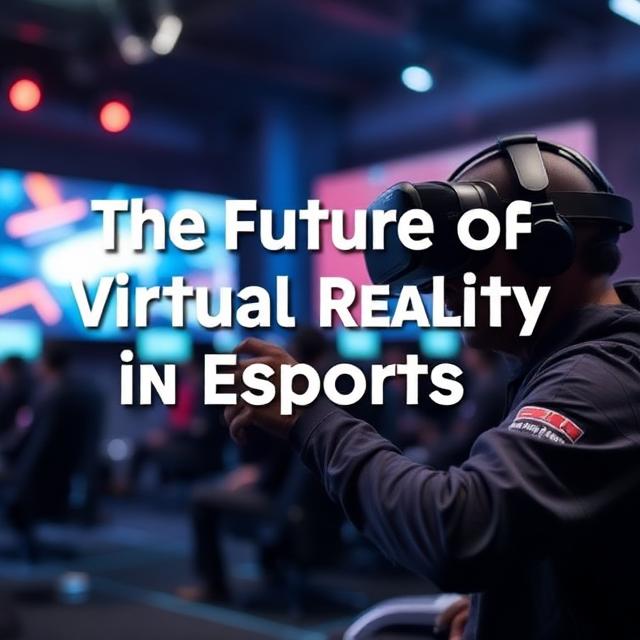
Small-scale gaming competitions gave rise to the billion-dollar worldwide entertainment sector known as esports. Professional athletes compete in crowded arenas, live-streaming platforms draw millions of viewers, and sponsorship agreements are on par with those in traditional sports. Virtual reality, a new technology trend, is poised to transform esports once more, despite its continued growth.
Virtual reality (VR) has the potential to completely change how people play, watch, and interact with games. Players enter immersive virtual worlds without using keyboards, controllers, or flat screens to interact. It may soon be possible for spectators to experience tournaments as though they were inside the game. VR in esports is going to be more than just improved visuals; it will fundamentally change viewer engagement, athleticism, and immersion.
The Evolution of Competitive Gaming
Screens and manual input devices are the mainstays of traditional esports games. Games like sports simulations, strategy games, and first-person shooters are played while seated, and players' skill is evaluated based on their coordination, strategy, and response time.
By adding full-body movement, virtual reality alters this dynamic. Players engage with the virtual world through motion controllers and headgear. Competitors physically move, dodge, aim, and react rather than using buttons to swing a sword or fire a target.
This change gives esports a new dimension of physicality. VR contests combine movement in the actual world with mental strategy, which could redefine what it means to be a professional player.
Increased Immersion and Spectator Engagement
Improved immersion is one of VR's greatest promises for esport. Currently, producers choose the camera angles that viewers see during matches. Although captivating, the experience is confined to a two-dimensional screen.
VR-enabled esport events allow fans to select their viewpoint within the virtual arena. They may roam freely throughout the virtual battlefield, stand next to their favorite player, or watch from above.
The potential benefits include:
✔ 360-degree viewing experiences
✔ Interactive audience participation
✔ Personalized camera angles
✔ Deeper emotional connection to players
Fans' experiences at competitions could be completely transformed by this degree of immersion. It would make viewers feel as if they were within the game rather than just observing it.
Physical Athleticism and Training
Competitive gaming is made more physically demanding by VR esports. VR athletes must move constantly, in contrast to traditional esports, where competitors sit for long stretches of time.
Specialized training programs may result from this physical component. Gamers could concentrate on reflex conditioning, balance, endurance, and spatial awareness. In addition to strategy analysts, professional teams may employ fitness coaches.
Additionally, including mobility could increase esports' appeal. When VR tournaments feature athletic performance, those who claim that gaming lacks physical activity should rethink.
The distinction between virtual competition and real-world sport will become increasingly hazy as VR gear advances and motion tracking and haptic feedback are added to improve authenticity.
Technological Advancements Driving Growth
Innovation in technology and software is critical to the future of virtual reality in esport. Despite their great features, current VR systems still have drawbacks such high costs, motion sickness, short battery life, and space needs.
Rapid technological advancement, however, is resolving these problems. VR is becoming more widely available because to lighter headgear, better display clarity, quicker processing speeds, and wireless capabilities.
5G connectivity and cloud computing also make it possible for multiplayer games to run more smoothly and with lower latency. In competitive gaming, where results can be decided by milliseconds, low latency is essential.
As infrastructure improves, VR esports will become more viable for large-scale tournaments.
New Game Genres and Competitive Formats
Developers can establish completely new genres for immersive competitions because to virtual reality. Studios are creating experiences that make use of spatial movement and environmental interaction rather than modifying classic games for virtual reality.
Examples of emerging competitive VR formats include:
✔ Arena-based shooter battles
✔ Virtual combat sports simulations
✔ Rhythm and reaction-based challenges
✔ Team-based tactical missions
The design of tournaments is encouraged by these new forms. Obstacle courses, strategic games, and athletic challenges can all be incorporated into competitions.
The uniqueness of VR gameplay could attract new audiences seeking fresh entertainment experiences.
Commercial Opportunities and Sponsorship
VR esports has enormous commercial potential as it expands. Companies are always looking for new and creative methods to reach younger, tech-savvy consumers.
Digital arenas can have dynamic ad placements thanks to virtual settings. Within the game itself, sponsors could develop engaging brand experiences. Additional revenue streams might be produced by virtual event tickets, digital skins, and merchandise.
Additionally, VR esports arenas may hold hybrid events in which spectators in person use headsets to participate in interactive match experiences.
Technology and entertainment together open up new revenue streams outside of traditional broadcasting.
Challenges to Overcome
Despite its promise, VR esports faces obstacles. Accessibility remains a major barrier. VR equipment can be expensive, limiting widespread adoption.
Space requirements also pose challenges. Unlike traditional gaming setups, VR requires physical movement areas, which may not be feasible for all players.
Standardization is another concern. For esports to thrive, consistent rules, hardware specifications, and competition formats must be established.
Additionally, concerns about health effects such as motion sickness or prolonged headset use need continued research and improvement.
Overcoming these barriers will determine how quickly VR integrates into mainstream esports.
Integration with Augmented and Mixed Reality
VR esports might not survive in a vacuum. Technologies like mixed reality (MR) and augmented reality (AR) have the potential to combine real and virtual worlds.
IImagine a competition where players compete in immersive virtual reality surroundings while holographic aspects are visible to live spectators in actual stadiums. This merging of realities has the potential to transform live esports competitions.
Technological convergence will likely shape the next stage of competitive gaming innovation.
Social and Community Impact
Community has always been a key component of esports. VR gives social interaction a new perspective. Through avatars that imitate gestures and body language, players can interact, improving engagement and teamwork.
International competitions could take place in virtual arenas, where competitors from several nations compete as though they were in the same physical location.
This global connectivity strengthens esports’ role as a cultural bridge.
The Long-Term Outlook
The future of VR in esports is still unfolding. While traditional esports will remain dominant in the near term, VR represents a powerful growth frontier.
As hardware becomes more affordable and internet infrastructure improves, immersive competitions may gain broader acceptance. Professional leagues dedicated solely to VR titles could emerge.
Ultimately, VR esports has the potential to transform gaming into a fully embodied experience. It merges technology, athleticism, and storytelling in unprecedented ways.
Conclusion
With its immersive, tangible, and participatory watching experiences, virtual reality has the potential to completely change the esports scene. Rapid technical advancement is gradually removing obstacles, even while issues like cost and accessibility still exist.
VR in esports has the potential to redefine participation in addition to improving visuals. Instead of watching from a distance, fans may participate in the action as players become virtual athletes.




Leave a Reply