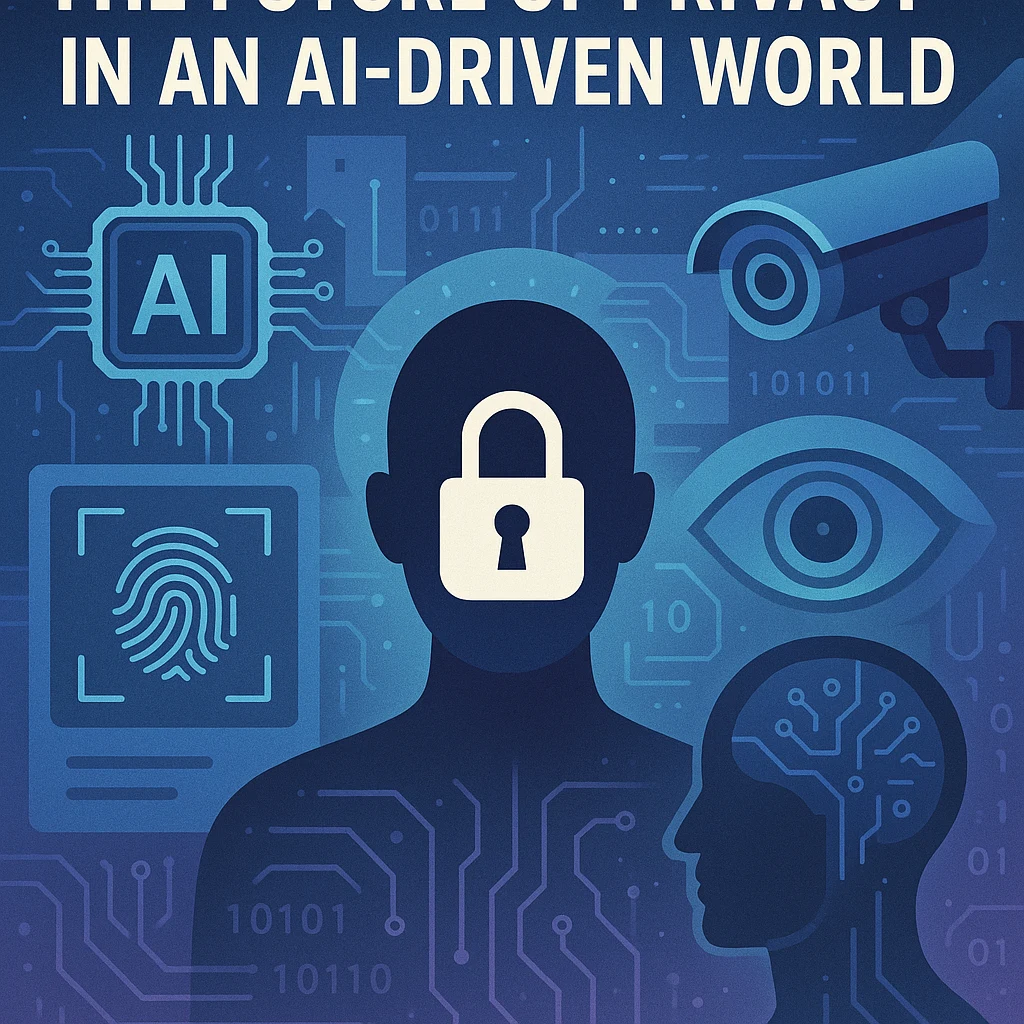
Artificial intelligence (AI) has subtly permeated almost every aspect of our daily life in the modern era. AI systems constantly gather, process, and evaluate enormous volumes of personal data, from facial recognition on our phones to algorithmic news feeds and tailored ads. While these technologies offer efficiency, convenience, and customisation, they also put privacy—one of the most basic human rights—at risk.
The idea of privacy itself is changing as AI develops. In the future AI-powered world, personal boundaries are technological borders rather than just social constructs. If we wish to protect freedom and autonomy in the digital age, we must comprehend how this transition is taking place.
1. The Rise of AI and the Death of Anonymity
Ten years ago, maintaining privacy meant deciding what information to post online. These days, it's all about what can be deduced, even from the things we don't discuss. AI systems are becoming surprisingly adept at assembling data from various sources to create thorough individual profiles.
For example, by examining your search history, internet purchases, and social media contacts, computers might forecast your political inclinations, emotional condition, or even health risks. While listening for voice commands, smart home appliances frequently capture more than they are supposed to. Your smartwatch tracks your pulse rate, your phone knows when you sleep, and your automobile keeps track of your whereabouts.
AI will soon be able to anticipate human input rather than merely react to it. This implies that our digital footprints will actively influence how the world engages with us in addition to describing who we are. Once seen as a fundamental digital right, anonymity is quickly vanishing.
2. Data: The New Currency of Control
Data, the raw material that powers algorithms, is the driving force behind the AI revolution. Every phone message, click, and GPS ping contributes to the growing data ecology that governments and businesses use to forecast and make choices.
Although this data-driven approach has produced enormous value, it has also led to an imbalance in which businesses have the power while individuals provide the data. AI acquires more control over the people it watches as it learns more.
Think about how predictive analytics is increasingly being used in credit scoring, recruiting, and policing. AI systems are only as impartial as the data they are trained on, even while they are capable of analyzing individual behavior patterns and rendering "objective" conclusions. Privacy is no longer only about keeping information private; it's also about being free from deception when data becomes the prism through which society views individuals.
3. Surveillance in the Age of Smart Everything
From cameras on street corners to unseen networks of sensors ingrained in everything around us, the idea of surveillance has changed over time. Convenience is promised by "smart" cities, gadgets, and systems, but they also increase the scope of surveillance in ways that most people are unaware of.
For example, facial recognition is currently utilized in retail, healthcare, education, and security. Even when people attempt to conceal their faces, AI is still able to identify them by analyzing their gait.
IWorkplace productivity, keystrokes, and communication patterns are all tracked by AI-powered monitoring systems. Despite being promoted as efficient tools, they pose serious concerns with autonomy and consent. In a hyperconnected world, privacy used to imply being left alone, but AI has made it almost impossible.
4. The Ethical Crossroads: Innovation vs. Invasion
A challenging balance between innovation and intrusion is at the center of the privacy issue. AI depends on data, and data depends on transparency, yet privacy requires boundaries.
Businesses acquire unparalleled insight into human behavior when they gather personal data in an effort to "improve user experience." The ethical dilemma now is not whether or whether data should be gathered, but rather how much and why.
Some contend that development comes at the expense of some privacy. Some argue that privacy is an essential component of human dignity and cannot be compromised. People cannot act, think, or communicate freely without it.
This is a turning point for governments as well. It is indisputable that AI has the ability to control traffic, identify crime, and forecast pandemics. However, these same devices can allow for widespread surveillance and control if they are not monitored. Developing moral frameworks that safeguard citizens without impeding innovation is the difficult part.
5. The Promise of Privacy-Enhancing Technologies
Notwithstanding these difficulties, privacy has a bright future. To provide consumers greater control over their data, a new generation of privacy-enhancing technologies (PETs) is developing.
The way AI systems manage data is being revolutionized by methods like homomorphic encryption, differential privacy, and federated learning. Federated learning enables AI models to learn from decentralized data sources, such as cellphones, without sending personal information to a central server, as opposed to gathering all data in one location.
In a similar vein, differential privacy protects individual identities while maintaining overall insights by adding statistical "noise" to datasets. These developments imply that, with careful design, privacy and AI do not have to be mutually exclusive.
Additionally, new methods for confirming data ownership and consent are being introduced by decentralized technologies like blockchain. In the future, people might have "data wallets," which would allow them to precisely and transparently authorize or revoke access to their personal data.
6. Legal Frameworks Struggling to Keep Up
Privacy rules are still catching up with the rapid advancement of technology. Though they were created for a time of static databases rather than self-learning AI systems, laws like California's Consumer Privacy Act (CCPA) and the EU's General Data Protection Regulation (GDPR) have established significant precedents.
Traditional distinctions between data gathering, processing, and analysis are blurred by AI. It can produce new information from data that already exists, frequently producing "derived" insights that are not covered by the privacy laws in place. For instance, is your online behavior protected by privacy law if an AI model determines your mental health status?
Future legislative frameworks must resolve these ambiguities by emphasizing algorithmic openness, accountability, and fairness in addition to data ownership. The right to know how AI systems make decisions that impact them should be granted to citizens, as should the ability to completely opt out of those systems.
7. Redefining Privacy in the AI Era
Privacy needs to change from being a passive right to an active practice when AI becomes an extension of human decision-making. Deeper digital literacy will be necessary in the future, comprehending not only what we share but also how computers analyze and utilize that data.
This redefinition of privacy involves three key shifts:
-
From secrecy to control: Managing access to information is just as important to privacy as concealing it.
-
From ownership to accountability: Owning your data is not enough; you also need to know who uses it and why.
-
From protection to empowerment: People can engage with digital systems on their own terms when they have true privacy.
Depending on how society choose to control and develop it, AI has the potential to either increase or decrease this empowerment.
8. Building a Future Where AI Respects Privacy
In the end, cooperation between technologists, legislators, and the general public will determine the future of privacy in an AI-driven world. AI can be developed with privacy as a fundamental principle, so it doesn't have to undermine it.
To achieve this, several actions are essential:
-
Privacy by Design: Privacy protections must be incorporated into AI systems from the beginning, not as an afterthought, by engineers.
-
Algorithmic Transparency: Businesses should reveal the data and decision-making processes used by their AI algorithms.
-
Ethical AI Standards: To develop universal privacy and data ethical norms, international cooperation is required.
-
Public Awareness: People need to be empowered to exercise their digital rights and informed about them.
9. The Human Element: Remembering Why Privacy Matters
It's simple to overlook the fact that privacy is a deeply human issue rather than just a technical one in the haste to automate and optimize. We can think freely, develop, make errors, and define ourselves without continual scrutiny when we have privacy.
Our sense of what it means to be human in a world where robots can watch, anticipate, and affect behavior must also change as AI advances. The difficulty is not in stopping AI, but rather in making sure that people's freedom is not diminished while robots become more intelligent.
Conclusion
In an AI-driven society, privacy's future is uncertain. Today's decisions about how to control, create, and engage with intelligent systems will mold it. AI has the capacity to both enhance human potential and threaten the basic autonomy that defines humanity.
In order to safeguard privacy in the future, we must view it as the cornerstone of a free and moral digital society rather than as a thing of the past. The question is whether we have the will to prioritize protecting privacy in the era of artificial intelligence, not whether we can do so.




Leave a Reply