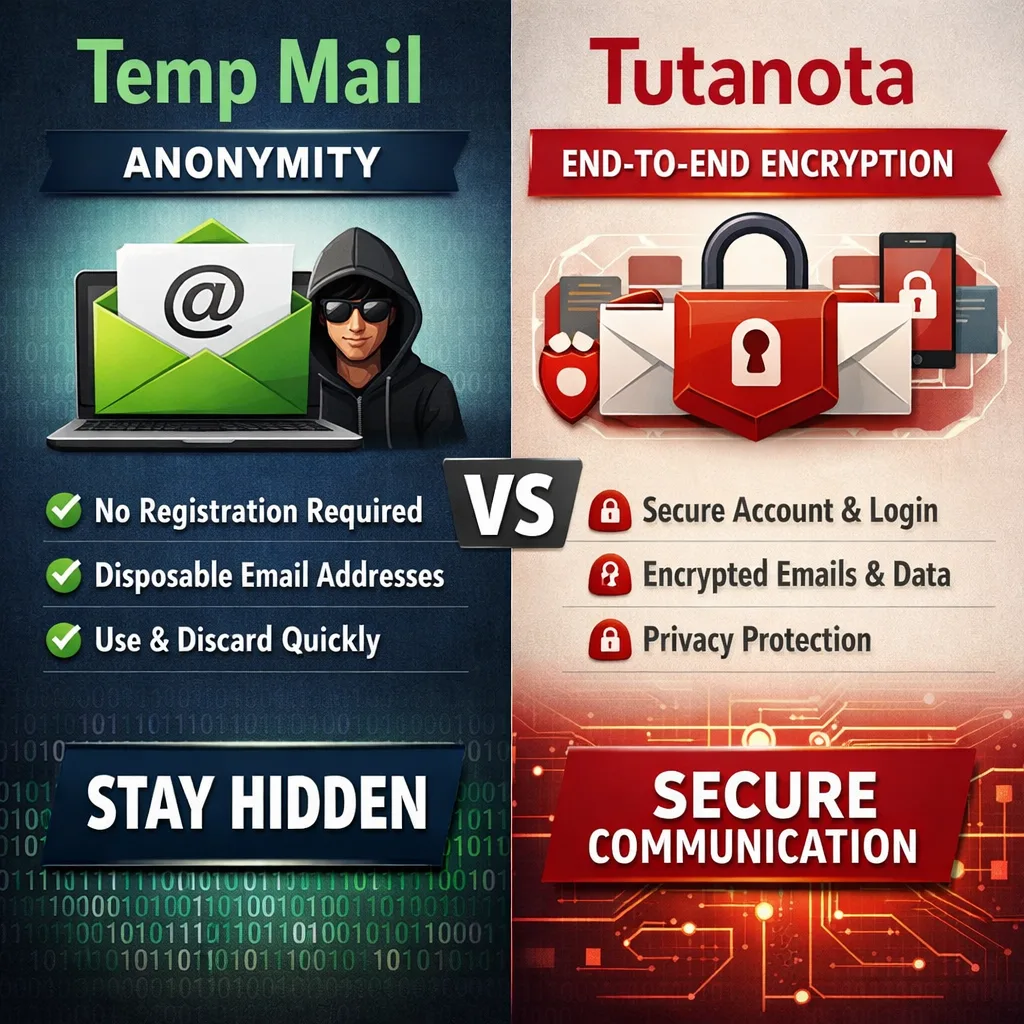
Email is still one of the most important communication tools in the digital age, whether you're using it to register for online services, get verification codes, communicate with coworkers, or handle sensitive accounts. However, not every email service is made equally. Some are only there to keep you anonymous, while others are designed to keep your messages safe from prying eyes. Temporary email services like Temp Mail and safe encrypted services like Tutanota reflect two very different approaches to "privacy" in email.
We'll examine the psychology and technology underlying both models—anonymity vs. encryption—in this blog post. We'll also discuss the advantages and disadvantages of each, as well as how to choose the best option for your online requirements.
What Is Temp Mail? Anonymity at Its Core
A class of short-lived, disposable email services known as "Temp Mail" creates temporary email accounts that you can use right away without registering or supplying personal data. Depending on the provider, these addresses are made to expire after a predetermined amount of time, which could be minutes, hours, or days.
Purpose of Temp Mail
The purpose of Temp Mail is to send you an email without linking it to your identity. A temporary email allows you to interact with services you don't trust, obtain whitepapers, join up for websites, and access free trials without revealing your actual mailbox. These addresses are anonymous by design since no personal information or registration is needed.
Additionally, Temp Mail assists you in avoiding long-term clutter, marketing lists, and spam. The address and its contents are usually promptly erased after the temporary inbox expires, leaving nothing connected to you.
Advantages of Temp Mail
- Without registering or providing any personal information, you may instantly create an email account.
- It shields your primary email from unsolicited newsletters, trackers, and spam.
- Your identity is not permanently linked to the address because it expires.
- Temp Mail doesn't require long-term maintenance or passwords, and it's free to use.
Limitations of Temp Mail
- Any emails you require later may be permanently lost because interim mail addresses are only meant to be used temporarily.
- Disposable email domains are blocked by numerous services for security or anti-fraud purposes.
- You can often only receive emails; sending is either not supported or very limited.
- Temp Mail only offers anonymity; it does not encrypt the contents of messages.
The basic tenet of Temp Mail is "don't tie email to identity at all." Anonymity comes first, not long-term privacy or safe storage.
What Is Tutanota? Encryption and Ongoing Privacy
Tutanota, sometimes abbreviated as Tuta or Tuta Mail, is a safe email service that prioritizes customer privacy and encryption. Tutanota is not disposable, in contrast to Temp Mail. It provides you with a legitimate, long-lasting email account with strong privacy safeguards.
Key Privacy Philosophy: End-to-End Encryption
Almost everything in your email account is automatically encrypted by Tutanota, including subject lines, contacts, calendars, and other metadata in addition to the message body. Because this encryption is end-to-end, the content can only be viewed by you and the intended receiver. Your data cannot even be decrypted by Tutanota.
This is frequently called zero-knowledge encryption because the provider cannot sell or scan your unencrypted data for profiling.
Privacy Protections and Features
Tutanota is designed for long-term email use with robust protections, in contrast to Temp Mail, which vanishes quickly:
- End-to-end encrypted emails (including subject and metadata).
- Encrypted contacts and calendars.
- No ad tracking, no scanning of inboxes for marketing.
- By default, there is no IP logging, and in order to protect location, sent emails remove IPs from headers.
- Optional two-factor authentication for strong login security.
Tutanota even provides password-protected encrypted messages for outsiders and automatic encryption for other Tutanota users.
Advantages of Tutanota
- Strong privacy and security for real, ongoing email communications.
- Encryption that protects content even from the provider itself.
- No ads, no data scanning, and a strict no-logs approach.
- Legitimate long-term email account with features like calendar and encrypted storage.
Limitations of Tutanota
- It requires account creation, which means storing login credentials and managing a password.
- Certain encryption capabilities are less frictionless, such as secure initial contact without password sharing with non-Tutanota members.
- The free storage tier is limited compared to mainstream email services.
- Accessing your email with third-party tools (IMAP/POP) is purposefully not supported because it is meant to be secure.
Tutanota's idea is essentially "secure and private communication with ongoing control." It's not just about temporarily concealing your identity; it's about long-term data protection.
Anonymity vs Encryption: Two Different Privacy Models
When comparing Temp Mail and Tutanota, the fundamental difference is not just technical — it’s philosophical.
Temp Mail: Anonymity Through Disposability
Erasure is the foundation of Temp Mail's privacy. There is no login or personal information associated with the produced email address, and it only exists momentarily. It is made anonymously, gets messages, and is then thrown away. Because the email is temporary, your identity is concealed.
This model works well for:
- One-time registrations
- Testing services
- Avoiding spam and tracking
- Quick access with no persistent digital footprint
Nevertheless, aside from the fact that messages are anonymous, Temp Mail does not protect their contents. Unlike Tutanota, there is no end-to-end encryption; the inbox is transient and not designed for privacy.
Tutanota: Privacy Through Encryption
The foundation of Tutanota's privacy model is continual communication and content protection. The data is encrypted so that the service cannot read it, but the email address is permanent. This guards against data breaches, provider-side scanning, spying, and illegal access.
This model works well for:
- Long-term email communications
- Sensitive personal or professional messages
- Users who prioritize data security and confidentiality
- People who want to avoid data monetization entirely
Here, encryption conceals both the material and identity (to some extent).
Where Each Option Fits in Real Life
When to Use Temp Mail
Temp Mail makes sense when:
- You only need to receive verification emails.
- You want to keep your real email private.
- You want to avoid spam or marketing lists.
- You do not need to maintain long-term communication with that address.
Examples include testing services, registering for a one-time free trial, or gaining access to content behind an email wall without disclosing your primary address.
When to Use Tutanota
Tutanota makes sense when:
- You communicate regularly by email.
- You handle sensitive information or personal communication.
- You should encrypt your emails so that not even the provider can read them.
- You want long-term privacy, no data selling, and no ad tracking.
Examples include using email for corporate communications, personal letters, or security-related tasks like legal issues, business privacy, or activism.
Trade-Offs: Choosing Between Anonymity and Encryption
Neither Temp Mail nor Tutanota is objectively “better” for all use cases — they simply serve different needs.
Temp Mail's anonymity is instantaneous and transient, providing short-term security but without long-term usefulness or content privacy. It prevents spam and conceals your actual email, but since stored messages don't last, it can't safeguard them.
Every message you send and receive is continuously protected by Tutanota's strong and persistent encryption. Although it prevents content from being read by unauthorized people, it is intended for continuity rather than ephemerality and necessitates commitment (password management, account setup).
Your choice depends on why you care about privacy:
- If you want to hide your identity temporarily and avoid spam, Temp Mail is ideal.
- Tutanota is the best option if you wish to safeguard email content over time from all parties, including the provider.
Conclusion: Privacy Is Not Singular — It’s Contextual
“Privacy” is not one thing. It is layered. Temp Mail and Tutanota each protect different dimensions of it.
By guaranteeing that there is no digital connection to your personal identity during brief use, Temp Mail safeguards who you are. By guaranteeing that only you and the intended receiver may view your email content in the long run, Tutanota safeguards what you communicate.
Knowing the difference between encryption and anonymity enables you to make informed choices regarding your digital life. Some users may even combine the two, using Tutanota when confidentiality, security, and long-term privacy are most important and Temp Mail when anonymity and spam avoidance are crucial.
In an increasingly connected and data-driven world, privacy is a spectrum; the more tools you know, the better you can defend yourself.




Leave a Reply