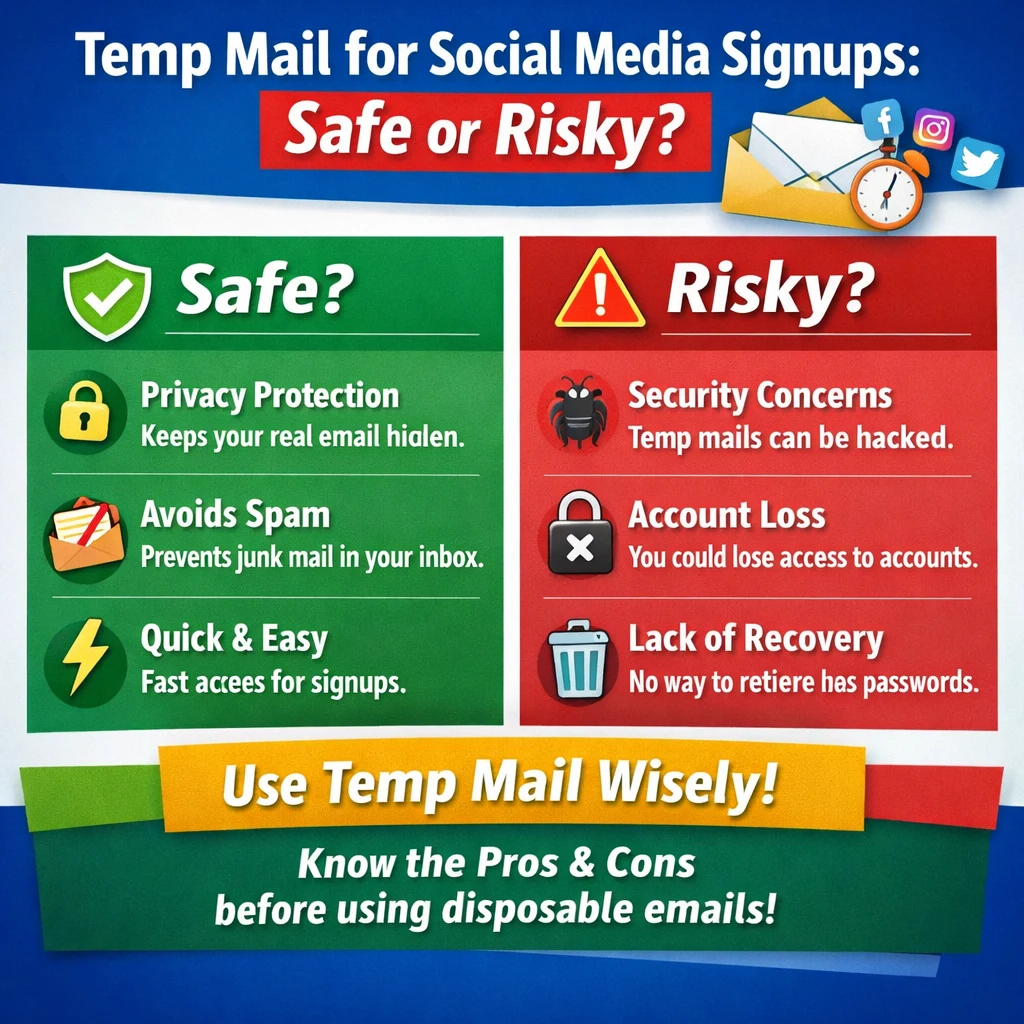
Social media has permeated every aspect of contemporary life. Platforms like Instagram, Facebook, X, TikTok, and LinkedIn have an impact on how people communicate and view the world, from sharing personal milestones to starting businesses and absorbing news. However, there is frequently a hidden penalty associated with registering for these platforms: giving up your email address, personal information, and long-term privacy. Temporary email services, or "temp mail," come into play at this point.
Nowadays, a lot of consumers wonder if using interim mail for social network signups is a wise privacy choice or if there are significant hazards. There is no clear-cut solution. Depending on how and why it is utilized, temporary mail can be both a liability and a shield. The safety, dangers, morality, and practicality of utilizing disposable email addresses for social media accounts in 2025 are all examined in this blog.
Understanding Temp Mail in the Context of Social Media
Temporary email providers offer short-lived, throwaway email addresses. Emails with verification codes can be sent to these addresses, although they frequently expire after a few minutes or hours. In contrast to Gmail or other permanent email services, temporary mail typically doesn't require a login, long-term commitment, or personal information.
Temp mail enables individuals to register for social media profiles without revealing their true email address. Those who wish to maintain numerous accounts, browse a platform discreetly, or stay away from spam may find this appealing. Social media companies are aware of this tendency, though. Many actively keep an eye on and limit the use of throwaway emails.
Why People Use Temp Mail for Social Media Signups
Due in large part to growing privacy concerns and platform weariness, temp mail is becoming more and more popular for social media signup.
Consumers are growing increasingly concerned about the use of their personal information. In addition to logging users in, social media sites also gather emails for cross-platform tracking, data profiling, and targeted advertising.
When people sign up, their inboxes are frequently overloaded with commercial emails, notifications, and newsletters. Your personal email and social media accounts are kept clearly apart by using temp mail.
Managing Multiple Accounts
For regional testing or experimentation, content producers, marketers, and testers frequently require numerous accounts. This procedure is made simpler via temp mail.
Exploring Platforms Without Commitment
Some users like to test a platform before making a long-term commitment. Low-risk exploration is made possible by temp mail.
✔ Temp mail reduces exposure of your real email
✔ It helps avoid long-term spam and tracking
✔ It supports anonymous or experimental usage
✔ It lowers the barrier to testing new platforms
How Social Media Platforms View Temp Mail
Most major social media platforms officially discourage or restrict the use of disposable email services. Their reasoning is tied to security, authenticity, and abuse prevention.
Email permanence is essential to social networks for identity verification, account recovery, and abuse prevention. These systems are compromised via transient emails. Because of this, a lot of systems keep lists of known temp mail domains up to date and prohibit them when users sign up.
Temporary mail is initially permitted on some systems, however these accounts are flagged for closer examination. Others might let the creation of accounts but later limit their functionality or demand more verification, like phone numbers.
This creates a gray area where temp mail might work temporarily but fail in the long run.
Potential Risks of Using Temp Mail for Social Media
While temp mail offers convenience and privacy, it also introduces notable risks—especially for social media accounts you care about.
Email recovery becomes crucial if your account is flagged, hacked, or locked. It could be impossible to regain access to a temporary email that has expired.
Disposable emails are frequently linked by platforms to spam, bots, and phony accounts. If a valid user's account is flagged, it may be suspended.
Accounts created with temp mail may face limitations such as reduced reach, restricted ads access, or inability to verify identity.
Certain free temp mail services make their inboxes visible to the public, so if someone guesses the address, they could be able to view verification emails.
✔ Increased chance of account loss
✔ Difficulty recovering hacked or locked accounts
✔ Greater scrutiny by platform algorithms
✔ Lower overall account credibility
When Using Temp Mail Can Make Sense
Despite the risks, there are scenarios where using temp mail for social media signups can be reasonable and low-risk.
If you’re testing a platform, feature, or interface and don’t intend to use the account long-term, temp mail can be practical.
Research and Observation
To view public content without interacting or being followed, journalists, researchers, or analysts can require anonymous access.
Some users maintain clear boundaries between personal, professional, and experimental online identities.
✔ Temporary or non-essential accounts
✔ Research or observational use
✔ One-time access needs
✔ Low-stakes exploration
When Temp Mail Is a Bad Idea
For accounts that matter, temp mail can become a serious liability.
Losing access to the account could be detrimental if it symbolizes your identity, brand, or company.
Stable contact details and authentication are frequently needed for influencer, advertisement, or company accounts.
Any account you plan to maintain over time should have a permanent, secure email attached.
✔ Primary social media profiles
✔ Business or creator accounts
✔ Monetized platforms
✔ Accounts tied to reputation or income
Privacy vs Responsibility: The Ethical Angle
Although using interim mail is not against the law, purpose is important. The goal of social media platforms is to lessen abuse, bots, and false information. Platforms are careful since disposable emails are frequently used for these purposes.
When temp mail is used responsibly, privacy protection takes precedence over deceit. It is unethical and illegal to create phony accounts in order to harass, control interaction, or disseminate false information. Users should be aware that accountability is not eliminated by anonymity.
Alternatives to Temp Mail for Safer Privacy
If privacy is your main concern but you want stability, there are alternatives worth considering.
Making a distinct, permanent email address just for social media is one choice. This keeps recovery options while isolating spam. Using email companies that prioritize privacy and provide robust encryption and aliases is another. Compared to throwaway emails, these technologies better strike a compromise between anonymity and dependability.
The Future of Temp Mail and Social Media
Disposable email detection will develop as platforms increase their investments in AI-driven moderation and identity verification. Simultaneously, privacy tools will develop to provide better long-term solutions for anonymity.
More platforms might implement "verified anonymity," which allows users to stay anonymous without using disposable contact information. Until then, temp mail will continue to be a tool that should be utilized carefully and sparingly.
Final Verdict: Safe or Risky?
Depending on how and why it's used, using interim mail for social media signups is neither totally safe nor intrinsically dangerous. It can be a useful privacy technique for short-term, low-stakes access. It adds needless risk to significant or long-term accounts.
✔ Safe for temporary or experimental accounts
✔ Risky for personal, professional, or monetized use
✔ Useful for privacy—but unreliable for longevity
Balance is the best strategy. Recognize the platform's policies, assess your objectives, and select the privacy level that doesn't jeopardize your online safety. Convenience should never take precedence over control in a world where online identity is more important than ever.




Leave a Reply