Introduction: Life Out of Sync
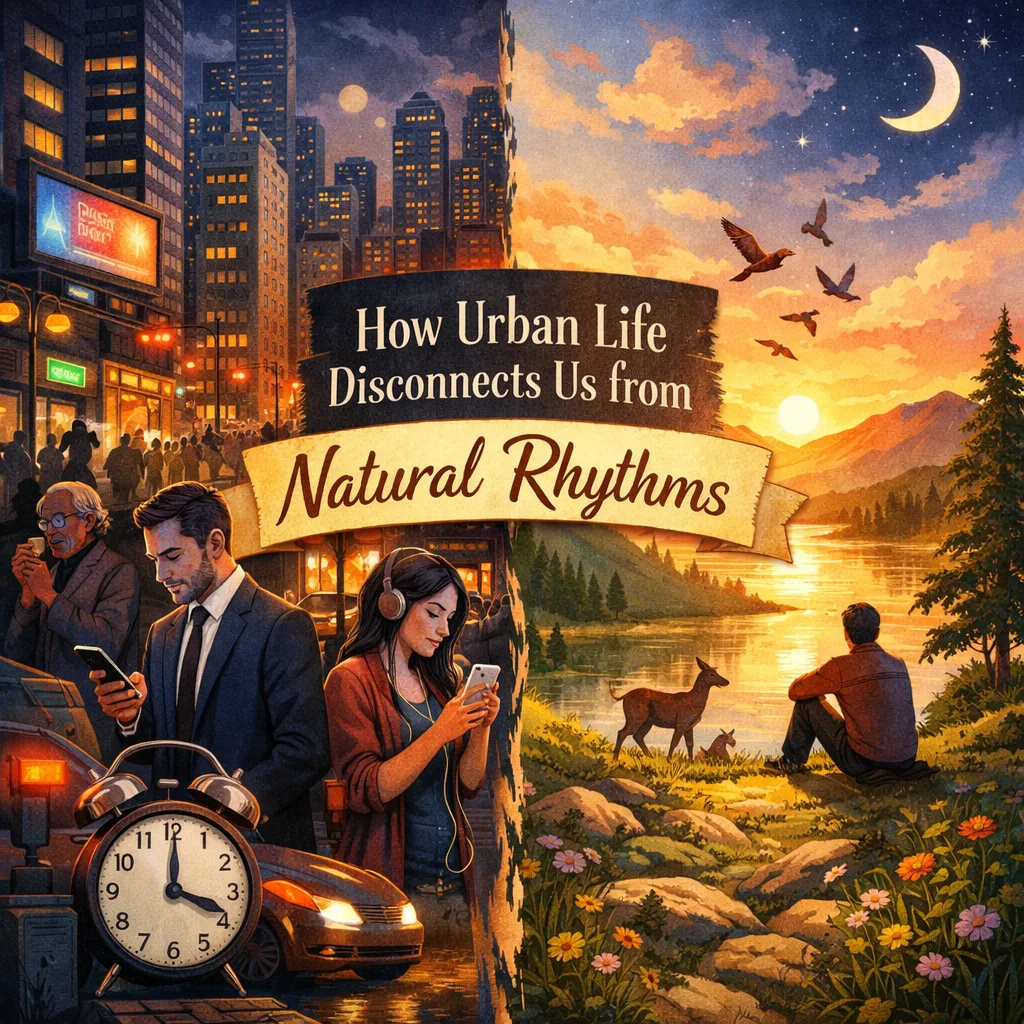
Contemporary cities are emblems of advancement. Urban success is characterized by skyscrapers, quick transit, digital connectedness, and limitless options. Beneath this efficiency, however, is a more subdued issue: people are gradually becoming disconnected from the natural cycles that formerly controlled our bodies and thoughts due to urban living. For the most of human history, everyday activities were dictated by the sun, the seasons, and the subtle signs found in the natural world.
These days, artificial light takes the place of daylight, sunsets are replaced by screens, and seasons are replaced by schedules. Although this change can seem innocuous, it has significant impacts on emotional equilibrium, physical health, and mental health.
Living in an urban area alters not just where we live but also how we spend our time, relax, and connect with others. The prevalence of burnout, sleep disorders, anxiety, and chronic stress in contemporary society can be better understood by taking into account this separation.
Understanding Natural Rhythms
What Are Natural Rhythms?
The biological and environmental cycles that govern life are known as natural rhythms. The most well-known is the circadian rhythm, an approximately 24-hour internal clock that regulates body temperature, hormone production, sleep, alertness, and digestion. Natural cues including sunlight, darkness, temperature variations, and seasonal fluctuations led to the evolution of these cycles.
These rhythms mostly persisted when people lived nearer to the natural world. Seasonal shifts influenced food intake, mobility, and social habits, while sunrise indicated activity and sunset promoted relaxation. The body developed a feeling of equilibrium and predictability by learning to anticipate these cycles.
Why These Rhythms Matter
Natural rhythms are necessary, not optional. When in harmony, they promote immune system performance, emotional stability, restorative sleep, and mental clarity. Fatigue, irritation, and long-term health problems result from the body's inability to regulate itself when it is disturbed.
The Urban Environment and Artificial Time
Instead of using biological time, cities use mechanical time. Work schedules disregard daylight, alarms set waking hours, and production frequently takes precedence over relaxation. The body's circadian clock is confused by the fact that many urban people sleep long after dusk and wake up before sunrise.
One of the main causes of this disturbance is artificial illumination. Daylight is extended well beyond natural bounds by screens, streetlights, and office illumination. The hormone that promotes sleep, melatonin, is suppressed by continuous artificial light exposure, notwithstanding its convenience. This eventually results in irregular sleep cycles and poor sleep quality.
✔ Artificial lighting interferes with the body’s sleep-wake cycle
Digital Overload and Constant Stimulation
The Always-On Lifestyle
Digital technology and urban life are strongly related. The brain is constantly attentive thanks to notifications, emails, social media, and news updates. Cities overwhelm the senses with information, in contrast to natural settings that provide silence and sensory relaxation.
There is limited opportunity for mental recuperation because of this continuous stimulation. Deep rest states are more difficult to achieve since the brain never completely shuts down. Contrast—activity followed by stillness—is essential to natural rhythms. That difference is frequently completely eliminated in urban living.
Loss of Natural Pauses
Pauses are a natural part of the day. There are subtle shifts between times, a natural slowing around sunset, and silence at night. Time is compressed in urban settings, which promotes speed and multitasking. Without breaks, the nervous system continues to be overstimulated, which lowers emotional resilience and raises stress hormones.
Disconnection from Seasonal Awareness
Seasons Without Sensation
Seasons frequently become abstract ideas in urban areas. Buildings with climate control keep their temperature constant throughout the year. The availability of food seldom varies with the seasons. The body doesn't need to adjust gradually because clothing adjusts instantaneously.
People become disconnected from longer natural cycles due to this lack of seasonal awareness. Traditionally, summer promoted activity and growth, while winter promoted relaxation and contemplation. These differences are flattened by urban living, which demands constant work throughout the year.
✔ Climate control removes environmental adaptation
Noise, Crowding, and Sensory Stress
The Sound of Disruption
Wind, birds, and water are examples of rhythmic, predictable noises found in natural settings. The nervous system receives these noises as a signal of security and stability. Conversely, urban noise is sudden, loud, and erratic. The body is kept in a low-level fight-or-flight state by traffic, sirens, construction, and crowded areas.
Sleep, focus, and emotional control are all hampered by prolonged noise exposure. The body becomes accustomed to stress as a baseline over time, making relaxation seem strange or even painful.
Crowding and Loss of Personal Space
There are less opportunities for isolation and introspection when there is a high population density. Regular access to calm times and open areas helped humans grow. These encounters are limited by urban crowding, which heightens emotional strain and mental exhaustion.
Psychological Consequences of Rhythmic Disruption
Anxiety, Burnout, and Emotional Fatigue
Psychological pressure results from disregarding natural rhythms. Emotional control is impacted by sleep disturbances. Anxiety is increased by ongoing stimulation. Days seem to blend together without significant shifts when there are no natural cues.
Environments that undervalue rest are conducive to burnout. People who live in cities are frequently rewarded for their endurance rather than their balance, which forces them to ignore their body's signals until fatigue becomes the norm.
✔ Disrupted rhythms increase anxiety and irritability
Relearning Rhythm in Urban Spaces
Small Ways to Reconnect
While it may not be feasible for everyone to completely forsake urban life, minor changes can aid in reestablishing natural alignment. The body's internal clock can be gradually reset by exposure to morning sunlight, cutting back on screen time at night, and spending time in green areas.
Routines that are mindful are also beneficial. Even in urban areas, awareness of natural cycles can be restored by eating at regular times, taking walks without headphones, and noticing variations in daylight.
The Importance of Urban Nature
In cities, parks, rivers, trees, and communal gardens serve as rhythmic anchors. They remind the body of slower, more natural patterns and provide sensory relief. Even a short time spent in nature can elevate mood and reduce stress hormones.
A Cultural Shift Toward Balance
Workplace culture and urban design are gradually changing. Growing awareness of rhythmic disconnection is reflected in ideas like biophilic design, flexible work schedules, and leisurely living. These changes acknowledge that people are living entities rather than robots built to produce continuously.
It is not necessary to give up modern life in order to re-establish a connection with natural rhythms. It necessitates honoring the body's need for pauses, cycles, and environmental equilibrium.
Conclusion: Finding Time Again
Urban living has provided humanity with previously unheard-of levels of comfort and opportunity, but it has also separated us from the rhythms that formerly gave our lives purpose. Anxiety, tired bodies, and sleepless nights are the results of this isolation. Knowing how living in a city disturbs natural cycles gives us the ability to make deliberate adjustments.
Restoring balance is the goal of regaining rhythm, not opposing advancement. Humans regain serenity, clarity, and a greater sense of well-being when they move in sync with natural time, even in solid environments.
✔ Fixed schedules ignore individual biological needs
✔ Productivity culture prioritizes output over rest
✔ Seasonal rest cycles are replaced by constant activity
✔ Emotional rhythms no longer match natural changes
✔ Sleep imbalance affects emotional control
✔ Burnout becomes normalized rather than treated




Leave a Reply