One of the most enduring digital annoyances of contemporary life is email spam. Spam has become a constant background noise on the internet, from phishing emails posing as banks, delivery services, or social media platforms to promotional newsletters you never signed up for. Spam still reaches millions of inboxes every day despite security technologies, unsubscribe buttons, and filters. Disposable email becomes one of the most straightforward and efficient options in this situation.
Disposable email is no longer a specialized tactic employed by tech-savvy users in 2025. For anyone who values having control over their digital identity, it has become a popular privacy tool. You may significantly minimize spam and shield your primary inbox from long-term clutter and risk by knowing how disposable email operates and how to use it strategically.
Understanding the Root Cause of Email Spam
Prior to understanding the benefits of disposable email, it's critical to comprehend the origins of spam. Spam doesn't happen at random. It is the outcome of aggressive marketing strategies that perceive email addresses as valuable assets, data collection, and list sharing.
A number of things could go place in the background if you enter your email address on a website. Your address may be permanently stored by the website, sold to advertisers, or included to marketing databases. Data is frequently shared with partners by even reputable companies. One benign sign-up can eventually result in dozens of unsolicited emails.
Data breaches also contribute to the growth of spam. Email databases are leaked and sold on the dark web when websites are compromised. It is quite impossible to fully erase your actual email once it has been added to these lists.
This cycle is broken from the outset with disposable email.
What Is Disposable Email and How Does It Work?
An email account intended for brief use is called disposable email, sometimes referred to as temporary or throwaway email. You create a temporary address for a few minutes or hours in place of utilizing your actual inbox. Emails with confirmation codes or verification links can be sent to you, but the address expires after that.
The majority of disposable email providers don't demand personal information or registration. They use a straightforward online interface to show incoming messages and rapidly generate random addresses. Any spam sent to the address after it expires vanishes.
Because of this, disposable email serves as a strong barrier between you and sources of spam.
Why Disposable Email Is So Effective Against Spam
Once spam is delivered, disposable email does not combat it. It keeps spam from ever getting to your actual inbox. It performs better than filters or unsubscribe links because of this proactive approach.
✔ It stops spam at the source
✔ It prevents long-term data storage of your real email
✔ It reduces exposure to data breaches
Disposable email completely removes the link, in contrast to conventional spam filters that respond to unsolicited emails. Your actual address is never discovered by websites, so they are unable to target it in the future.
Common Situations Where Spam Starts
Spam frequently starts in predictable locations. You can choose when to utilize disposable email instead of your primary inbox by being aware of these situations.
Free Downloads and Resources
To access free PDFs, tools, or templates, many websites require an email address. These emails are frequently included in marketing funnels that send out promotions on a regular basis.
Online Contests and Giveaways
Giveaways are a common approach to gather email addresses. Your inbox might suffer after the contest, even if it is legitimate.
Account Signups You’ll Never Use Again
Seldom should trial apps, one-time forums, or transient services get access to your actual email.
E-commerce Browsing
Even if you quickly browse or abandon a shopping, certain retailers will still send you pushy advertising emails.
For all of these scenarios, disposable email is perfect since it absorbs spam without having any negative effects.
How Disposable Email Protects Your Privacy
Spam poses a privacy issue in addition to being obnoxious. A lot of marketing emails have tracking pixels that keep track of your location, the device you're using, and when you view messages. This data creates intricate behavioral profiles over time.
Disposable email reduces this risk by acting as a privacy firewall.
✔ No personal identity linked to the email
✔ No long-term tracking possible
✔ No behavioral profiling of your real inbox
Marketers are unable to create profiles based on throwaway emails because they are transient. Tracking ends entirely when the address expires.
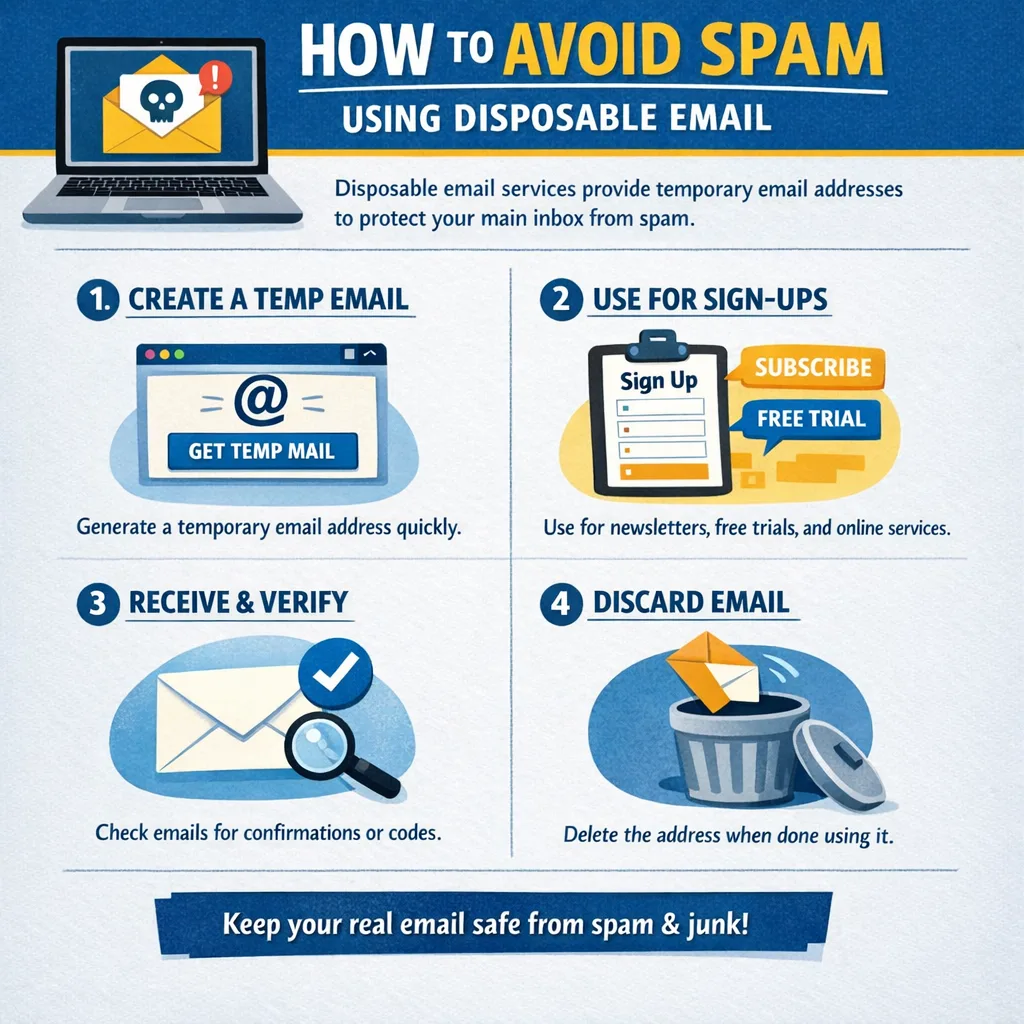
Step-by-Step: Using Disposable Email to Avoid Spam
Using disposable email is surprisingly simple and requires no technical skills.
Step 1: Choose a Disposable Email Service
Select a reliable temporary email provider that offers fast delivery and auto-expiry.
Step 2: Generate a Temporary Address
The service instantly creates an email address you can copy and use.
Step 3: Use It for Signups
Paste the disposable email into the website or form instead of your real address.
Step 4: Receive Verification Emails
Check the temporary inbox for confirmation links or codes.
Step 5: Let It Expire
Once you’re done, simply close the page. Any future spam sent to that address will vanish.
This process takes less than a minute but saves years of inbox clutter.
Disposable Email vs Traditional Spam Protection
To control spam, a lot of people employ email rules, unsubscribe buttons, or spam filters. These technologies are useful, but they are reactive rather than proactive.
Spam filters are not always effective. Links to unsubscribe can verify that your address is active. Rules need to be maintained continuously. By avoiding exposure in the first place, disposable email eliminates all of this.
✔ No need to unsubscribe
✔ No risk of confirming your email to spammers
✔ No inbox management required
Instead of depending on algorithms, disposable email returns control to the user.
When You Should Not Use Disposable Email
Disposable email is great for preventing spam, but it's not always appropriate.
You should avoid using disposable email for:
✔ Banking or financial accounts
✔ Long-term subscriptions
✔ Password recovery emails
✔ Legal or official communication
For brief, low-risk exchanges where long-term access is not required, disposable email works best.
Psychological Benefits of a Spam-Free Inbox
Avoiding spam has significant psychological benefits in addition to technical ones. Decision fatigue and low-level tension are brought on by a packed inbox. Even for a few moment, each unsolicited email requires attention.
A cleaner inbox leads to:
✔ Better focus
✔ Less digital stress
✔ Faster response to important emails
By keeping distractions out of your main communication route, disposable email helps protect your mental space.
Disposable Email and Phishing Protection
Phishing attempts and spam frequently overlap. Fake emails that pose as social media, delivery services, or banking depend on volume. The likelihood of success increases with the number of inboxes they contact.
Disposable email reduces phishing exposure by:
✔ Limiting where your real email exists
✔ Isolating risky signups
✔ Preventing repeated targeting
When a phishing effort reaches a disposable inbox, it vanishes without causing any harm once the address expires.
Why Disposable Email Matters More in 2025
Instead of getting less aggressive, digital marketing is growing more aggressive. Flooding inboxes is now simpler than ever because to AI-driven campaigns, data brokers, and automated outreach tools. Millions of email addresses are still made public every year due to data breaches.
In an increasingly complicated digital world, disposable email provides a straightforward, low-effort defense. Subscriptions, in-depth expertise, or ongoing observation are not necessary. By default, it protects your actual inbox while operating silently in the background.
Final Thoughts
Nowadays, avoiding spam is about more than simply convenience—it's about security, privacy, and mental clarity. One of the easiest and most efficient strategies to lower spam exposure in 2025 is to use disposable email.
By using disposable email strategically, you:
✔ Protect your real inbox
✔ Reduce spam permanently
✔ Minimize tracking and data collection
✔ Maintain control over your digital identity
Disposable email offers you a straightforward but effective benefit in a world where people are often asking for, sharing, and analyzing your email address. You prevent spam before it starts rather than responding to it when it does.




Leave a Reply