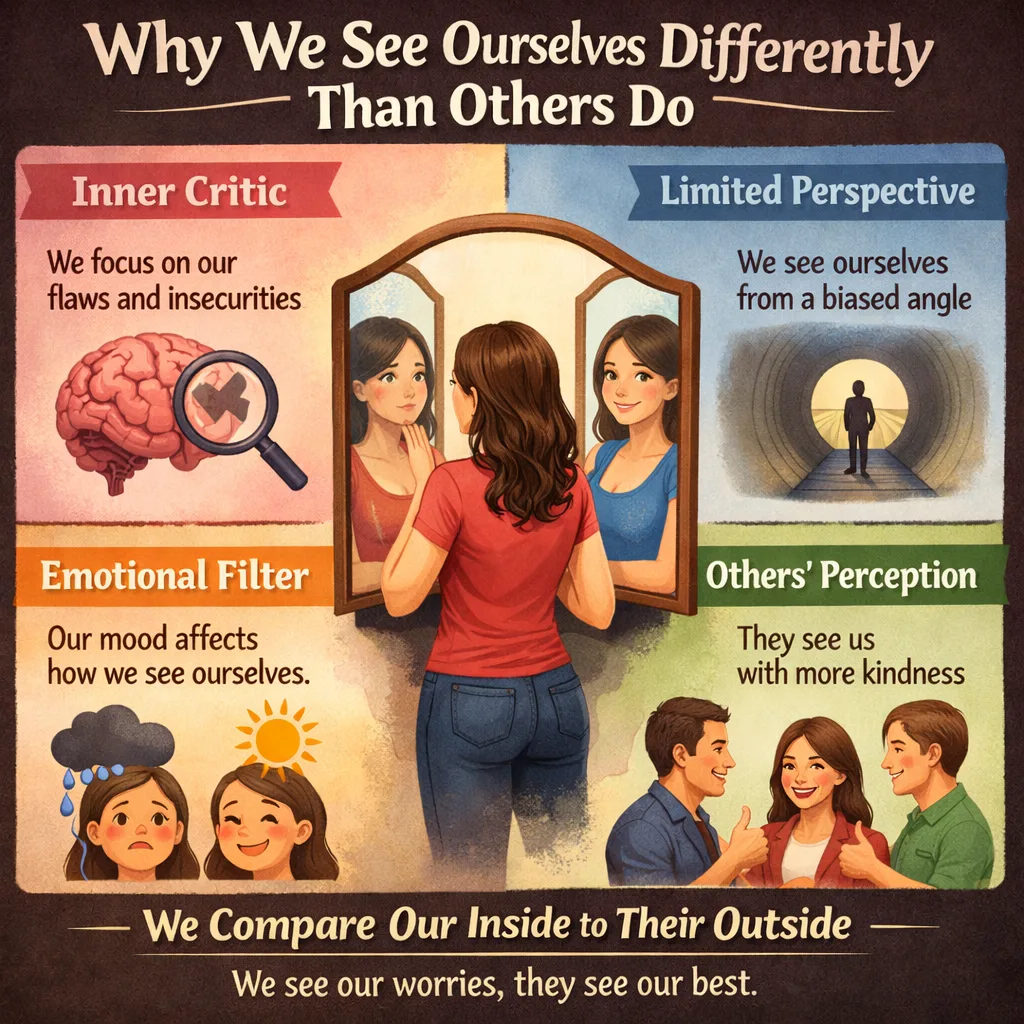
Have you ever looked at a picture of yourself and said, "That doesn't look like me at all," even though other people think it looks just like you? Or perhaps you think you come across as self-assured, kind, or restrained, but those around you describe you quite differently. One of the most intriguing facets of human psychology is the discrepancy between our perceptions of ourselves and those of others.
Thoughts, memories, feelings, and individual experiences all contribute to the internal formation of our self-image. On the other hand, we are perceived by others through our actions, tone, expressions, and conduct. Relationships, self-esteem, identity, and mental health are all impacted by the fact that these two viewpoints seldom align exactly. Knowing the reasons for this disparity promotes personal development, improved communication, and a stronger sense of self.
The Inner Self vs. The Outer Self
Everybody has a mind of their own. We personally experience our thoughts, feelings, challenges, aspirations, and objectives. This inner world seems genuine, intricate, and very intimate. We are aware of our efforts, our concern, and the frequency of our silent struggles. When we assess ourselves, we typically focus more on our goals than our deeds.
This inner world is invisible to others. They just pay attention to our words, actions, tone of voice, facial expressions, and decisions. From their point of view, our actions define who we are. They make judgments about us based on appearances rather than emotions. Two versions of the same person are produced by this disparity in access: the exterior version that others encounter and the internal version that we live with.
✔ We judge ourselves by our intentions
✔ Others judge us by our actions
✔ Our inner world is invisible to others
✔ Their perspective is shaped by observation
These two viewpoints are inherently distinct as they are based on different facts.
How Self-Perception Is Shaped
Our perception of ourselves is not formed at random. It evolves over time as a result of early experiences, parental criticism, educational settings, friendships, culture, and individual achievements or failures. Based on how we were treated by others and how we felt during significant events, we construct narratives about who we are.
Someone may grow up believing they are trustworthy if they receive praise for being responsible. Someone who has experienced criticism or neglect may come to believe that they are unimportant or defective, even if this is untrue. Self-perception is strongly influenced by emotional experiences, frequently more so than by objective truth.
We also start to filter information in ways that reinforce our preexisting perception of ourselves over time. If we think we're socially awkward, we focus on instances that support that belief while ignoring instances that don't. This is known as confirmation bias, and it has a significant impact on how we perceive ourselves.
Why Others Often See Us More Objectively
Others may notice patterns in our conduct that we are unable to, even though they are unaware of our inner lives. They might be better able to identify habits, strengths, or shortcomings because they are not emotionally invested in our narrative. When we feel uncertain, they might see confidence; when we feel inadequate, they might see kindness; or when we feel overwhelmed, they might sense emotional distance.
This does not imply that we are always appropriately seen by others. Their own experiences, expectations, cultural background, and emotional state all affect how they perceive things. They are less susceptible to internal self-criticism, uncertainty, or anxiety, though, because they are outside of our minds.
✔ Others observe patterns we overlook
✔ They are not attached to our inner struggles
✔ Their view is shaped by visible behavior
✔ Their feedback can offer valuable insight
Sometimes what appears to be a miscommunication is merely a difference of viewpoint rather than an error.
The Role of Social Masks
The majority of people don't express all of their emotions to everyone. Depending on the situation, we put on social masks. We might come across as professional and self-assured at work. We could be sensitive or emotional while we are with family. We can be lighthearted or laid back while we're around friends. Different versions of ourselves are activated in different contexts.
Others typically only see one or two of these forms, thus their perception of us is lacking. They are blind to the full spectrum of emotions, personal challenges, and untapped abilities. In the meantime, we perceive ourselves as a complete, including aspects that are invisible to others. Self-image and societal image diverge as a result of this distinction.
Why Negative Self-Perception Is So Common
A lot of people have a worse opinion of themselves than others do. The human brain's negative bias is the reason for this. Criticism sticks in our memories more than praise. We pay more attention to errors than to achievements. Positive moments are forgotten while unpleasant ones are replayed.
Compared to outward feedback, internal self-talk frequently grows harsher. Even a minor error can be interpreted as evidence of failure. A small imperfection may seem like a distinctive characteristic. Others, on the other hand, might not even be aware of these things or would consider them to be typical and human.
✔ We remember criticism more than praise
✔ We replay mistakes more than success
✔ We judge ourselves more harshly than others
✔ Others often see us more kindly than we see ourselves
Relationships, emotional well-being, and confidence may all be impacted by this mismatch.
How Emotional States Distort Self-Image
Our perception of oneself is greatly influenced by our emotional condition. Our perception of ourselves frequently darkens when we are under stress, anxiety, sadness, or overwhelm. We could have feelings of inadequacy, unlovability, or disconnection. On the other hand, our perception of ourselves improves when we are at ease, self-assured, or supported.
Self-perception is unstable as a result of this emotional influence. It changes according to mental condition, living circumstances, and mood. Where we experience variation, others could perceive consistency. This discrepancy causes uncertainty, particularly when we feel insecure on the inside while others characterize us as strong, capable, or steady.
The Role of Culture and Social Expectations
Our perceptions of ourselves and others are also influenced by culture. While some cultures promote confidence, self-expression, and self-promotion, others promote humility, emotional control, or self-criticism. This influences people's self-talk and behavior interpretation.
Someone who was brought up to be modest, for instance, might think of themselves as ordinary or unremarkable, whereas others might think they are gifted or outstanding. Gaps between one's internal identity and one's external recognition can be caused by cultural indoctrination.
Why Feedback Often Feels Uncomfortable
It can be unsettling or even dangerous when people characterize us in ways that do not align with how we see ourselves. Positive comments could seem unfair. It could seem unfair to give constructive feedback. Feedback challenges our preexisting self-story, which is why this occurs. Even if the narrative is false, the brain favors consistency.
Nonetheless, one of the most effective methods for developing self-awareness is feedback. It provides a mirror that reflects our experiences rather than our emotions. Growth, emotional maturity, and improved relationships are made possible by learning to accept criticism without becoming defensive.
✔ Feedback challenges our self-story
✔ Discomfort does not mean feedback is wrong
✔ Openness leads to self-growth
✔ Awareness strengthens relationships
The Psychological Gap Between Intention and Impact
The difference between impact and intention is one of the main reasons we perceive ourselves differently than others. We concentrate on our intended actions. What we truly accomplished is experienced by others. These aren't always the same.
For instance, someone may mean to be truthful but come across as harsh. Someone else could want to be helpful yet come across as domineering. Even though someone is trying to remain silent out of respect, they may come out as aloof. While our intentions seem rational and kind to us, others only see the results.
Recognizing this divide facilitates better communication and less conflict. It enables us to express emotional connection and trust by saying things like, "I meant this, but I understand how it felt to you."
Why Self-Awareness Is Difficult but Essential
Holding two views simultaneously—how we see ourselves and how others see us—is necessary for true self-awareness. It's not simple. It calls for humility, emotional maturity, and a desire to develop. It also necessitates keeping behavior and self-worth apart. We are not inherently wicked just because we made a mistake. We are not always incorrect just because someone else sees something that we do not.
Increased self-awareness promotes stronger emotional intelligence, healthier boundaries, improved relationships, and personal development. It enables us to match our identity with reality, our beliefs with our behavior, and our aims with our influence.
Learning to Balance Self-View and External View
The intention is not to replace one's own perception with that of others. Integrating both is the aim. Your inner life is important. Your feelings are important. Your intentions are important. However, it also matters how you impact other people.
We develop a more accurate and sympathetic self-image when we integrate self-reflection with candid criticism. Without passing judgment or being overly optimistic, we learn to view ourselves clearly. We develop greater emotional intelligence, authenticity, and groundedness.
✔ Self-awareness requires both perspectives
✔ Inner experience and external impact both matter
✔ Growth comes from integration, not denial
✔ Balance leads to emotional maturity
Conclusion: Understanding the Difference Builds Emotional Wisdom
Because we live within our thoughts while others live inside our actions, we perceive ourselves differently from others. While others evaluate us based on behavior, conversation, and obvious patterns, we evaluate ourselves based on our objectives, feelings, and internal conflicts. This distinction is inevitable, human, and natural.
However, we can embrace this gap as a tool for progress rather than allowing it to lead to uncertainty, conflict, or confusion. We may better grasp who we are and how we impact the world by listening, thinking, and remaining emotionally open. Increased emotional intelligence, deeper self-acceptance, and healthier relationships are all facilitated by this comprehension.




Leave a Reply