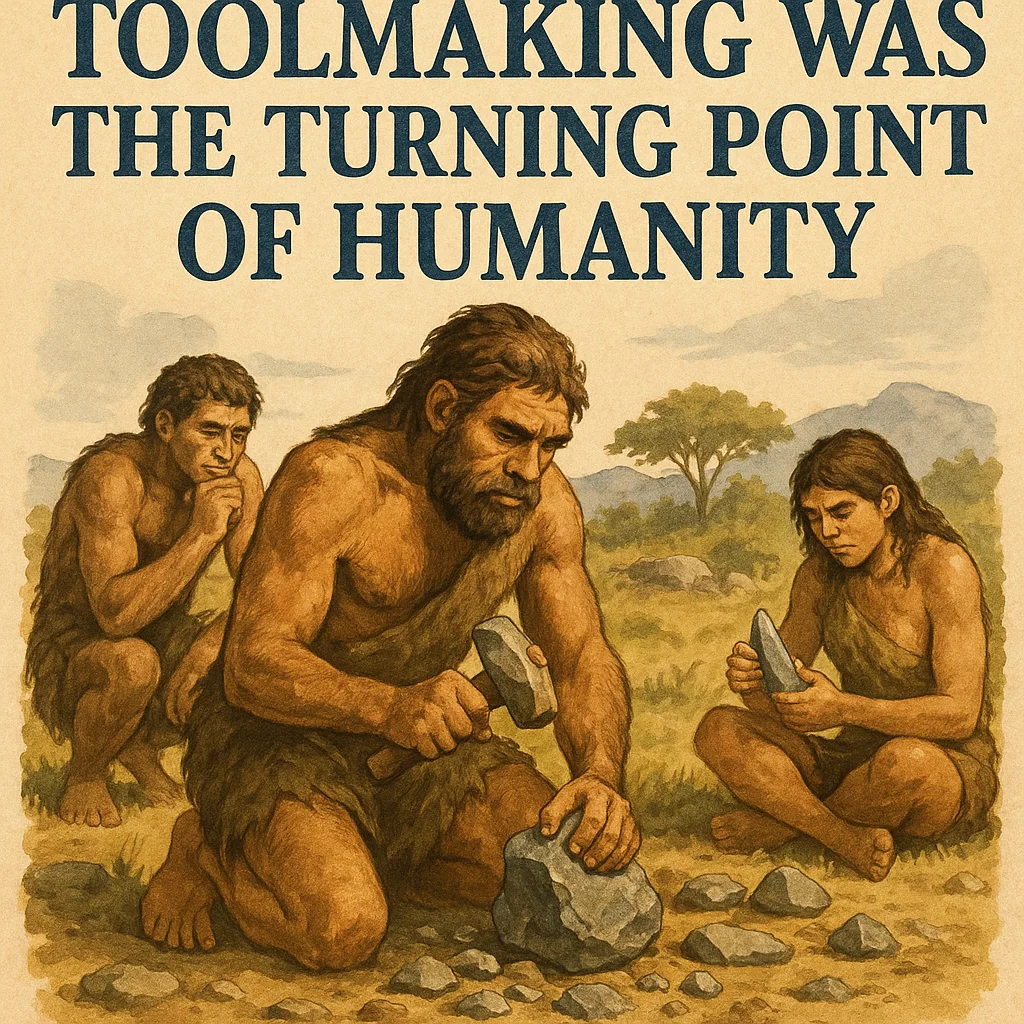
The broad narratives of migration, agriculture, language, and civilizations are frequently used to describe human history. Beneath all of these significant events, however, is one key factor that fundamentally altered everything: toolmaking. The turning point that separated us from the rest of the animal kingdom was when our ancestors started forming wood, bone, and stone into tools. In addition to helping humans survive, toolmaking radically changed our brains, influenced our societies, and set the stage for everything from smartphones to space travel.
This blog examines why toolmaking was the most significant turning point in human history, why it continues to be the foundation of our cultural and technological advancements, and why it continues to define what it means to be human.
The First Sparks of Human Ingenuity
The oldest stone tools, called Oldowan tools, are thought to have existed more than 2.5 million years ago, according to archeological evidence. These basic stone flakes were sharpened by intentional blows and were used to break bones for marrow, scrape hides, and cut meat. Although they may appear rudimentary to the modern eye, they were revolutionary in their day.
Tools could be molded, enhanced, and taught, in contrast to teeth or claws, which are genetically fixed. It was a step beyond biological evolution to be able to construct external extensions of the body. Humans could create sharper stones in a matter of minutes rather than waiting thousands of years for sharper claws. The relationship between humans and technology began with the invention of tools and is still going strong today.
Tools and the Expansion of the Human Brain
The feedback loop between toolmaking and human intelligence was one of the most significant outcomes. According to studies, advanced planning, motor skills, and spatial reasoning were necessary for the creation and use of tools. This pressure probably helped the human brain grow over many generations.
New diets were also made possible by tool use. Early humans were able to process plants to produce more calories and nutrients, crack open nuts, and butcher large animals with the aid of tools. This change in diet stimulated additional brain development. In a way, we advanced because the brain created better tools after being fed by tools.
Given that skills could be passed down and shared, anthropologists frequently contend that toolmaking served as the catalyst for culture. Tools, in contrast to instincts, needed to be learned, and this learning served as the basis for instruction, imitation, and ultimately language.
Tools as the Basis of Human Survival
The extent to which tools influenced our survival cannot be overstated. Think about the threats our ancestors had to deal with: predators, hostile environments, and limited food supplies. Humans lacked great speed, thick fur, and sharp teeth, making them physically vulnerable. With tools, however, everything was different.
-
Hunting: Spears and arrows gave humans the ability to take down prey far larger than themselves.
-
Shelter: Stone axes and knives allowed the cutting of wood to build protective structures.
-
Fire: Tools helped control and transport fire, giving warmth, safety, and cooked food.
-
Clothing: Needles made from bone enabled the creation of fitted garments, crucial for surviving ice ages.
Humans became more reliant on creativity and less on biology as a result of each of these advancements. In human hands, the world itself became malleable.
Toolmaking and the Rise of Societies
Human societies became increasingly complex along with tools. Division of labor was necessary for the production of tools; some people collected materials, others shaped tools, and still others hunted. Around these processes, specialization and cooperation grew organically.
Tools also made settlement possible. Humans could use plows to farm, pottery to store food, and weapons to protect villages rather than wander aimlessly. The first real civilizations emerged as a result of the ability to alter the environment on a large scale.
Toolmaking was another area where trade flourished. Resources like obsidian, flint, and later iron and bronze were highly prized. Along with items, tool technologies spread concepts, methods, and culture from one place to another.
From Stone to Steel: Humanity’s Technological Arc
The story of toolmaking is essentially the story of human progress. Each major age of history is named after tools and materials:
-
Stone Age: Hand axes, blades, and grinding stones laid the groundwork.
-
Bronze Age: Early urban centers, agriculture, and more powerful weapons were all made possible by the ability to cast bronze tools.
-
Iron Age: Harder metals gave rise to empires and transformed warfare.
-
Industrial Age: Machines became humanity’s ultimate tools, harnessing energy on massive scales.
-
Digital Age: Our most significant "tools" nowadays are intangible, such as networks, software, and algorithms, but they all work toward increasing human potential.
Something fundamental is revealed by this arc: the history of humanity cannot be divorced from its instruments. Every advancement in toolmaking changed worldviews, economies, and societies.
Toolmaking as the Root of Creativity
Although they are frequently thought of as useful tools, tools can also be creative expressions. Imagination was needed just to shape an object to serve a purpose. Tools weren't just discovered by early humans; they were imagined.
Eventually, this same inventiveness permeated storytelling, music, and art. For instance, pigments, chisels, and brushes—tools of expression as much as survival—were used to create cave paintings and carvings. By connecting survival and meaning, toolmaking fostered humanity's artistic side.
The Philosophical Weight of Toolmaking
What does it mean to be defined by our tools? In contrast to other animals that use sticks or rocks, humans are constantly inventing new tools. In addition to genes, methods, information, and technologies are passed down from one generation to the next.
Therefore, toolmaking is the first step toward what some philosophers refer to as the extended mind, which holds that human intelligence coexists with the tools we make rather than being limited to the brain. Our tools, which range from writing to smartphones, extend memory, reasoning, and problem-solving capabilities well beyond the individual.
In this sense, toolmaking wasn’t just a turning point in survival. It was a turning point in identity. Humans became the species that shapes the world through imagination made physical.
Modern Reflections: Are We Still Toolmakers?
One may wonder if people still make tools in this age of automation and artificial intelligence. Yes, but our relationship has changed over time. These days, we design digital tools—apps, algorithms, and machines that make other tools—instead of carving stone.
It's interesting that this creates new difficulties. We now face risks from tools so potent that they can alter economies, politics, and even the climate, whereas early humans ran the risk of getting hurt by chipped stone. Making tools is still what makes us human, but it comes with responsibility.
Conclusion: The Point Where Humanity Began
Toolmaking is not a minor footnote but rather the primary turning point in history when we follow its lengthy trajectory. It provided us with culture, civilization, intelligence, and survival. We learned collaboration, ingenuity, and foresight from it. This same lineage has produced every invention since, including every bridge, spacecraft, and smartphone.
To comprehend toolmaking is to comprehend humanity. We would still be just another species fighting against the odds if it hadn't been for it. As a result, we evolved into the species that shapes Earth and, maybe, other worlds.




Leave a Reply