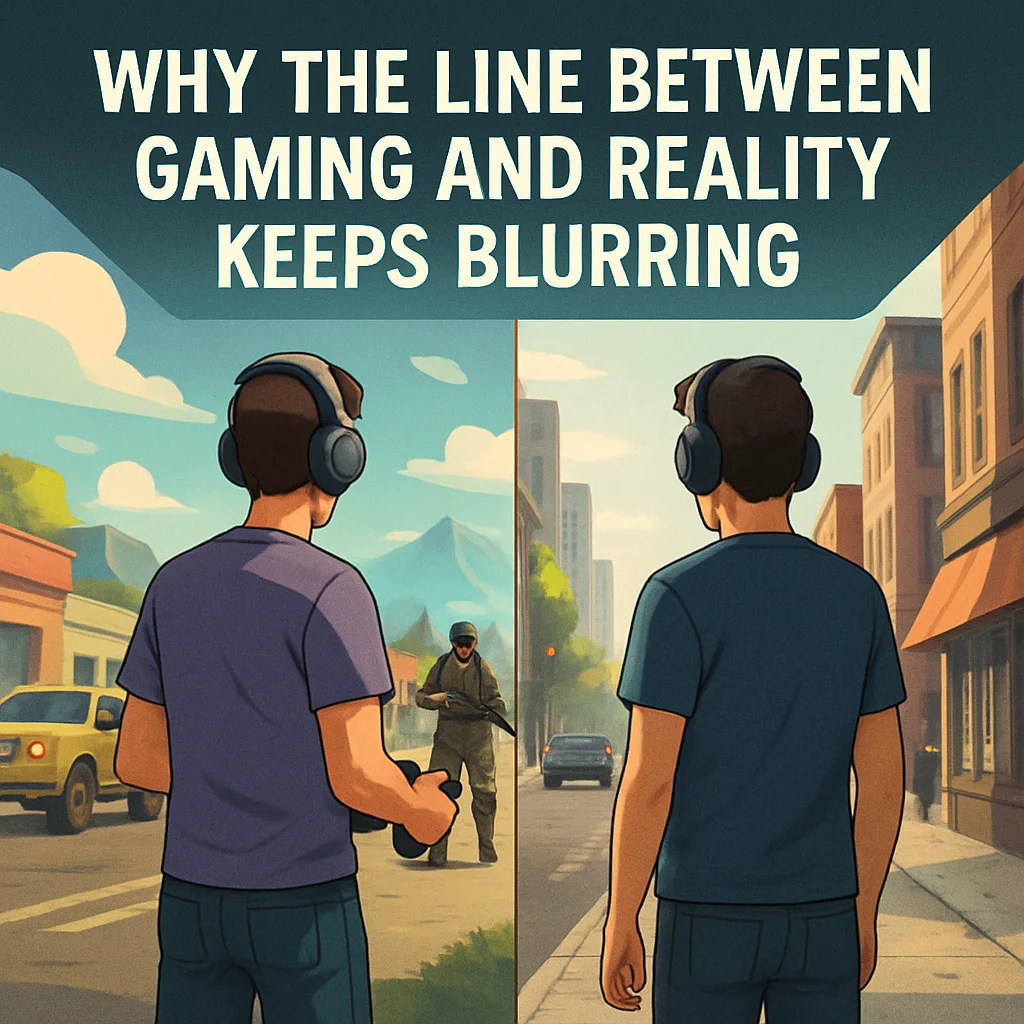
For many years, gaming has served as a kind of escape, allowing us to enter realms where we can act as explorers, heroes, or universe builders. However, that "escape" is beginning to feel more like an extension of reality than a departure from it. The distinction between real life and games is becoming increasingly blurred.
Our identities, economics, and social structures are all being impacted by games. Players are living second lives that feel just as important as their first, making real money, and forming connections that cut across geographical boundaries. This change is happening more quickly than before thanks to the convergence of blockchain economics, augmented reality (AR), virtual reality (VR), and artificial intelligence (AI).
Let's examine how and why reality and gaming are merging, as well as the implications for human experience going forward.
1. The Evolution from Pixels to Presence
Gaming in the 1980s and 1990s was a hobby of controllers, cartridges, and consoles that was obviously distinct from everyday life. You didn't play for money, identity, or connection—you played for fun.
Fast forward to today: the experience has evolved from pixels on a screen to immersive digital presence.
-
VR headgear that engage several senses, such as the Meta Quest and PlayStation VR2, immerse players in fully 3D environments.
-
Cities are transformed into dynamic playgrounds by augmented reality applications like Pokémon GO, which superimpose gameplay onto actual locations.
-
Every gesture, look, and movement counts thanks to haptic feedback and motion tracking, which blur the lines between digital and physical responses.
The distinction between "playing" and "being" is becoming more and more hazy due to these technologies. The brain interprets virtual encounters as real when your body, speech, and emotions are all completely involved.
This has been proven by psychological research: because our minds interpret immersive simulations as lived events, VR can elicit real emotional and physiological reactions, ranging from terror to empathy.
2. The Rise of Digital Identity
In the past, your in-game avatar was just a character. Now, it’s a representation of self.
Gamers spend money, time, and ingenuity creating virtual personas that either mirror or enhance their true selves. Virtual residences, titles, emotes, and skins are no longer insignificant; they now serve as status and personality indicators.
Millions of users interact, perform, and even go to concerts as their avatars on sites like Fortnite, Roblox, and VRChat. These are social ecosystems rather than merely games.
When interacting with pals via their Fortnite avatar instead of over the phone, a Gen Z gamer might feel more genuine. Their internet persona is an extension of who they are, not anything distinct.
This change reflects how digital life has evolved more broadly. The distinction between "online" and "real" has been blurred by social media, and gaming is now doing the same, but in a more vivid, engaging, and emotional way.
3. Gaming as a Real Economy
Perhaps the most tangible way reality and gaming overlap is money.
What was once fantasy now fuels a multibillion-dollar economy where players earn, trade, and invest.
-
Esports professionals earn salaries, sponsorships, and tournament prizes rivaling traditional athletes.
-
Streaming and content creation on platforms like Twitch and YouTube Gaming turn gameplay into full-time careers.
-
Blockchain games like Axie Infinity and Star Atlas introduced “play-to-earn” models, allowing players to collect assets with real-world value.
-
In-game economies — from Counter-Strike skins to Roblox items — support secondary markets worth millions.
Due to these advancements, gaming is becoming an economic ecology rather than just a recreational pastime. For millions of people throughout the world, games serve as workplaces, investment platforms, and creative studios in addition to being sources of enjoyment.
Nowadays, the idea of "virtual wealth" is just as legitimate as material belongings, particularly among younger generations who see digital ownership as having similar significance.
4. Augmented Reality: Turning the Real World into a Game
If VR brings reality into the virtual, AR brings the virtual into reality.
Pokémon GO and other games demonstrated how virtual and real-world entities may interact. In order to capture virtual Pokémon, millions of users worldwide strolled through actual streets, turning public areas into cooperative experiences.
With wearables, smart glasses, and location-based augmented reality, this mixing has only gotten stronger. Businesses like Apple and Niantic envision a future in which the digital and physical worlds are constantly blending together, with a layer of interactive data present in every building, park, and street corner.
Imagine:
-
Walking into a park where AR quests appear based on your history.
-
Competing with others for virtual territory overlaid on your city.
-
Shopping for both physical and digital goods at once through AR displays.
In these scenarios, life itself becomes gamified. The boundary between player and participant dissolves.
5. The Metaverse: The Ultimate Convergence
The metaverse — an interconnected virtual universe — represents the next major stage of this fusion.
The metaverse is not restricted to a single title or objective, in contrast to conventional games. Users are supposed to live, work, learn, and play in this shared, persistent three-dimensional world.
Platforms like Decentraland, Sandbox, and Horizon Worlds are early attempts to build these spaces, blending gaming mechanics with social, economic, and creative elements.
Inside these worlds, users can:
-
Attend virtual meetings or concerts.
-
Buy and sell digital real estate.
-
Build businesses and communities.
The metaverse turns gaming into the foundation of digital life, or infrastructure. Redefining reality is more important than simply running away from it.
6. Artificial Intelligence: Personalized Worlds That Feel Alive
AI is making virtual worlds smarter — and eerily realistic.
AI-driven personas that can engage in dynamic dialogue, react emotionally, and learn are replacing written bots as non-player characters (NPCs).
Imagine:
-
An NPC who remembers your past decisions and adapts their behavior.
-
Entire cities that evolve autonomously, responding to player actions.
-
AI game masters generating endless quests tailored to your mood and history.
Procedural creation is already used in games like No Man's Sky to build expansive, explorable universes. These settings may now respond intelligently thanks to generative AI, making it harder to distinguish between lived experience and written narrative.
In the near future, each player's interpretation of a game environment might be distinct, a personal reality influenced by their actions and feelings.
7. Social Connection and Emotional Reality
For many, gaming is no longer a solitary pastime — it’s a social lifeline.
In ways that mimic or even exceed real-world relationships, players develop close friendships, fall in love, and work together. Online gaming communities can promote true belonging, empathy, and cooperation abilities, according to studies.
The emotional connection is enhanced in virtual reality. Your brain perceives interactions with avatars as physically real when you share a space, make eye contact, and make natural gestures.
Millions of people used video games to communicate during the COVID-19 pandemic, holding protests in Minecraft, marriages in Final Fantasy XIV, and birthdays in Animal Crossing.
Gaming is no longer separate from life; for many, it is life, in digital form.
8. The Psychology of Immersion
The more real games become, the more our brains treat them as genuine experiences.
According to neurological research, high-immersion gaming and virtual reality can elicit physiological and emotional responses that are exactly like those that occur in real life, such as dread, empathy, or even trauma.
Transfer of presence is the phenomenon wherein gamers who have a strong sense of identification with their avatars bring lessons learned, self-assurance, and behaviors into real life.
Because of this psychological immersion, serious sectors including education, healthcare, and defense are using gaming technology for rehabilitation and training. When done correctly, reality blurring can improve learning, foster empathy, and increase emotional fortitude.
9. The Ethical and Psychological Challenges
But this convergence also brings new questions:
-
What happens when the digital self feels more authentic than the physical one?
-
How do we handle addiction or escapism when virtual success replaces real-world motivation?
-
Who owns your digital identity and data in these immersive worlds?
Determining boundaries, ownership, and responsibility becomes increasingly important as game and reality become more entwined.
In these hybrid places, game designers, legislators, and players must consider how to strike a balance between freedom, safety, and mental health.
10. The Future: A Reality That Plays Back
In the near future, gaming won’t just imitate reality — it will merge with it.
-
AI-driven NPCs will become indistinguishable from human players.
-
AR glasses will gamify everyday tasks — from fitness to learning.
-
Blockchain assets will ensure true ownership of digital creations.
-
Biometric feedback will make games respond to your emotions in real time.
The question will be "What do we choose to make real?" rather than "Where does gaming end?" once reality itself can be programmed.
Conclusion: Living in the Game
Technology is not the only factor contributing to the blurring of the boundaries between reality and gaming; human desire is also at play. the want to go beyond physical boundaries in order to connect, discover, and create meaning.
Games are now extensions of reality that allow us to explore concepts, feelings, and identities rather than being a means of escape.
The future will belong to those who can successfully manage both worlds as our digital and physical lives continue to merge, realizing that we are all now participants.
Reality is evolving. The game never ends.



Leave a Reply