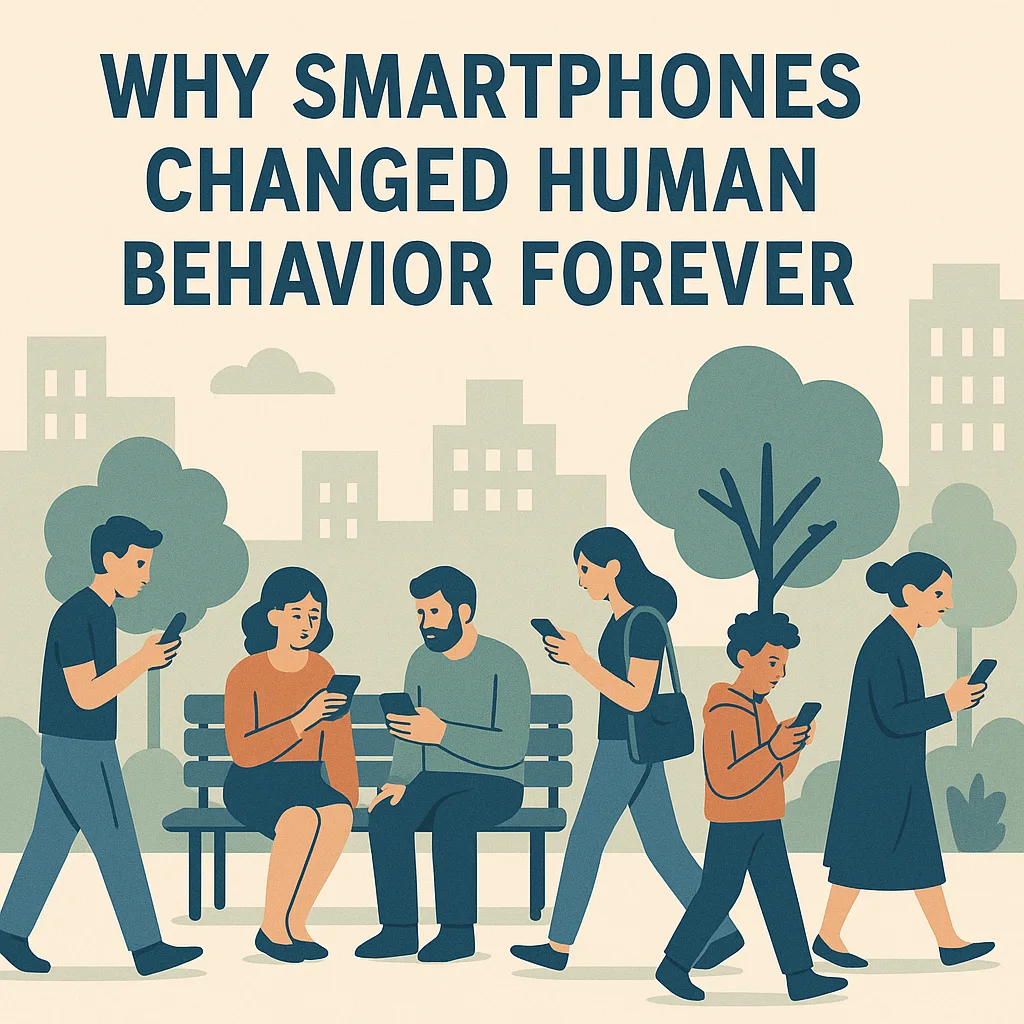
Smartphones have evolved from luxuries to indispensable tools in just over ten years. From the moment we wake up until we go to sleep, they hold our attention, rest next to our beds, and sit in our pockets. It's difficult to recall a time before them or to envision life without them because of their immense influence.
Beyond convenience, however, smartphones have radically changed how people connect, think, and act. They are extensions of who we are, not merely instruments. We must look at how smartphones have affected psychology, relationships, work, culture, and even how we perceive time if we are to comprehend why they have permanently altered human behavior.
From Tools to Extensions of the Self
Typewriters and landlines were examples of earlier technologies that were useful but distinct from everyday life. Smartphones are distinct. Customized with our apps, pictures, conversations, and memories, they are incredibly intimate.
A smartphone combines the functions of a camera, GPS, calendar, gaming console, mall, and library. From the songs we listen to, to the way we text, to the private notes we make, it bears pieces of who we are. According to psychologists, losing a smartphone can make many people feel as though they are losing a part of who they are.
This intimate integration means that smartphones shape not only what we do, but who we are.
The Attention Economy and the Rewiring of Focus
Perhaps the most significant behavioral change comes from how smartphones manipulate attention.
Constant Stimulation
Alerts, notifications, and endless scrolling offer constant stimulation. Dopamine, the brain's reward chemical, is released in spasms with each ping. As a result, we develop compulsive-like habits of constantly checking our phones.
Shrinking Attention Spans
In the age of smartphones, the average attention span has decreased. People frequently multitask—checking emails in the middle of a conversation, browsing social media in between tasks, or switching between apps—instead of paying close attention for prolonged periods of time.
Always “On Call”
Prior to smartphones, you might not be reachable once you left your house or place of employment. People carry their jobs, friends, and world news in their pockets these days. The psychological line separating "on" and "off" has become less distinct, which has led to an increase in stress and burnout.
Smartphones and Human Relationships
In fact, smartphones have made it simpler to stay in touch, as they promised connection. However, the nature of connection has changed in ways that will always change how people behave.
Hyper-Connected but Lonely
Social media and messaging apps facilitate instant communication across continents, but research indicates that loneliness is on the rise. Face-to-face relationships can occasionally be replaced by online interactions, giving people more contacts but weaker ties.
Social Validation and the “Like” Economy
A new behavioral loop was brought about by smartphone-accessible platforms: validation through shares, likes, and comments. Nowadays, a lot of people use digital recognition to gauge their own value, changing their online and offline personas.
Phubbing and Presentness
The practice of ignoring someone in favor of your phone, or "phubbing," has become widespread. Smartphones have the potential to distract users from the here and now, which reduces empathy and meaningful dialogue.
Work and Productivity in the Smartphone Era
Smartphones revolutionized work, but not always for the better.
Freedom and Flexibility
Smartphones enable digital entrepreneurship, gig economies, and remote work. They enable employees to run companies, cooperate internationally, and remain aware of opportunities.
The Curse of Constant Availability
Conversely, smartphones bind people to their work outside of regular business hours. Overwork is fostered by bosses who demand immediate responses, Slack notifications during dinner, and emails sent at midnight.
Productivity Paradox
Smartphones have many useful features, such as note-taking apps and calendars, but they are also full of distractions. Many people are caught between procrastination and productivity, constantly alternating between work and leisure.
Redefining Knowledge and Memory
In the past, information was either remembered by hard work or kept in libraries. These days, memory is externalized by smartphones.
Outsourcing the Brain
With Google at your fingertips, why commit facts to memory? We recall less information and more about how to find it, a phenomenon known as the "Google Effect" by psychologists. External storage has replaced internal memory in smartphones.
Information Overload
Behavior has also changed as a result of the wealth of information at our fingertips. People frequently click, skim, and consume superficial information from dozens of sources every day in place of deep learning.
Cultural Shifts and New Norms
Smartphones have created entirely new cultural behaviors that define modern life.
The Rise of the Selfie
Smartphones made selfies popular, which revolutionized how people record and share their lives. They place a strong emphasis on personal branding, which breeds conceit and empowerment.
Digital Etiquette
Social norms were altered by smartphones. It's commonplace to use a map rather than ask for directions, to tap to pay, or to text rather than call. Once-rude or strange behaviors have become commonplace.
Entertainment on Demand
Smartphones made entertainment portable and customizable, thanks to platforms like YouTube and TikTok. This change made media consumption shorter, quicker, and more individualized to individual preferences.
The Psychological Costs
While smartphones unlocked opportunities, they also introduced new challenges.
Anxiety and Dependence
Researchers refer to the anxiety that many people experience when they are not using their phones as "nomophobia" (no-mobile-phone-phobia). Restlessness is bred by the constant need to check for updates.
Sleep Disruption
Smartphone blue light disrupts sleep cycles by interfering with the production of melatonin. Beyond biology, late-night scrolling also makes it harder to get enough sleep.
Social Comparison
Smartphone social media makes comparison more intense. Seeing carefully chosen highlights of other people's lives can make one feel inferior, envious, and depressed.
Smartphones and Human Identity
Smartphones aren’t just tools we use; they shape how we see ourselves.
-
Personal Branding: Social media profiles act as curated identities.
-
Digital Footprints: Online behavior leaves lasting traces, influencing reputations and opportunities.
-
Blurring Public and Private: Smartphones expose personal lives to public audiences, shifting how people think about privacy.
For younger generations, identity is almost inseparable from the digital world carried in their phones.
Smartphones and Society at Large
The ripple effects go beyond individuals:
-
Politics: Social movements are fueled by smartphones, which make activism, awareness-raising, and protests possible.
-
Economics: Global economies were reshaped by the financial access that mobile banking provided to millions of people.
-
Education: Smartphones democratize learning by putting resources and online courses in students' pockets.
Misinformation, on the other hand, spreads quickly via the same devices, demonstrating that smartphones are neutral tools that are boosted by human intent.
Why This Change Is Permanent
Smartphones, in contrast to earlier technologies, are not going away. By combining wearable technology, augmented reality, and artificial intelligence, they are developing into even more potent gadgets.
Human behavior is now ingrained with the habits they established, including digital identity, continuous stimulation, and instant communication. The behavioral patterns that smartphones solidified would persist even if they vanished tomorrow.
Conclusion: A New Human Story
More than just altering communication, smartphones changed our relationships, rewired our brains, and reinterpreted what it means to be a modern person. Future historians may distinguish between periods "before smartphones" and "after smartphones" due to the profound changes they brought about in attention, memory, work, culture, and identity.
They are reflections of human strength and weakness, instruments that both empower and ensnare us, unite and separate us, educate and overwhelm us.
Because smartphones entered our minds as well as our hands, they permanently altered human behavior.




Leave a Reply