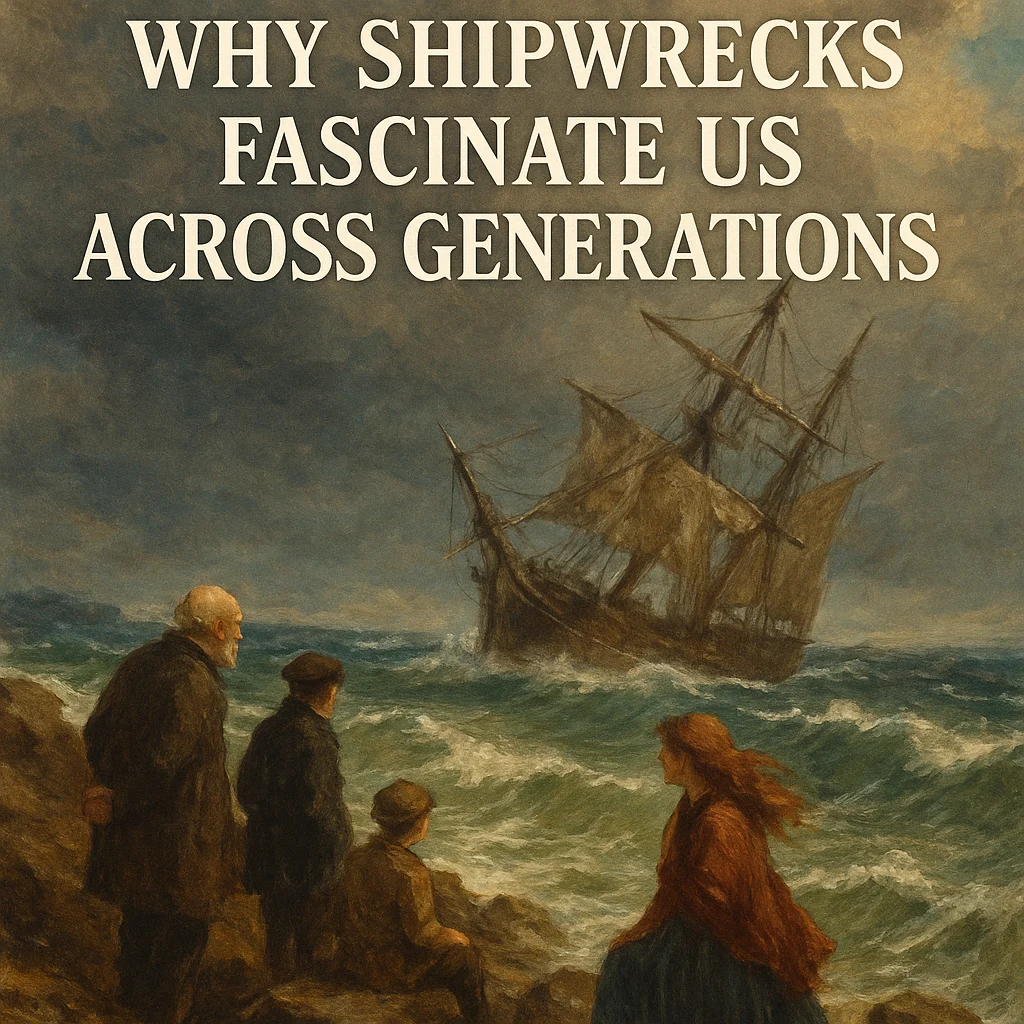
Ships have sunk for as long as people have been sailing the oceans, taking with them lives, mysteries, and stories. Shipwrecks, however, have always had a powerful hold on people's imaginations despite the peril and tragedy they symbolize. They serve as inspiration for adventure stories, cautionary tales, and even scientific research. Every wreck, from the Titanic resting in the Atlantic to ancient shipwrecks buried beneath the Mediterranean, is a time capsule hidden beneath the waves that whisper secrets to anyone brave enough to discover them.
But why do shipwrecks continue to captivate people of all ages? Why, even after the sea has taken them, do they still captivate our attention? The answer is found in the special fusion of history, tragedy, mystery, and the enduring human desire they represent.
Shipwrecks as Time Capsules
Every shipwreck is a snapshot of the world as it was at a specific moment in time, not just a catastrophe. Stories about human culture, commerce, and technology can be gleaned from the cargo transported, the ship's design, and the personal effects left behind.
For instance, the Antikythera shipwreck off the Greek coast uncovered the Antikythera mechanism, a sophisticated apparatus that many refer to as the first computer in history, in addition to amphorae containing antiquated goods. Viking shipwrecks have also taught us about Norse burial practices, trade routes, and navigation methods.
Shipwrecks become historical portals as a result of these discoveries. They are unaltered and unedited, preserved precisely as the sea determined, in contrast to books or oral traditions. They are invaluable to historians and archaeologists because of their authenticity. It stimulates the public's imagination and provides a direct link to a bygone era.
The Allure of Tragedy
Tragic tales of lost lives and doomed expeditions are frequently found aboard shipwrecks. Because of the magnitude of the catastrophe as well as the deep symbolic meaning it conveys—hubris, ambition, and the limits of human control over nature—the Titanic continues to be the most well-known example.
A deeper aspect of human psychology is connected to the fascination with shipwreck tragedies. Tragic events encourage compassion, introspection, and narrative. We can't help but wonder about the last moments of the explorers, sailors, and passengers who embarked on these expeditions. Were they in a panic? Were they able to find tranquility? Did they hold out hope all the way to the end?
In addition to ensuring that the wrecks themselves are never viewed as nothing more than rusting steel or decaying wood, these inquiries help to preserve stories. Rather, they serve as monuments to the fragility and bravery of humanity.
Mystery Beneath the Waves
The sea itself has a certain enigmatic quality. Although we have only explored a small portion of it, it makes up over 70% of the Earth. Shipwrecks, which lie at the bottom of a world that is both real and foreign to us, contribute to this mystery.
There are shipwrecks that have never been located, and their absence piques curiosity. Myths and conjecture are still sparked by the disappearance of ships like the Mary Celeste, which was found adrift without its crew, or the innumerable ships lost in the Bermuda Triangle. Did they fall prey to sabotage, storms, or something else entirely?
Shipwrecks become legends that invite constant retelling and reinvention because of this persistent sense of mystery, which elevates them above the status of historical artifacts.
Treasure Hunting and Adventure
The fact that shipwrecks are associated with treasure contributes to our fascination with them. Explorers, pirates, and fortune seekers have been searching the seas for centuries because of tales of sunken ships that were carrying gold, jewels, and artifacts.
The best examples are the Spanish galleons that were destroyed in the Caribbean during the era of empire. Some returned to Spain with enormous loads of gold and silver from the Americas. The lure of their wealth has never diminished, even though many were lost to storms or attacks.
Video games, books, and movies frequently capitalize on this idealized view of shipwrecks by depicting them as ruins full of treasure just waiting to be found. The dream of hidden wealth sustains fascination even though reality is typically less glamorous—most wrecks contain more pottery than gold.
A Blend of History and Myth
The distinction between historical fact and legend is muddled by shipwrecks. Take pirate ship tales like Blackbeard's Queen Anne's Revenge, which blend mythological figures with actual historical events. Although the wreck, which was discovered off the coast of North Carolina, has given archaeologists important information about pirate life, it continues to represent adventure and lawlessness in the minds of the general public.
Over time, even wrecks connected to everyday occurrences frequently become legendary. The ocean's drama, mystery, and loss turn them into cultural icons that are passed down from one generation to the next.
Scientific and Environmental Fascination
Scientists and environmentalists are fascinated by shipwrecks in addition to their cultural and emotional significance. Underwater, wrecks form man-made reefs that support marine life that flourishes in the ruins of old ships.
Shipwrecks offer marine biologists the chance to research ecosystems. The wreckage is frequently colonized by fish, coral, and even rare species, turning human tragedy into vibrant life.
Innovation in technology has been fueled by shipwreck exploration. To investigate inaccessible wrecks like the Titanic, advanced sonar systems, remotely operated vehicles (ROVs), and deep-sea submersibles have been developed. Shipwrecks become more than just artifacts of the past; they become catalysts for the future as a result of this pursuit of knowledge, which advances human ingenuity.
The Emotional Pull of the Unknown
Something very human—the attraction of the unknown—lies at the core of our fascination with shipwrecks. What is just out of reach, concealed beneath layers of time and water, is what draws us in. Shipwrecks stand for both past and present loss and discovery.
They make us aware of our frailty in the face of nature, but they also make us marvel at how resilient and inquisitive people can be. We experience a sense of connection to the vast expanse of human history when divers unearth a forgotten wreck or when technology enables us to view images of vessels that have been lost for centuries.
Why the Fascination Endures Across Generations
Generations may change, but the appeal of shipwrecks does not fade because they touch universal human themes:
-
Curiosity: The desire to know what lies beneath.
-
Mortality: A reminder of life’s fragility against nature.
-
Legacy: Stories of those who sailed before us.
-
Imagination: Legends and myths that captivate young and old alike.
While adults may view shipwrecks as symbols of ambition, loss, or resiliency, children may first encounter them in pirate stories or adventure films. Every generation ensures that shipwreck stories never fade from our collective imagination by finding something personal in them.
Conclusion: The Eternal Pull of the Deep
Shipwrecks are more than just debris. They are myths, scientists, storytellers, and monuments. Because they represent who we are—ambitious, inquisitive, delicate, and resilient all at once—they captivate our collective imagination.
Even in the era of satellites and instant messaging, the ocean continues to keep its secrets. And the vessels of those secrets are shipwrecks, silent and solemn beneath the waves. They serve as a reminder that, despite the passage of time, the human imagination will always be drawn to the deep and the tales that are concealed beneath the ocean.




Leave a Reply