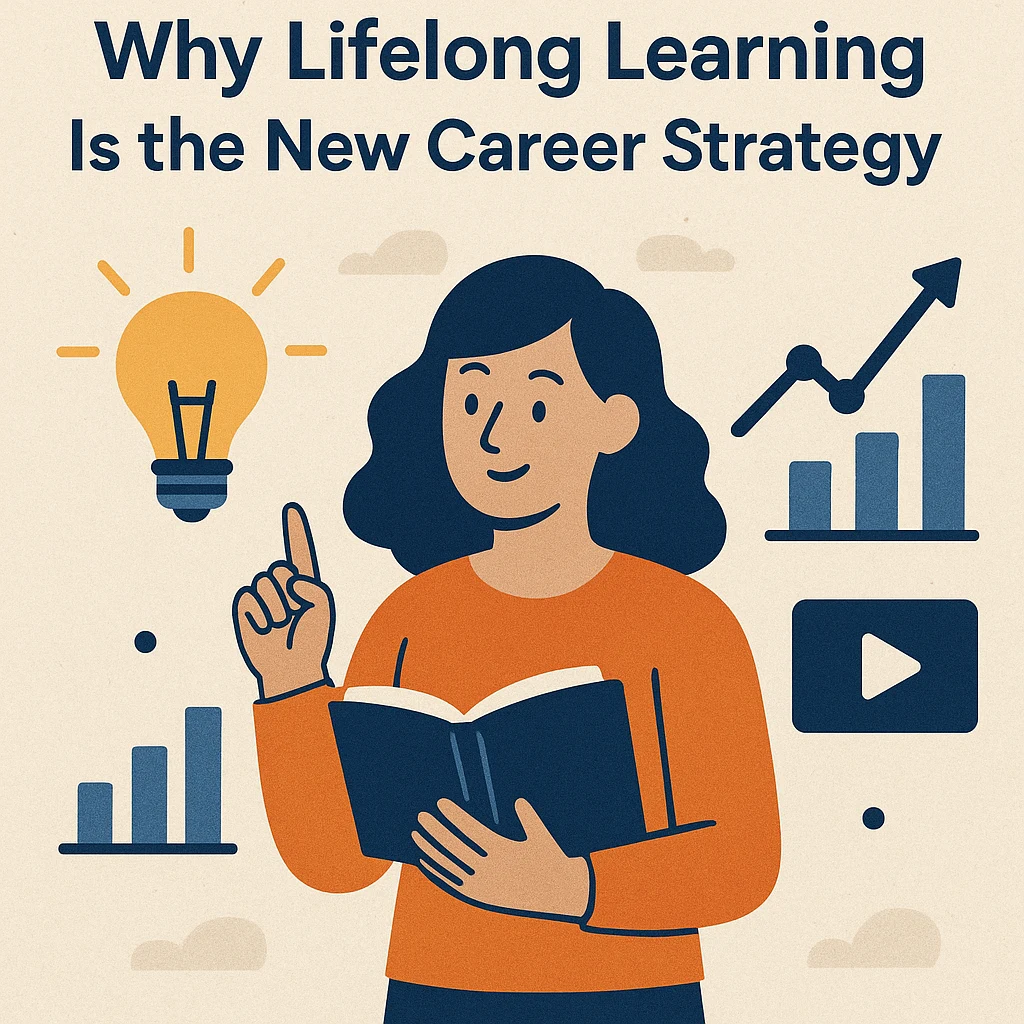
Introduction: The End of the “One-Degree-for-Life” Era
A few decades ago, obtaining a degree, finding employment, and moving up the corporate ladder until retirement seemed to be the simple route to a secure career. Education was a stage, something you finished before becoming an adult. However, that approach has failed in the quickly evolving world of today.
The rules of work have been rewritten by globalization, automation, and technology. New sectors are emerging overnight, disrupting entire industries. Knowledge is a living currency in this setting rather than a static asset. What you know now might not be relevant tomorrow.
Let's talk about lifelong learning, which is the attitude and practice of constantly picking up new abilities, information, and viewpoints throughout one's life. Lifelong learning, often considered a luxury for the intellectually curious, is now a survival tactic in the workplace. The most adaptive people succeed in the twenty-first century, not the strongest or smartest.
The New Reality of Work: Change Is the Only Constant
Examine the rate of change to see why lifelong learning is now unavoidable. The half-life of abilities, or the amount of time it takes for half of your knowledge to become obsolete, is rapidly decreasing. Many professional abilities now have a half-life of only five years, according to research from IBM and the World Economic Forum.
Consider how different industries have transformed:
-
Marketing has evolved from print and TV ads to data analytics, SEO, and social media algorithms.
-
Finance now demands fluency in blockchain, fintech, and AI-driven analytics.
-
Manufacturing is increasingly automated, requiring digital literacy rather than just manual skill.
-
Healthcare is integrating telemedicine, genomics, and data science.
No field is immune, to put it briefly. Those who can learn, unlearn, and relearn more quickly than the rate of disruption will own the future.
From Job Security to Employability Security
The old idea of employment security—staying in one position or organization for many years—is no longer relevant. Rather, employability security—the capacity to remain relevant, marketable, and in demand regardless of changes—is the new benchmark.
This change is significant. It implies that your ability to develop is more valuable than your degree or work title.
Businesses are adjusting to this reality as well. Employers now look for candidates that have the ability to adapt, pick things up quickly, and think creatively rather than just those with expertise. According to LinkedIn's 2024 Global Talent Trends study, "adaptability" is really one of the most sought-after abilities in all sectors.
Lifelong learners have a tactical advantage in this environment. They're staying ahead and converting uncertainty into opportunity, not just keeping up.
The Psychology of Continuous Growth
Beyond technology and economics, lifelong learning appeals to a fundamental human need for development and meaning. The spirit of this new career ethic is encapsulated in psychologist Carol Dweck's concept of the growth mindset, which is the conviction that skills can be developed through effort and study.
People who have a development mentality view obstacles as chances to grow rather than as dangers. Instead of asking, "What if I fail?" they ask, "What can I learn from this?"
Resilience is fueled by this way of thinking. Lifelong learners are less inclined to panic when occupations expire or industries change; instead, they change course. They see change as a necessary component of the trip rather than a hindrance.
Essentially, lifelong learning is a worldview that values inquiry, flexibility, and self-renewal rather than merely a collection of abilities.
Technology: The Great Accelerator of Learning
Ironically, learning has become easier than ever because to the same technologies that are disrupting careers. Education has become more accessible in the digital era. Knowledge that formerly required costly degrees or special access is now at your fingertips.
-
Online platforms like Coursera, Udemy, and edX offer university-level courses in everything from AI to philosophy.
-
Podcasts and YouTube channels provide informal yet powerful ways to stay informed.
-
Microlearning—short, focused learning bursts—fits easily into busy schedules.
-
AI tutors and adaptive learning tools personalize education to your pace and goals.
You no longer have to put your career on hold in order to pursue further education. The distinction between job and education has become less clear. In order to keep a competitive edge, continuous improvement is now not only possible but also necessary.
The Skills That Define the Future
Certain skill categories are becoming globally useful as sectors change. In order to future-proof their jobs, lifelong learners concentrate on acquiring both hard and soft skills:
1. Digital Fluency
Understanding technology, from cybersecurity to data analytics, is now a prerequisite for all professions. The new literacy is digital literacy.
2. Emotional Intelligence (EQ)
Logic may be replicated by automation, but empathy cannot. Communication, teamwork, and leadership are all components of emotional intelligence, which will continue to be a key human advantage.
3. Critical Thinking and Problem Solving
The capacity to analyze, assess, and apply knowledge is increasingly important than simply memorizing facts when information becomes more readily available.
4. Creativity and Innovation
Those that are able to think creatively will be the ones to lead the next wave of development. Technology is transformed by creativity.
5. Adaptability and Learning Agility
The most important meta-skill of the twenty-first century is the capacity to pick up new information fast and let go of old knowledge.
Lifelong learners develop these qualities not only to maintain their employment but also to reimagine their positions and direct their own professional trajectories.
The Corporate Shift: Companies as Learning Ecosystems
Innovative businesses have realized that their most precious asset is not money but rather human potential. Businesses are becoming learning ecosystems in order to remain competitive.
Every year, tech behemoths like Google, Amazon, and Microsoft spend billions on staff upskilling. They are aware that innovation stems from ongoing reinvention rather than static expertise.
Progressive employers now typically offer tuition subsidies, mentorship programs, and corporate learning initiatives. Employees at even tiny businesses are being pushed to try new things, fail quickly, and pick things up more quickly.
A new business paradigm is represented by this mutually beneficial interaction between organizational growth and personal learning: as employees develop, the company does too.
Breaking the Myth: Learning Isn’t Just for the Young
The fact that learning has no age restrictions is one of the most freeing facts of our day. The notion that education ends when a person is young has been disproved. In actuality, mid-career professionals frequently have an advantage because they contribute perspective, experience, and a distinct sense of purpose to their learning process.
According to studies, adults who continue their education benefit not only in their careers but also in their mental flexibility, self-assurance, and level of life satisfaction. Learning becomes a tool for personal enrichment and a means of sustaining curiosity, in addition to being a professional necessity.
A deeper fact is embodied by the 50-year-old who learns to code, the 40-year-old who obtains a leadership credential, and the retiree who studies philosophy: education is life itself, not a means of preparation.
Lifelong Learning in Practice: Building a Personal Strategy
Developing a system for long-term development is the goal of adopting lifelong learning, not earning certifications. This is how contemporary experts are doing it:
-
Curate Your Learning Goals:
Identify skill gaps in your current role or industry. Ask: What will make me more valuable five years from now? -
Leverage Technology:
Use online courses, mobile learning apps, and webinars to fit learning into your daily routine. -
Seek Mentorship and Communities:
Learning accelerates in networks. Join professional forums, online communities, or local groups where you can exchange ideas. -
Experiment and Apply:
Knowledge sticks when practiced. Take on stretch projects, volunteer for new roles, or launch small side initiatives. -
Reflect and Recalibrate:
Regularly assess what you’ve learned and how it’s serving your goals. Learning is not a race—it’s a rhythm.
Learning becomes a habit that builds over time, much like interest in a bank account, when you approach it as a way of life rather than a chore.
The Deeper Payoff: Identity, Purpose, and Resilience
Fundamentally, lifelong learning is about becoming the best version of yourself rather than just being employable. You develop curiosity, humility, and openness to change when you make a commitment to personal development.
This way of thinking not only increases your success but also your adaptability, creativity, and sense of fulfillment. Lifelong learners view their professions as dynamic journeys full of pivots and reinvention rather than as straight lines.
That adaptability is the best kind of security during unpredictable times. The capacity to learn guarantees that you can always find your position in the world, even though it may change.
Conclusion: The Future Belongs to the Learners
Nowadays, learning is the best professional plan and is no longer an alternative. Those with the longest resumes or the most prestigious degrees won't be the ones that prosper in the upcoming decades. They will be the ones who continue to be inquisitive, flexible, and fearless in making new beginnings.
The new job title is, in a way, lifelong learning. It entails viewing every day as an opportunity to develop, every event as a classroom, and every failure as a lesson.
The future of work is uncertain, but one thing is clear: those who keep learning will never be left behind.


Leave a Reply