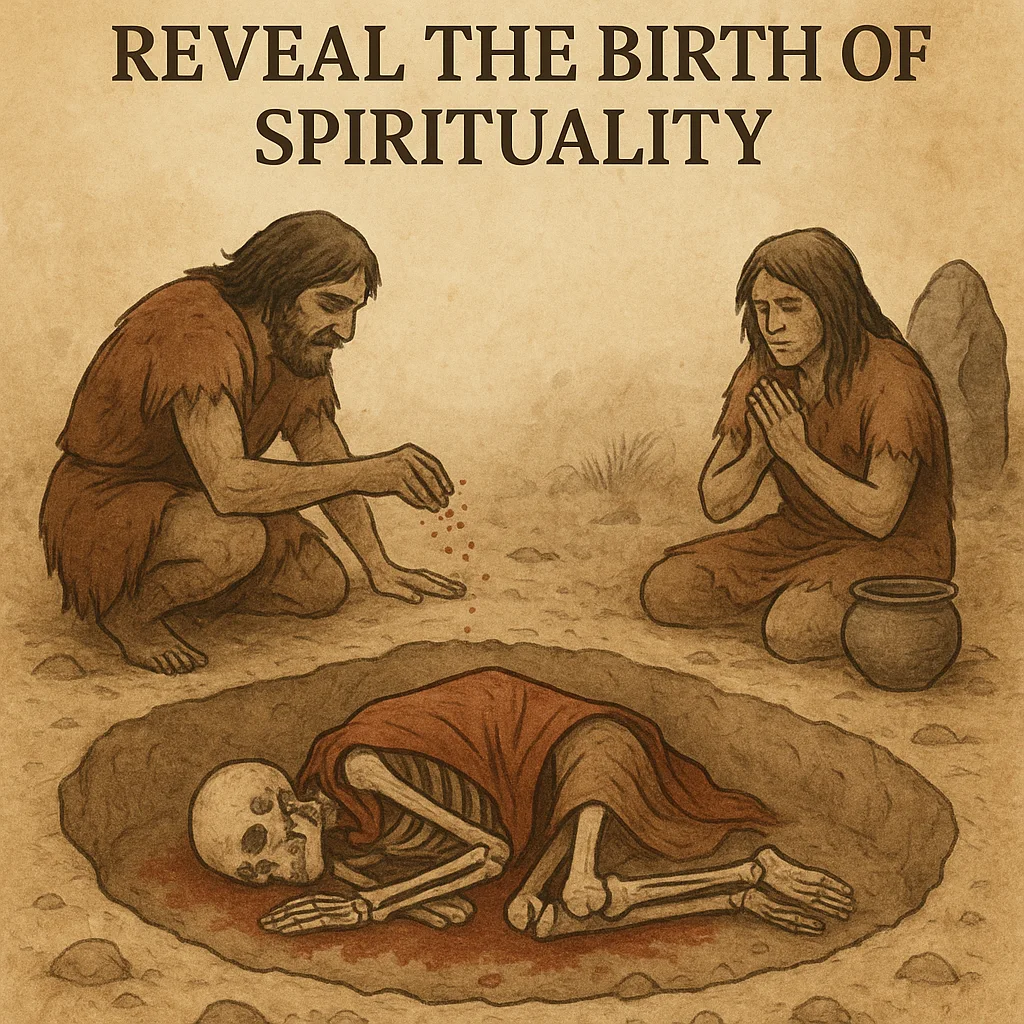
Language, fire, and tools are frequently mentioned as the characteristics that set humans apart from other animals. Burying our dead is a more subdued but possibly more significant indication of our humanity. With bodies meticulously buried in the ground and frequently encircled by items like food, weapons, or beads, archaeologists have discovered graves that date back tens of thousands of years.
Why would prehistoric people do such things? After all, while other animals experience loss—dolphins linger over the bodies of their deceased, elephants mourn—only humans formally buried their dead. In addition to implying social ties, these early customs also allude to the emergence of spirituality and the initial nascent inquiries concerning life, death, and the afterlife.
This blog examines the ways in which burial customs influenced human identity, what they can teach us about prehistoric belief systems, and why they are still essential to our common history.
The Archaeological Record: Burials Across Time
The Neanderthals are thought to have been the first people to intentionally bury people, dating back about 100,000 years. Skeletons encircled by clusters of pollen were discovered at sites such as Shanidar Cave in Iraq, indicating that flowers had been interred alongside the deceased.
Burials later became even more ornate in Homo sapiens sites such as Qafzeh in Israel (c. 90,000–100,000 years ago). Ochre, a red pigment that frequently represents blood or life, beads, tools, or animal bones were used to arrange the bodies. These customs imply that people found significance in the act of burial rather than viewing death as the simple disposal of a body.
Since then, rituals surrounding death have been a part of every culture, regardless of time and location. Its profound evolutionary and spiritual significance is indicated by its sheer universality.
Beyond Disposal: Why Burials Signify Something More
At a purely practical level, burial could serve purposes like keeping predators away or preventing disease. But the intentionality behind early burials reveals something deeper.
-
Symbolism in Objects
-
The fact that tools, beads, and pigments were included suggests that people thought the deceased would "need" or "use" these objects after they passed away.
-
This reflects the first evidence of an afterlife belief—that existence might continue in some form.
-
-
Positioning of Bodies
-
As if to represent rebirth, many early burials positioned the bodies in fetal positions. This implies that death was viewed as a transition rather than a conclusion.
-
-
Collective Participation
-
Burials were communal rather than individual acts. They were characterized as rituals rather than chores because they required cooperation, teamwork, and emotional commitment.
-
-
Expression of Identity
-
A recognition of individuality is demonstrated by the ornamentation of bodies. Early manifestations of self-awareness and legacy were suggested by the unique memories of the deceased.
-
Burials were the first human-made spaces where biology met belief.
The Birth of Spirituality
When people face questions like "what happens after death?" that cannot be addressed by their immediate survival needs, they begin to develop a sense of spirituality. Why are we here? What purpose does suffering serve? The first tangible indication that such questions had started to surface was found in early burial customs.
-
Confronting Mortality
-
The ability of humans to envision their own deaths and project into the future makes them special. Through the consolation that life went on in another form, burial customs offered a means of coping with mortality.
-
-
Connection Between Life and Death
-
Red ochre or animal bones may have been used symbolically to symbolize transformation, vitality, or fertility. These behaviors imply that people perceived life, death, and perhaps even rebirth as continuous.
-
-
Community and the Sacred
-
Humans established sacred moments—ritualized pauses that gave existence meaning—by congregating to grieve and pay respect to the deceased. Spiritual practice grew out of this shared reverence.
-
Neanderthals and Early Spirituality
Scientists argued over whether Neanderthals were spiritual for a long time. The Shanidar Cave burial sites disproved the notion that Neanderthals were savage. Flowers suggested reverence, and some skeletons displayed signs of disability, indicating care from others.
The evidence points to a shared emotional and symbolic capacity, even if their spirituality was simpler than that of modern humans. Burial customs demonstrate that spirituality is ingrained in human nature and is not a relatively recent development.
Burials as the First Cultural Memory
In addition to being sacred, burial grounds served as symbols of remembrance. Communities established a kind of continuity between generations by revisiting the same caves or locations. These locations served as the first cemeteries, binding individuals to particular environments and establishing their sense of self.
This also reveals the link between death rituals and the rise of culture:
-
Graves preserved not just bodies, but stories—reminders of kinship, ancestry, and belonging.
-
Burials made the invisible (grief, memory, belief) visible through ritual.
In this way, early burials were humanity’s first attempts at archiving meaning.
The Evolution of Death Rituals
Since the first funerals, people have created progressively more intricate ways to remember the deceased:
-
Mummification in Egypt reflected a sophisticated belief in an afterlife journey.
-
Cremation in India and Greece symbolized transformation through fire.
-
Tombs and monuments, like Stonehenge or the Pyramids, tied cosmic cycles to human mortality.
The desire to use ritual to give death significance is the root of all these complex traditions.
The Psychology of Burial Rituals
Why did humans ritualize death so early, and why do we continue to do so?
-
Coping with Grief
Grief is externalized through rituals, which provide structure to feelings that are too intense to handle on their own. Communities established collective healing by burying and paying respect to the deceased. -
Fear of Death
Rituals of burial provided comfort. Mortality was less frightening if death was a journey rather than a conclusion. -
Social Cohesion
Rituals made relationships stronger. People reaffirmed their membership in a group by taking part in the act of burial. -
Meaning-Making
People look for purpose in their lives. Death, an apparently pointless event, was given a symbolic narrative through burial customs.
Burials as the First Sacred Acts
If acknowledging something bigger than ourselves is the essence of spirituality, then burials were the first sacred acts performed by humans. By paying respect to the deceased, people realized:
-
The mystery of life.
-
The presence of forces beyond comprehension.
-
The continuity between past, present, and future.
In this sense, burial rituals weren’t just about death—they were about life’s significance.
What Early Burials Teach Us Today
These ancient customs are still echoed in contemporary funerals, whether held in churches, temples, or nonreligious ceremonies. We are connected to the first humans who planted flowers in Shanidar Cave by the fact that death rituals—prayers, offerings, and memorials—are universal across cultures today.
Their actions remind us:
-
Spirituality isn’t confined to religion; it begins with awe and reverence.
-
Our search for meaning is as old as our species.
-
Death rituals are not just about the dead—they are about how the living understand themselves.
Conclusion: The Dawn of Spiritual Humanity
Early funeral customs symbolize the beginning of spirituality because they demonstrate how people transcend survival and enter the world of meaning. They show that our ancestors struggled with issues of legacy, mortality, and the invisible even 100,000 years ago.
They were sowing the seeds of belief when they buried their loved ones in the ground with flowers, ochre, or beads, not merely burying bodies. Religion, philosophy, art, and the universal human desire to find meaning in the face of uncertainty all sprouted from those seeds.
Burial customs serve as a reminder that spirituality is a profoundly human reaction to the greatest mystery of all: death, rather than an abstract construct.




Leave a Reply