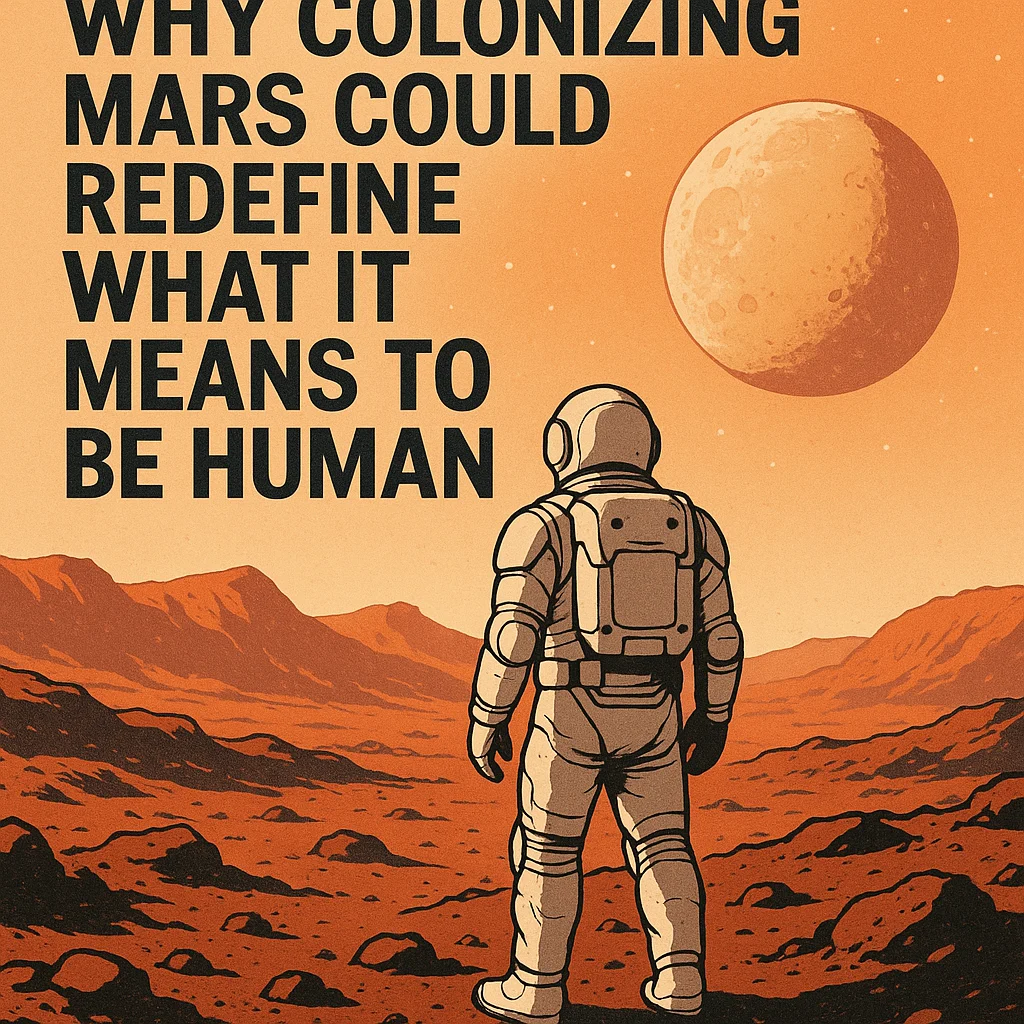
We have pondered what it would be like to live among the stars for as long as people have gazed up at the night sky. For centuries, scientists, philosophers, dreamers, and storytellers have been enthralled with Mars, the red planet. Mars feels accessible, in contrast to far-off galaxies or gas giants. We might live on it in the future, so it's more than just a planet we can see.
But it takes more than just rockets, habitats, or survival techniques to colonize Mars. The question is philosophical as well: What happens to people who live on different planets? The trip to Mars will change not only our technology but also who we are, how we define ourselves, and what it means to be human.
The Leap Beyond Earth: A New Chapter of Evolution
Under its gravity, in its air, and in its sunlight, humans evolved on Earth. This planet shapes every facet of our biology. However, what occurs if we transcend it?
Only 38% of Earth's gravity is present on Mars. We cannot be protected from dangerous radiation by the planet's thin atmosphere. The years are nearly twice as long, but the days are marginally longer than those on Earth. Humans may undergo biological adaptation over many generations in ways that are currently unknown to us. Our descendants may be reshaped by lighter bones, different circadian rhythms, or even new immune system reactions.
Since the emergence of our species on Earth, this would be the first significant divergence in human evolution. The goal of colonizing Mars is to create a new human being, not just a backup planet.
Redefining “Home”
As our home, we take Earth for granted. The notion that the Earth is our common cradle is ingrained in every culture, religion, and language. However, colonizing Mars compels a deep reexamination of the concept of home: what does it mean for humans to live on multiple planets?
In the same way that contemporary diasporas perceive ancestral lands, future Martians might regard Earth as a faraway homeland. But over many generations, they may develop a stronger connection to Mars's dusty plains than to Earth's azure seas. Consider a child who was born on Mars and has never visited Earth. For them, Mars is "home," not Earth at all.
This change in psychology has the potential to destroy human identity. Will Martians continue to identify as Earthlings? Or are they going to start thinking of themselves as something new—Martians, in name and spirit?
Cultural and Social Evolution on Mars
It takes more than just erecting domes and growing crops in greenhouses to colonize Mars. Under Martian conditions, society, politics, and culture will develop differently. Communities that are more cohesive, disciplined, and resilient than many Earth societies may be fostered by resource scarcity, the necessity of cooperation, and the risks of isolation.
The difficulties of surviving on an alien planet may inspire the development of new philosophies. Consider religions that view Mars as a sacred site for a fresh start rather than just a planet. Consider political structures intended for tiny, mutually reliant colonies where a conflict could result in extinction.
Music, literature, and art will also evolve. Similar to how stories of the sea influenced Earth's cultures, Martian culture will be dominated by tales of survival, exploration, and resiliency on a hostile frontier.
The Ethical Questions of Martian Colonization
Deep ethical questions are also raised by the colonization of Mars. Should humans terraform Mars in an attempt to make it habitable, possibly eradicating any potential native microbial life? Or should we leave Mars in its current state, even if it makes colonization more difficult?
Moreover, who has the authority to determine who resides on Mars? Will the powerful and wealthy establish an elite society off-world while inequality plagues Earth? Or will the colonies on Mars be viewed as a universal human legacy?
These inquiries reverberate from earlier Earthly colonization, but they are amplified because we are traversing planets rather than just oceans. The repercussions will influence not just Mars but the human race as a whole.
Psychological Challenges of Becoming Martians
The human mind would be drastically altered by living on Mars. Millions of kilometers from Earth, the extreme remoteness could encourage both resiliency and hopelessness. Humans have never experienced loneliness like that which the first colonists will experience.
Real-time conversations are impossible because communication with Earth can take up to 22 minutes one way. Because of this delay, Martians might be forced to become more self-sufficient and less dependent on Earth for direction.
Then there is the cosmic viewpoint, which involves seeing Earth rise as a tiny dot in the sky while standing on a new world. This inversion—perceiving Earth as the "star in the sky" rather than the earth beneath our feet—has the potential to drastically change how people perceive their place in the cosmos.
Mars as a Mirror for Humanity
We may learn more about Earth from colonizing Mars than anything else. We might finally understand how delicate and special our planet is by looking at it from a distance. We are reminded of the delicate balance that supports life on Earth by the thinness of Mars' atmosphere.
In this way, Mars turns into a mirror as well as a destination. Colonizing it might increase our awareness of the value of preserving our current planet while simultaneously pursuing our aspirations for new ones.
A New Human Story
In the end, colonizing Mars will be about more than just survival; it will be about purpose. From fire to writing to space travel, every significant human advancement has changed our perception of ourselves. It won't be any different on Mars.
It will reinterpret terms like "home," "human," and "civilization." It will put our morals, beliefs, and sense of community to the test. Most importantly, it will change the narrative of humanity from one of a single planet to one of multiple planets.
The first humans on Mars will not just be explorers. They will be authors of the next chapter in human history.
Conclusion: The Human Journey Beyond Earth
The most significant change in human history might very well occur with the colonization of Mars. It is about identity, evolution, and meaning, not just technology or survival. Entering a different world will force us to face the most profound issues surrounding what it means to be human.
Perhaps humanity will discover a new self in the red dust of Mars, in addition to a new home.




Leave a Reply