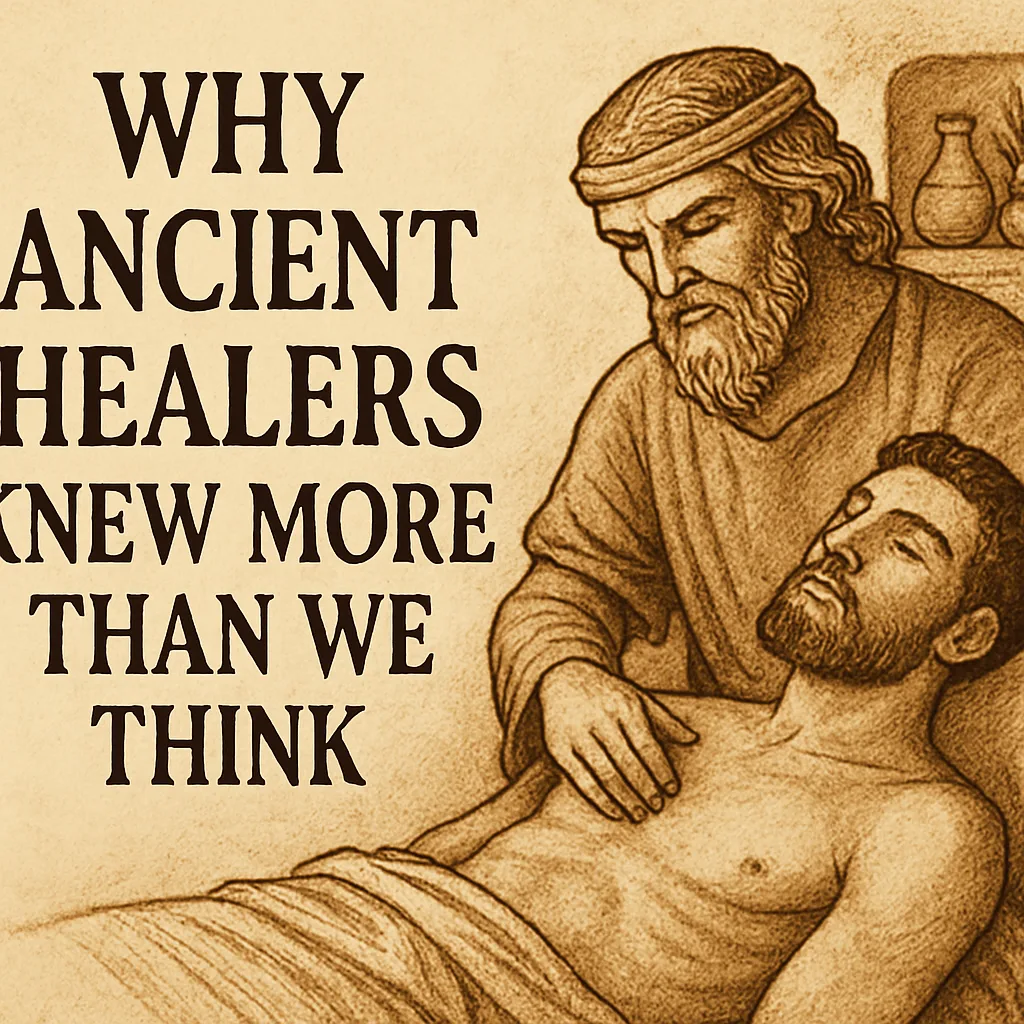
Modern medicine conjures images of sterile hospitals, sophisticated imaging devices, robotic procedures, and a growing stock of pharmaceutical medications. Thanks to scientific discoveries, modern medicine has improved life expectancy, decreased infant mortality, and discovered treatments for diseases that were once fatal. The belief that ancient healers, including shamans, herbalists, midwives, and physicians, were archaic, unscientific, and unsophisticated, however, casts a shadow over this advancement.
However, what if that presumption is not accurate? What if we underestimated the knowledge of ancient healers? Healers created complex systems of diagnosis, holistic treatment, and preventative medicine that are still relevant to contemporary science across centuries and cultures. From Indigenous shamanic practices to Greek and Egyptian traditions, from Ayurvedic medicine in India to Traditional Chinese Medicine (TCM), these healers developed understandings of the human body, mind, and environment that are only now being rediscovered by modern medicine.
This blog examines the possibility that ancient healers knew more than we realize and how applying their knowledge can improve our current approach to health.
1. Healing Was Holistic, Not Fragmented
Perspective is one of the biggest distinctions between traditional and contemporary healing. According to ancient healers, the human body, mind, spirit, and environment are all interwoven into one cohesive whole. It was uncommon to view illness as merely a bodily malfunction; instead, it was perceived as an imbalance.
For example:
-
Ayurveda defines health as the balance of dietary habits, lifestyle choices, and doshas (energetic forces).
-
Traditional Chinese Medicine (TCM) highlights the harmony of yin and yang and the flow of qi, or life force.
-
Greek medicine, Hippocrates-influenced, he discussed the four humors and the importance of environment, exercise, and diet for good health.
In contrast, modern medicine frequently treats the symptom in one organ or system while ignoring the underlying cause. However, emerging disciplines such as psychoneuroimmunology are confirming the ancient healers' understanding that the mind and body are intricately linked, and that stress, emotions, and surroundings can affect immunity and the course of disease.
2. The Wisdom of Plants
Ancient healers used the natural pharmacy of plants long before pharmaceuticals were invented. Herbal remedies were transmitted orally or recorded in ancient writings such as the Charaka Samhita in India or the Ebers Papyrus in Egypt.
What’s striking is how many of these remedies align with modern pharmacology:
-
Willow bark, contains salicin, the precursor to aspirin, and was used by the ancient Greeks to treat pain and inflammation.
-
Turmeric, Curcumin, which is valued in Ayurveda, is now known for its antioxidant and anti-inflammatory qualities.
-
Foxglove, contains substances that were used as the heart medication digitalis in medieval Europe.
Approximately 25% of contemporary medications are still made from plants. Through centuries of observation and experimentation, ancient healers understood efficacy even though they were unaware of the chemistry.
3. Preventative Medicine Was Central
In the past, prevention was just as important as treatment. In order to preserve equilibrium, healers stressed daily schedules, diets, seasonal adaptations, and rituals.
For instance:
-
Ayurveda suggests daily practices (dinacharya) such as yoga, oil pulling, and mindful eating.
-
Chinese medicine incorporates techniques like acupuncture and tai chi, not only for healing but also for preserving health.
-
Greek physicians suggested "letting food be thy medicine"—moderation in eating, drinking, and exercising.
We're rediscovering today that prevention is more cost-effective and life-saving than treatment. The lessons taught by healers thousands of years ago are echoed in public health campaigns centered on stress management, exercise, and diet.
4. Listening to the Patient
Time is a problem in modern healthcare. Tests and prescriptions may take up to ten to fifteen minutes of a doctor's appointment. However, ancient healers were more than just technical experts; they were also community leaders, storytellers, and listeners.
They looked at relationships, spiritual health, dreams, posture, and voice intonation. The diagnosis was ingrained in the patient's life context and was not only physical.
This tradition is being revived today by movements like integrative medicine and functional medicine, which encourage physicians to focus more on understanding the full patient rather than just their lab results.
5. Placebo, Ritual, and the Healing Power of Belief
Ritual is one of the most underappreciated elements of traditional healing. Healers fostered an atmosphere of faith and trust through rituals, chanting, or holy objects. This might appear superstitious to contemporary skeptics. However, neuroscience demonstrates that belief has quantifiable therapeutic benefits.
Long disregarded as "fake," the placebo effect is now acknowledged to exist: patients who take sugar pills under the mistaken impression that they are medication frequently experience improvements. Expectation, ritual, and trust set off neurochemical reactions that promote healing. This was intuitively used by ancient healers long before it was verified by clinical studies.
6. The Role of Community and Connection
Healing was a shared experience rather than merely an individual one. In ancient societies, where family, ritual, and shared responsibility were commonplace, healers played a central role in providing care.
According to Indigenous customs, healing may involve rituals that strengthened social ties by uniting the entire tribe. In contrast, patients must navigate sterile clinics alone in modern healthcare, which can feel isolating.
According to recent studies, social support is essential for healing. Strong community ties help people live longer, recover more quickly, and handle stress better. Once again, ancient wisdom anticipated modern findings.
7. Body, Spirit, and the Natural World
Ancient healers believed that environment and health were intertwined. Well-being was thought to be influenced by food, water, seasons, and even the rhythms of the stars. Both farmers and healers paid attention to natural cycles and adapted their methods accordingly.
Some of this is now being validated by modern science. Sleep, mood, and metabolism are all significantly impacted by circadian rhythms, which are influenced by light and dark. SAD is an example of how mental health can be affected by a lack of sunlight. Ancient healers would have understood that our gut microbiomes, which are influenced by our diet and soil, connect us to the earth.
8. Misunderstood or Ahead of Their Time?
It's critical to recognize that not all of the ancient customs were advantageous. Due to ignorance or superstition, some treatments were detrimental. For instance, bloodletting did more harm than good.
However, to completely reject ancient medicine due to its shortcomings would be equivalent to rejecting early astronomy for assuming that the Earth was the center of the universe. There were insights that foreshadowed contemporary innovations for every outmoded notion. Healers were ahead of their time in some respects.
9. The Modern Rediscovery of Ancient Healing
Ancient healing techniques, such as yoga, acupuncture, herbal remedies, and mindfulness meditation, are seeing a resurgence in popularity. Their efficacy is being bolstered by scientific research:
-
Mindfulness reduces stress, anxiety, and even chronic pain.
-
Yoga improves flexibility, circulation, and mental health.
-
Acupuncture shows benefits in pain management and migraine prevention.
The distinction between traditional and contemporary wisdom is becoming increasingly hazy as these practices are incorporated into wellness initiatives, hospitals, and mental health services.
10. Bridging the Old and the New
Whether ancient healers were more "right" than contemporary physicians is not the question. Rather, it's about how we can combine their knowledge with advancements in science. Acute care, including surgeries, infections, and trauma, is where modern medicine shines. Ancient medicine was excellent at treating the full person, prevention, and lifestyle. When combined, they create a more comprehensive strategy.
This bridge, which combines the best of evidence-based science with patient-centered, holistic care influenced by long-standing customs, is demonstrated by the growth of integrative medicine.
Conclusion: Respecting Forgotten Knowledge
Although they weren't magicians, ancient healers weren't stupid either. They were watchers, researchers, and keepers of knowledge that sustained societies for thousands of years. They understood that promoting balance, meaning, and connection is just as important to healing as curing illness.
In a world where technology is advancing so quickly, we run the risk of forgetting that mental, spiritual, and environmental health are just as important as physical health. Perhaps we should pay more attention to what the ancient healers knew.




Leave a Reply