Adulthood is frequently depicted as life's ultimate goal. As kids, we envision it as a stage of self-reliance, self-assurance, financial security, and time management. We are eager to live independently, earn money, and make our own judgments. However, many people are unprepared for the weight of adulthood. Confusion has taken the place of clarity. There is pressure rather than freedom. There is perpetual uncertainty in place of stability.
This emotional gap between reality and expectations is not a reflection of one's own shortcomings. It is a common experience influenced by social institutions, psychological growth, and contemporary cultural expectations. The world has changed more quickly than our emotional preparedness for it, which is why adulthood feels more difficult than anticipated—not because people are weaker.
The Expectation vs. Reality Gap
The discrepancy between what we were told and what we really experience is one of the most potent reasons adulthood feels daunting. Adulthood is portrayed as a prize from an early age. If you put in a lot of effort and go by the rules, life will ultimately get easier. But contemporary adulthood frequently seems like a never-ending list of obligations with no end in sight.
Many experience employment insecurity and ongoing skill development in place of a solid career. People struggle with growing living expenses rather than purchasing a home. Relationships feel brittle and time-constrained rather than emotionally certain. The realization that the finish line we envisioned never actually existed is what causes the disappointment, not adulthood per se.
A silent anguish results from this distance. Even if they are unable to express it completely, they lament the life they believed they would have. Anxiety, burnout, or a persistent feeling of falling behind are common manifestations of this emotional burden.
Decision Fatigue and Constant Responsibility
Many decisions are made for us as kids. Others generally dictate what we should eat, where we should go, when we should sleep, and what is expected of us. That structure is completely eliminated in adulthood. This freedom has a significant cognitive cost, despite its apparent attraction.
Numerous choices, both big and small, must be made every day. Future objectives, relationships, boundaries, financial planning, health habits, and career choices all require consideration. Both a pause button and a universal instruction manual are absent. Decision fatigue is the ensuing mental exhaustion that gradually depletes energy.
✔ Adults are accountable for results that have long-term ramifications.
Even when life seems solid on the outside, adulthood can be mentally taxing due to the ongoing pressure to make the right decisions.
Emotional Growth Without Emotional Guidance
The fact that emotional development is expected but seldom taught is another reason why adulthood feels challenging. Many people have a practical education but few emotional resources when they reach maturity. Work is taught to us, but coping mechanisms are not. How to achieve, but not how to process disappointment.
Grief, comparison, loneliness, self-doubt, and identity confusion are among the numerous emotional issues that come with adulthood. Family dynamics alter, friendships evolve, and youth safety nets gradually vanish. However, there is frequently an implicit expectation to "handle it" discreetly.
Struggles appear individualized rather than universal because of this emotional isolation. People internalize their struggles as a sign of weakness while everyone else seems to be doing well. In actuality, a lot of grownups are overwhelmed but are better at disguising it.
The Myth of Having It All Figured Out
The idea that people should have figured out life by a particular age is one that society frequently conveys. Rather than being continuous processes, career clarity, emotional maturity, secure relationships, and financial confidence are viewed as benchmarks. Shame develops when reality deviates from this timetable.
In actuality, adulthood is not a stable condition of self-assurance. It is an ongoing cycle of modification. Identities, priorities, and goals all change over time. However, the idea that everyone else is content and safe is strengthened by social media and cultural narratives.
✔ Comparing life timelines increases anxiety and self-doubt
This misconception makes the trip feel more burdensome and lonely than it has to be by putting pressure on people to pretend to be adults rather than truly experiencing it.
Economic Pressure and Unstable Foundations
Earlier generations frequently connected financial security with adulthood. That basis is significantly less dependable now. Adulthood has changed due to rising housing costs, student loan debt, healthcare costs, and employment instability. Financial insecurity can affect even decent and diligent people.
A background amount of tension is added by this instability, and it never completely goes away. Nowadays, survival is more important than preference when making decisions. Relationships, job satisfaction, and mental health can all be impacted by the worry of falling behind financially.
Adulthood becomes less about development and more about perseverance when fundamental security seems questionable. Daily obligations feel more burdensome than they normally would due to this ongoing low-level tension.
Loneliness in a Hyper-Connected World
Unexpected loneliness is a common part of adulthood. Friendships need more work to sustain as routines change. People start families, relocate for jobs, or get overwhelmed by obligations. Missed connections and planned talks take the place of the informal intimacy of school or early life.
However, without satisfying emotional demands, digital connections give the appearance of social fulfillment. Feeling understood or supported does not necessarily follow from being inundated with messages and updates.
✔ Adult friendships require intentional effort
Adulthood can be emotionally taxing due to this quiet loneliness, particularly when there isn't much room for candid conversation.
Identity Pressure and Self-Worth
Additionally, identity and productivity become intimately linked in adulthood. How you are treated and how you view yourself are frequently influenced by what you do, how much money you make, and how "successful" you seem. This puts pressure on people to continuously demonstrate their value through their work.
Self-worth can be negatively impacted when personal ambitions take longer than anticipated or careers stagnate. It starts to seem like unearned rest. Having fun makes you feel bad. This kind of thinking eventually results in emotional weariness and burnout.
When life seems more dependent on success than on intrinsic worth, adulthood becomes more difficult.
Why This Struggle Is More Common Than We Admit
Since struggle is sometimes confused with failure, the challenges of adulthood are rarely acknowledged openly. People worry about being perceived as immature, ungrateful, or incompetent. Because they think they are the only ones who feel this way, many people carry their confusion in silence.
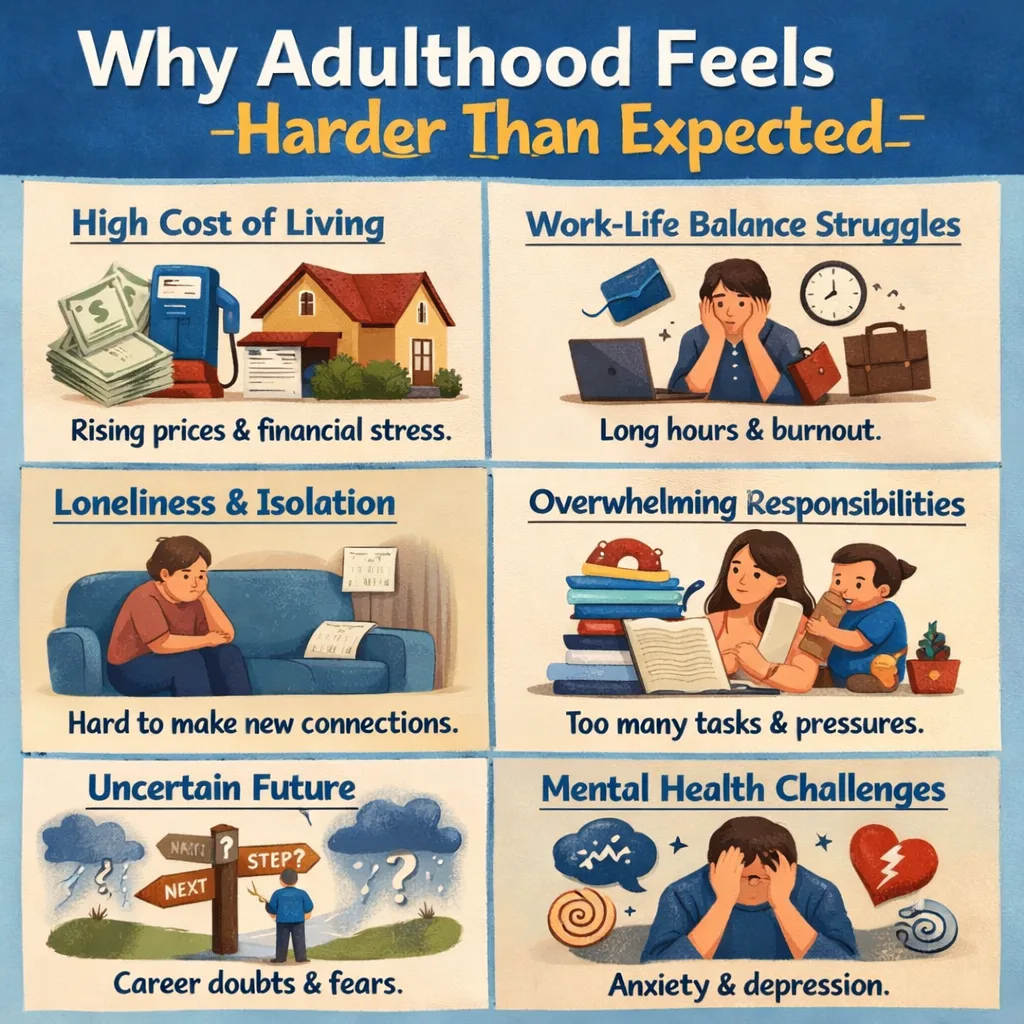
Adulthood has, in fact, always been difficult, but the difficulties of contemporary life have increased. A mentally taxing and emotionally complex version of adulthood has been produced by economic uncertainty, digital comparison, emotional isolation, and changing societal expectations.
The first step to lessening its burden is acknowledging this shared experience.
Redefining What Adulthood Means
Maybe we are using out-of-date definitions to measure adulthood, which makes it seem tougher than it should. Many people will always feel like they are failing if adulthood is defined as certainty, stability, and control. However, the experience becomes more forgiving when adulthood is viewed as flexibility, education, and emotional fortitude.
Growing up does not entail knowing everything. It entails developing the ability to live with uncertainty. It entails realizing that suffering does not equate to falling behind and feeling lost does not equate to being shattered.
✔ Adulthood is a process, not a destination
Adulthood becomes less daunting and more relatable when it is reinterpreted as a dynamic process rather than a static accomplishment.
Conclusion
Because it requires more of us than we were emotionally and psychologically ready for, it feels more difficult than we anticipated. A distinct type of fatigue is produced by the discrepancy between expectations and reality as well as financial strain, emotional loneliness, and identity stress. However, this challenge is not an indication of one's own shortcomings. It is a mirror of contemporary life.
It can be comforting to realize this. The goal of adulthood is to learn how to bear life's burdens with self-compassion rather than to master it. We allow ourselves to experience adulthood more honestly—and maybe a bit more gently—when we stop expecting it to be simple.
✔ Because mistakes have an impact on relationships, income, and health, they feel riskier.
✔ Seldom is there outside confirmation that decisions are "right."
✔ Social media highlights success but hides struggle
✔ Feeling “behind” becomes a constant emotional burden
✔ Vulnerability feels riskier with age
✔ Many adults feel lonely despite being socially active
✔ Emotional uncertainty is normal, not a flaw
✔ Asking for help is part of maturity, not the absence of it




Leave a Reply