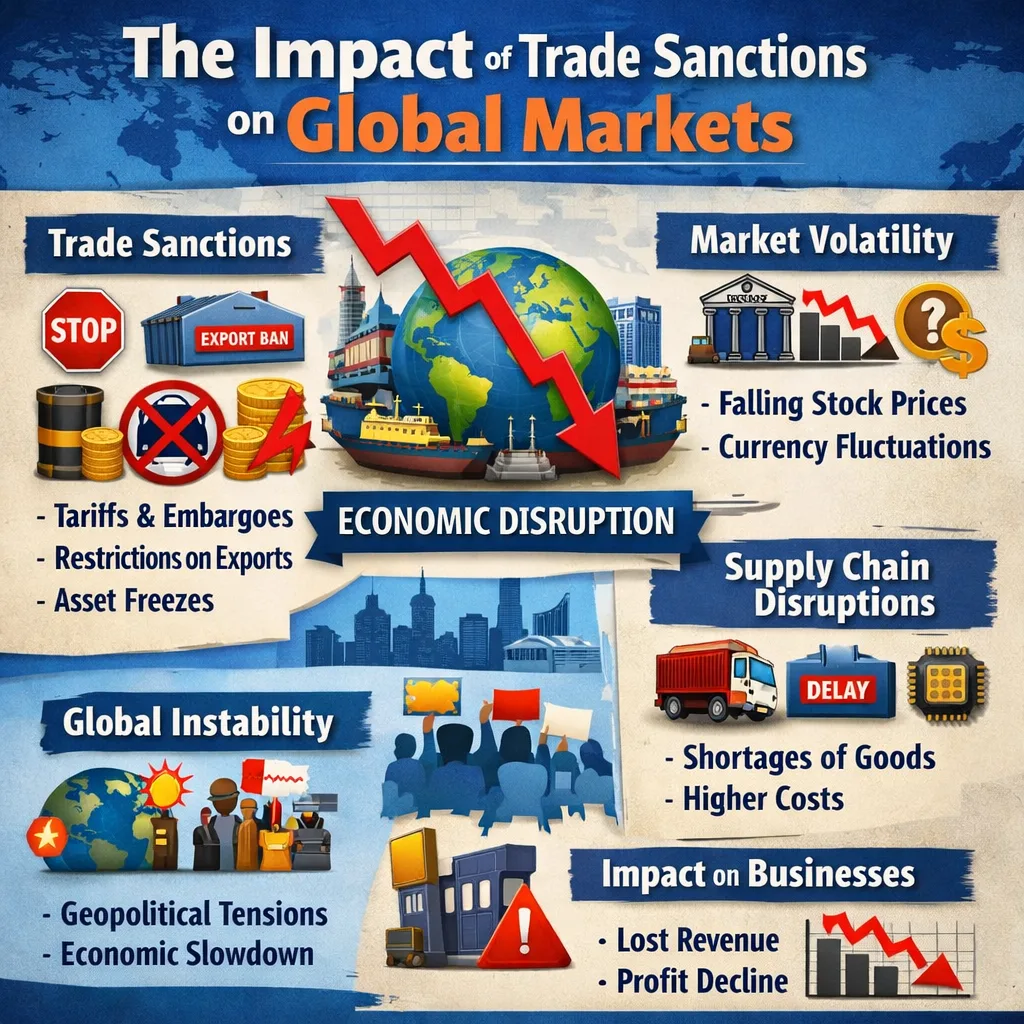
One of the most effective instruments in international diplomacy nowadays is trade sanctions. In order to influence political behavior, uphold international law, or address geopolitical issues, nations increasingly rely on economic limitations rather than direct military combat. Sanctions have far-reaching effects that transcend national boundaries, even though they are frequently directed at particular governments, businesses, or people. Trade sanctions have an impact on financial markets, supply chains, commodity prices, and investor sentiment in an integrated global economy.
Examining trade sanctions' economic mechanisms, consequences on trade flows, and long-term structural ramifications is necessary to comprehend how they affect international markets.
What Are Trade Sanctions?
Government-imposed limitations on trade with a certain nation, business, or person are known as trade sanctions. These could include restrictions on financial transactions, asset freezes, export or import prohibitions, or restrictions on access to international banking systems.
Major global actors such as the United States, the European Union, and the United Nations frequently use sanctions as policy instruments.
Sanctions can be targeted, concentrating on specific industries like energy, technology, or defense, or they can be broad, impacting entire economies. Regardless of size, because trade and finance are intertwined, their impact reaches international markets.
Immediate Market Reactions
Financial markets usually respond swiftly to the announcement of sanctions. Anticipated interruptions may cause stock indices to drop, currency values to change, and commodity prices to change.
Sanctions against large exporters of commodities, for instance, might rapidly raise the price of metals, oil, or gas because of concerns about a shortage. In particular, energy markets are extremely susceptible to changes in geopolitics.
The currency markets react as well. A sanctioned nation's currency may drastically decline if it is subject to limitations on international transactions. During uncertain times, investors frequently shift their money to safer assets.
Market volatility becomes a defining feature during sanction periods.
Disruption of Global Supply Chains
Contemporary supply chains are intricately linked across continents. Trade sanctions have the potential to disrupt these networks in unanticipated ways.
Global manufacturers may find it difficult to find substitute sources if a nation is prohibited from exporting essential raw materials or industrial components. Production in sectors like electronics and automotive manufacture may be slowed as a result.
The worldwide scarcity of semiconductors served as an example of how disruption can be amplified by concentrated supply chains. Trade restrictions that impact vital industries have an impact on the entire world.
Companies must adapt quickly by diversifying suppliers, relocating production, or absorbing higher costs.
Impact on Energy and Commodity Markets
Global commodity markets can be significantly impacted by sanctions on countries that produce energy. Exports of natural gas or oil are restricted, which lowers the supply and raises prices.
Increased production costs across industries are a result of rising energy prices, which fuel global inflation. Fuel and energy prices are on the rise for consumers, while businesses' profit margins are being squeezed.
Sanctions affecting grain shipments or fertilizer exports in agricultural markets might have an impact on food prices worldwide. Particularly at risk are emerging markets, which frequently rely significantly on imported goods.
Commodity volatility caused by sanctions can reshape global trade patterns for years.
Financial System Fragmentation
Access to international financial systems is often restricted as part of trade sanctions. For example, a nation's capacity to carry out cross-border transactions may be severely restricted if it is excluded from international payment networks.
In international finance, organizations like SWIFT are essential. Limitations on these systems cause immediate problems with liquidity and interfere with international corporate operations.
Sanctions may promote the creation of regional financial partnerships or alternative payment methods. This could eventually cause the global financial architecture to become fragmented.
Such fragmentation reduces efficiency and increases transaction costs for global trade.
Effects on Emerging Markets
Emerging markets often experience indirect consequences of sanctions even when they are not directly targeted.
During times of geopolitical unrest, investors typically lower their risk exposure, which causes capital to leave developing economies. Local currencies may decline as a result, and borrowing rates may rise.
Countries that rely on commerce with sanctioned countries may also lose money. Economic growth may be slowed by decreased imports or exports.
Emerging markets with high external debt are especially sensitive to shifts in global financial conditions.
Corporate Strategy and Multinational Companies
When sanctions are applied, multinational firms have to deal with complicated compliance obligations. If they don't comply, businesses that operate in or trade with sanctioned regions risk legal repercussions.
Because of this, businesses frequently halt operations or leave impacted markets. Significant financial losses, layoffs, and changes in international business tactics may result from this.
Geopolitical risk analysis is becoming a more important part of long-term strategy for businesses. It is now strategically important to diversify markets and supply chains.
Sanctions reshape corporate risk management frameworks.
Inflation and Consumer Impact
Sanctions can increase production costs and limit supply, which can lead to inflation. Businesses pass expenses on to customers as items become scarce or more costly to get.
Price increases lower purchasing power, which could impede economic expansion. Central banks may be forced to tighten monetary policy due to inflationary pressures, which would raise interest rates and further impact markets.
The indirect impact of sanctions often reaches households far removed from the geopolitical conflict that triggered them.
Geopolitical Realignment and Trade Diversification
Countries may look for new trading partners in reaction to sanctions. Sanctioned countries frequently deepen their economic connections with other markets that are open to continuing commerce.
This realignment has the potential to change regional alliances and global economic flows. Global trade may change when new economic blocs form throughout time.
However, such transitions take time and may not fully offset lost access to major markets.
Trade diversification is a long-term strategy rather than an immediate solution.
Long-Term Structural Changes
Long-term sanctions may promote the development of self-sufficiency in domestic industry in impacted nations. Policies that substitute imports may become more popular.
While this can stimulate certain sectors, it may also reduce efficiency and limit access to advanced technology.
Global trends toward economic decoupling, especially amongst major powers, may be accelerated by the continued application of sanctions.
A fragmented global economy could mean higher production costs, slower innovation diffusion, and reduced overall growth.
The Role of International Institutions
Promoting free trade and resolving disputes are the goals of organizations such as the World Trade Organization. However, because of their political nature, penalties frequently function outside of established trade dispute procedures.
The tension between economic integration and geopolitical rivalry poses challenges for international governance.
When regulations are predictable, international markets operate most effectively. Investment decisions become more difficult when there are frequent or extensive sanctions.
Conclusion
Although trade sanctions are effective tools for foreign policy, their effects on the economy go much beyond their intended objectives. Commodity prices, supply chains, financial stability, and investor confidence are all impacted by trade and financial limitations in a highly integrated global economy.
Sanctions may accomplish political goals, but they can exacerbate inflation, volatility, and structural changes in international trade patterns. Multinational firms and emerging markets must adjust to these changes, frequently at great expense.
The complicated interplay between geopolitics and economics is reflected in the increasing dependence on trade sanctions. Markets will continue to react to both economic fundamentals and political strategic choices as tensions across the world change.




Leave a Reply