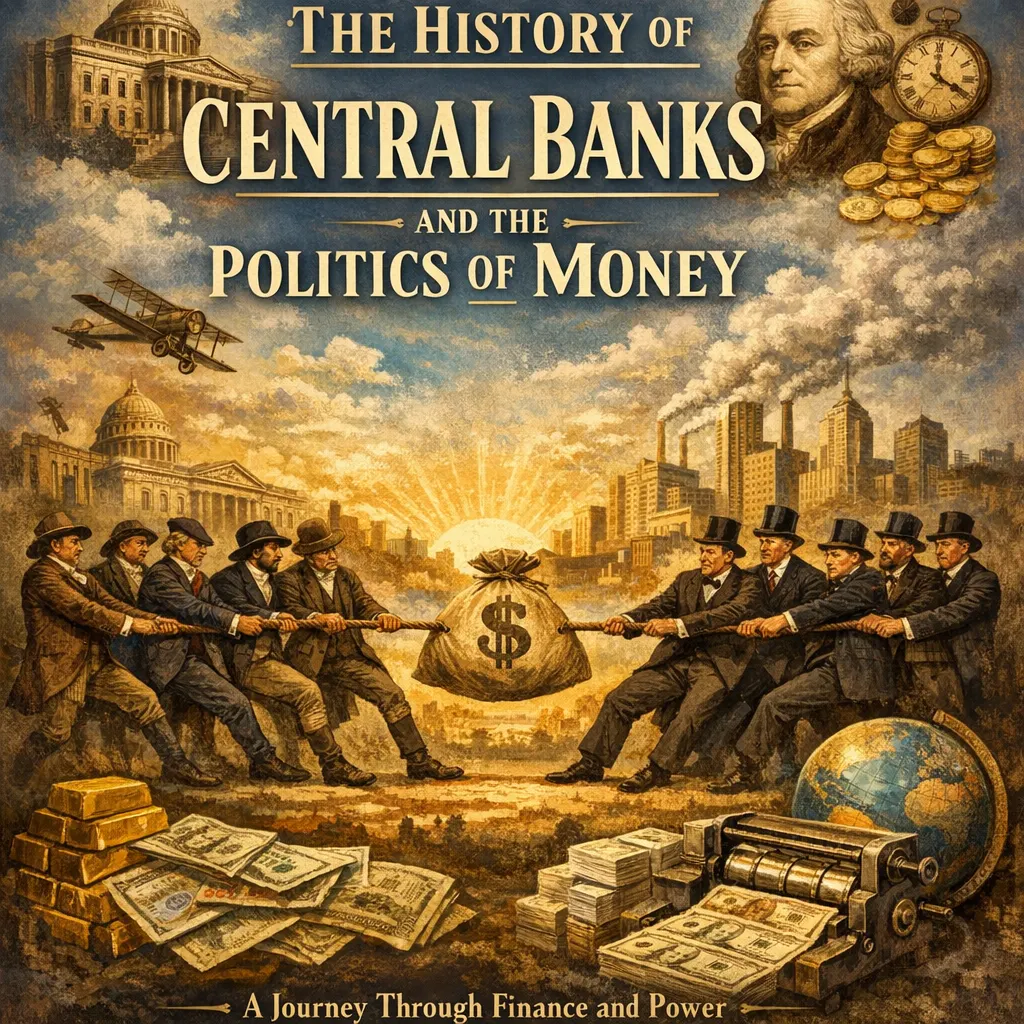
There has always been more to money than just a means of transaction. It serves as a basis of political authority, an instrument of power, and a symbol of confidence. The central bank is the organization in charge of overseeing the management of all contemporary currencies. The history of central banks is intricately linked to the politics of money, showing how society, markets, and governments bargain for control over national sovereignty and economic stability.
These days, central banks supervise monetary policy, control financial institutions, control inflation, and frequently serve as lenders of last resort. However, they had more than just economic roots. They arose from disputes about who should be in charge of a country's resources, political conflicts, wars, and financial crises.
The Early Origins of Central Banking
The concept of a centralized financial management system did not emerge overnight. In order to finance wars or public projects, early civilizations' rulers frequently reduced the amount of metal in their coins. This currency manipulation demonstrates how money has always had political ramifications.
The earliest known central bank dates back to the late 17th century, when governments were looking for dependable ways to control public debt and fund military operations. One significant event was the founding of the Bank of England in 1694. It established a systematic method for issuing notes backed by government credit and was designed to finance military activities.
Unlike private banks, this institution served national interests. It marked the beginning of a shift from decentralized money systems toward centralized monetary authority.
Soon after, other European countries established banks to control public finances and stable currencies. From lenders to governments to regulators of whole financial systems, these organizations have changed over time.
Money, War, and Political Power
Central banks have generally developed more quickly during times of war. Large sums of money are needed by governments to fund wars, and central banks offer tools for issuing debt and managing the availability of currency.
Throughout the 18th and 19th centuries, countries came to understand that having stable banking systems enhanced their military prowess. Monetary policy evolved into a tool for strategy.
Key political dimensions of early central banking included:
✔ Financing government debt
✔ Managing wartime inflation
✔ Stabilizing currency value
✔ Building international financial credibility
Central banks thus became guardians of national economic strength. Their credibility influenced international trade and diplomatic relations.
The Gold Standard and Monetary Discipline
The gold standard, which directly tied currency value to gold reserves, was adopted by numerous nations in the 19th century. Central banks were essential to the upkeep of this system.
Under the gold standard, money supply was constrained by gold availability. This limited governments’ ability to print money freely, imposing fiscal discipline.
International trade was stabilized by this framework, but political flexibility was also limited. It was difficult for governments to increase spending during recessions without running the risk of depleting their gold reserves.
The tension between monetary discipline and political needs became increasingly visible during global crises.
The Birth of Modern Central Banking
The early 20th century marked a turning point. Financial panics and banking collapses revealed weaknesses in decentralized systems.
The Federal Reserve System was established in the United States in 1913 as a result of numerous crises. The Federal Reserve established procedures to control liquidity and oversee banks in order to provide financial stability.
In a similar vein, several nations fortified their central banks. Central banks began actively regulating economic cycles instead of just creating currency over time.
Additional constraints were revealed during the 1930s Great Depression. The focus of economic recovery initiatives shifted to monetary policy. Governments came to understand that interest rates and the money supply had a direct impact on GDP and employment.
This era solidified central banks as powerful economic actors.
Independence vs Political Control
The independence debate is one of the most important in the history of central banking. Should central banks continue to be directly answerable to elected governments or function independently of politics?
Proponents of independence contend that, particularly before to elections, political pressure might result in careless money creation. Independent central banks are thought to be in a better position to keep inflation under control and preserve stability over the long run.
Monetary policy, according to critics, has an impact on public welfare, wages, and employment. Thus, monitoring should continue to be exercised by elected officials.
The politics of money continue to revolve around this conflict. Central banks are subject to political scrutiny notwithstanding their legal independence in many nations.
The balance between autonomy and accountability defines modern monetary governance.
The End of the Gold Standard and Fiat Currency
Another shift occurred in the middle of the 20th century. Global monetary systems were restructured following World War II using the Bretton Woods framework, which anchored currencies to the US dollar, which was backed by gold.
But the system fell apart by the early 1970s. The US ended the dollar's ability to be exchanged for gold, signaling the shift to fiat money, which is backed by government faith rather than tangible goods.
This shift expanded central banks’ power. Without gold constraints, they could adjust money supply more flexibly.
Fiat currency systems rely heavily on credibility. If citizens and markets lose confidence, inflation or currency depreciation may follow.
Central banks therefore operate not only as financial managers but as guardians of public trust.
Inflation, Crisis, and Quantitative Easing
New difficulties emerged in the late 20th and early 21st centuries. The 1970s inflation compelled central banks to implement more stringent monetary policies, frequently resulting in significant interest rate increases to maintain price stability.
Central banks were later put to the test once more during the 2008 global financial crisis. Unconventional policies like quantitative easing were employed by organizations like the Federal Reserve and the European Central Bank.
These measures involved large-scale asset purchases to inject liquidity into financial systems. While controversial, they prevented deeper economic collapse.
Central banks expanded their influence significantly during this period, shaping recovery trajectories worldwide.
Politics in the Modern Monetary Era
Central banks now operate at the nexus of politics and economics. They have to oversee currency stability, respond to global financial shocks, and strike a balance between economic growth and inflation management.
Political debates often intensify during economic hardship. Interest rate decisions affect mortgage payments, business investment, and consumer spending.
Central banking decisions influence:
✔ Inflation and purchasing power
✔ Employment levels
✔ National debt sustainability
✔ Exchange rates and trade balances
As a result, central bank leaders frequently face public scrutiny and political commentary.
Another layer is added by new debates about central bank digital currencies (CBDCs). Central bank-issued digital currencies have the potential to transform financial institutions and change how people interact with money.
Globalization and Monetary Cooperation
Globalization has increased interdependence among central banks. Economic shocks in one country can ripple across borders.
Institutions collaborate through international frameworks, sharing information and coordinating responses to crises.
But geopolitical conflicts might make collaboration more difficult. Trade conflicts, currency wars, and sanctions show that money is still quite political.
The global monetary system reflects both collaboration and competition.
The Future of Central Banking
In the future, central banks will have to deal with many difficult issues. Monetary policy is impacted by factors such as rising debt levels, digital currencies, climate change, and geopolitical fragmentation.
Financial infrastructure could be redefined by technological innovation. Payment methods and risk management may be revolutionized by blockchain technology and artificial intelligence.
Yet the fundamental question remains unchanged: who controls money, and for whose benefit?
Central banks must navigate economic stability while maintaining democratic legitimacy.
Conclusion
The history of central banks reveals that money is never neutral. It reflects political priorities, national interests, and societal values.
Central banks have developed into significant players influencing economic fate, from the founding of early organizations like the Bank of England to contemporary monetary interventions during international crises.
They play a very political role in addition to a technical one. Every choice regarding interest rates, liquidity, or currency change affects both governments and citizens




Leave a Reply