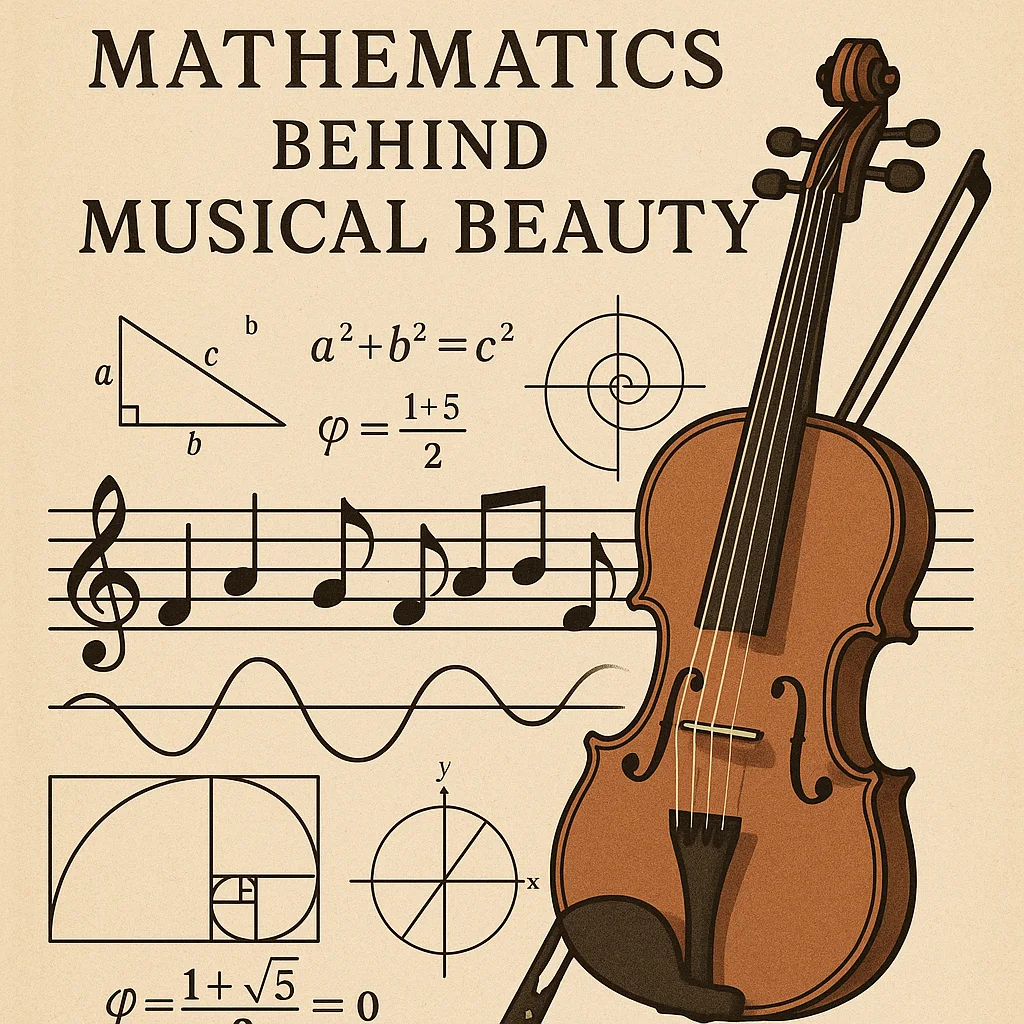
It may appear that mathematics and music are two distinct realms; one is logical and exact, while the other is expressive and emotional. Philosophers, scientists, and musicians have, however, noted the close relationship between the two throughout history. Every lovely melody, harmonic chord, and rhythmic beat has a mathematical underpinning that influences our perception of sound.
We'll examine the hidden mathematics of musical beauty in this blog, demonstrating how harmony, rhythm, and structure are created through numbers and ratios in ways that appeal to the human mind.
1. The Ancient Origins of Music and Math
Pythagoras and other ancient Greeks discovered that simple numerical ratios resulted in harmonious sounds, which is how music and mathematics first became connected. He discovered that by plucking strings of varying lengths, specific ratios, such as 2:1 or 3:2, produced aesthetically pleasing intervals (the fifth and the octave).
The notion of the harmonic series, the natural phenomenon that explains why particular notes sound good together, was founded on this idea. Pythagoras and his adherents even held that music, a "music of the spheres," represented the order of the universe.
2. Ratios and Harmony
In music, harmony is basically about how different frequencies relate to one another. Our ears interpret two notes as beautiful or consonant when their vibrations are simple multiples of one another.
-
Octave (2:1 ratio): It feels like the "same" note, only higher, when played at twice the frequency of another note.
-
Perfect Fifth (3:2 ratio): The foundation of innumerable scales, this interval is among the most stable and aesthetically pleasing.
-
Perfect Fourth (4:3 ratio): Although it feels stable, this simple ratio is a little more tense than the fifth.
The reason why some chords sound dissonant and others harmonious can be explained by these basic fractions. A mathematical alignment lies at the heart of harmony's beauty.
3. The Geometry of Rhythm
Another aspect of music that is closely related to math is rhythm. Patterns and subdivisions are essential to beats, measures, and time signatures. Music in a 4/4 time signature, for instance, is divided into four equal beats, whereas a 3/4 waltz is divided into threes.
Mathematical ratios can be used to describe complex rhythms, including polyrhythms, which are two distinct rhythms played simultaneously. The same numbers that define harmonious pitches are used to create a 3:2 ratio, which is produced when a drummer plays three beats against another's two. Similar to harmony, rhythm uses numbers to strike a balance between conflict and resolution.
4. Fibonacci, the Golden Ratio, and Musical Beauty
The Fibonacci sequence (1, 1, 2, 3, 5, 8, 13…) and its associated golden ratio (1.618…) appear throughout nature, art, and architecture—and music is no exception.
Composers such as Béla Bartók and Claude Debussy structured pieces around Fibonacci numbers, placing climaxes or transitions at golden ratio points. Even in modern pop, researchers have found subtle alignments to these proportions.
Why? Whether in the flow of a musical composition or visual art, the golden ratio is inherently aesthetically pleasing to humans. It strikes a balance between surprise and predictability.
5. Symmetry and Patterns in Music
Symmetry is essential to both music and mathematics. Inversions, recurring themes, and mirrored structures are common in many pieces.
Johann Sebastian Bach, for example, was well-known for his application of mathematical structures. Even though the melodies in his fugues repeat and change according to exact logic, the end effect is intensely emotional. The smooth blending of expression and structure is what makes it beautiful.
6. Fourier Analysis: Breaking Down Sound
The physical workings of music can be understood with the aid of modern mathematics. Any sound can be decomposed into a sum of sine waves, or simple vibrations, according to Fourier analysis.
A violin note is more than just a single frequency; it is made up of numerous harmonics that are all mathematically related to the fundamental pitch. The distinctive timbre of the instrument is shaped by the harmony of these harmonics. Even when playing the same note, a piano and a trumpet have different sounds, which can be explained by the mathematics of waves.
7. Probability, Patterns, and Musical Surprise
Predictability and originality are balanced in great music. A piece feels chaotic if it is too random, and dull if it is too predictable. How improvisers and composers achieve this balance is explained by mathematics, particularly probability theory.
For instance, jazz performers frequently work within scales but add surprising notes or rhythms that eventually return to well-known patterns. This mathematical tension and release is rewarding to the brain, much like solving a puzzle.
8. Fractals in Music
Music also contains fractals, which are self-repeating patterns that occur in nature. A motif may recur within a measure, then throughout a section, and finally throughout the entire composition in some compositions that mirror structures on several levels.
Because of the coherence created by this fractal quality, listeners are able to identify themes without realizing it. As a result, the music has a sense of unity and complexity.
9. Music and the Brain: A Mathematical Connection
It's possible that music is mathematically processed by the brain itself. According to studies, our brains essentially sync with the beat of music when neural activity corresponds with rhythmic patterns. We naturally nod or tap our feet in time, which is explained by this synchronization.
Furthermore, when the brain recognizes patterns and predictions in music that are fulfilled, it rewards us with dopamine. Put another way, our brain's affinity for math may be the source of our love of music.
10. Modern Applications: From AI to Sound Design
Music's mathematical nature influences contemporary innovation in addition to theory. Algorithms analyze styles, create harmonies, and compose music using mathematical models. Math enables accurate control of frequencies, rhythms, and effects in sound design.
Even streaming services use mathematical models to make song recommendations, estimating our tastes based on our listening habits. The art and technology surrounding music are shaped by the hidden math of music.
Conclusion: Beauty in Numbers
The next time a song moves you, keep in mind that structure is hidden beneath the emotion. Mathematics gives us the blueprint for what we consider beautiful, while ratios produce harmony and patterns create rhythm.
But it's not just the math that makes music magical; it's also how those numbers speak to people's emotions. It's possible that ancient philosophers were correct when they said that music is the sound of mathematics come to life.




Leave a Reply