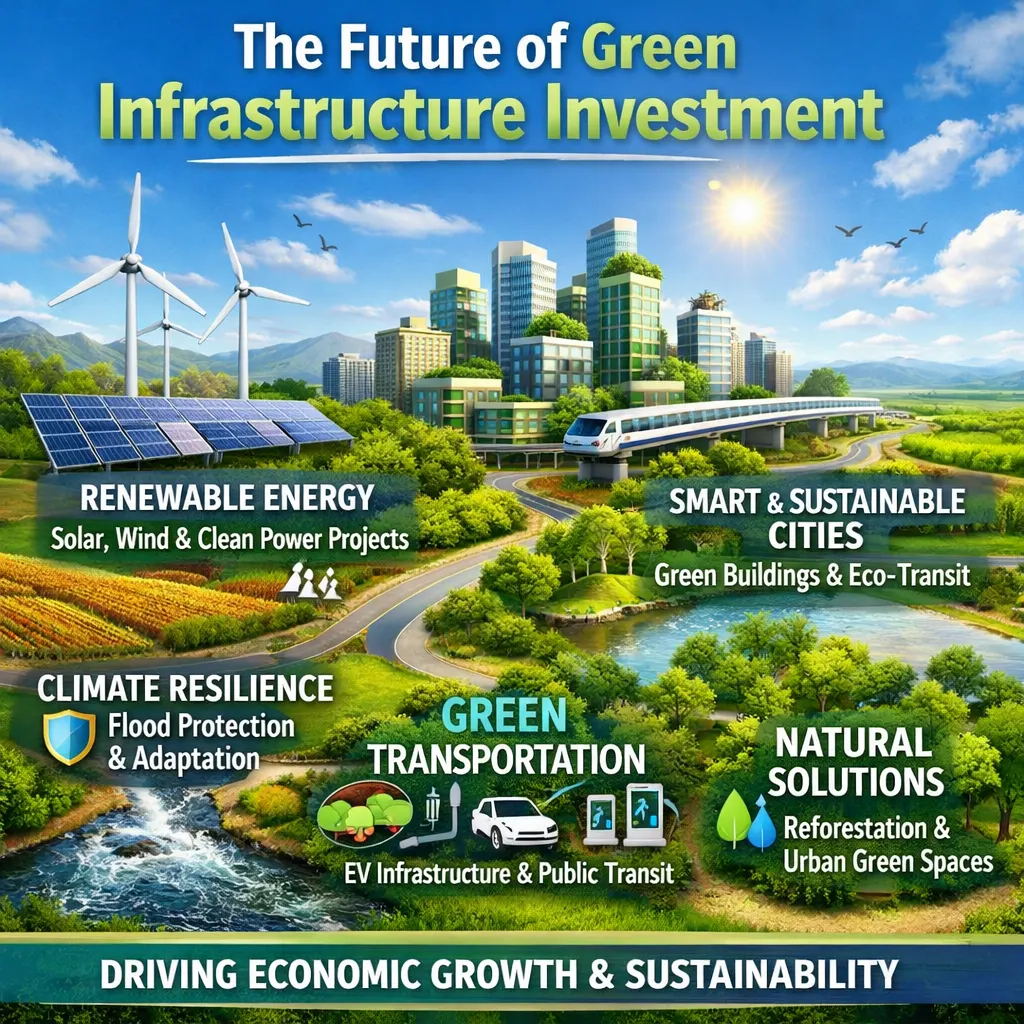
The world economy is changing fundamentally as environmental constraints increase and climatic change quickens. Sustainability is shifting from the periphery to the core of economic planning as governments, businesses, and financial institutions reconsider how money is distributed. Green infrastructure investment, or the intentional funding of initiatives intended to lessen environmental impact, increase resilience, and promote long-term economic growth, is at the core of this shift.
Installing solar panels and planting trees are only two examples of green infrastructure. Water management technologies, energy-efficient structures, climate-resilient urban design, renewable energy systems, sustainable transportation networks, and ecosystem restoration are all included. Green infrastructure is emerging as a key component of future development plans as the globe deals with resource constraint, extreme weather, and rising temperatures.
Investing in green infrastructure in the future involves more than just environmental responsibility. It is among the biggest economic prospects of the twenty-first century.
Understanding Green Infrastructure
The term "green infrastructure" describes systems and initiatives that promote economic activity while also benefiting the environment. Green systems place more emphasis on sustainability, efficiency, and resilience than traditional infrastructure, which frequently depends on fossil fuels and resource-intensive procedures.
Solar and wind farms, electric vehicle charging stations, environmentally friendly public transit, flood control systems, smart water grids, and air-improving urban green spaces are a few examples.
Both financial and environmental gains are produced by these investments. Long-term cost savings and economic stability result from lower emissions, better public health, and climatic resilience.
As sustainability becomes embedded in policy frameworks, green infrastructure is evolving from an optional initiative to a strategic necessity.
The Economic Drivers Behind Green Investment
Several powerful forces are accelerating green infrastructure investment globally.
The first is that financial decision-making is changing due to climate risk. Every year, extreme weather events interrupt supply chains, destroy property, and raise insurance rates, resulting in billions of dollars' worth of losses. Putting money into climate-resilient infrastructure lowers long-term financial losses.
Second, governments are implementing regulatory incentives and carbon reduction targets. Both the public and corporate sectors are encouraged to give green initiatives top priority by policies like carbon pricing, renewable energy subsidies, and sustainability reporting requirements.
Third, there is a sharp increase in investor demand for sustainable assets. Capital is being allocated to projects that are in line with environmental, social, and governance (ESG) principles by institutional investors, pension funds, and sovereign wealth funds.
Key investment motivations include:
✔ Reducing long-term climate-related financial risks
✔ Meeting national and international sustainability commitments
✔ Accessing green bonds and sustainable finance markets
✔ Strengthening energy independence and security
Together, these drivers are transforming capital markets.
Renewable Energy as a Core Investment Area
The cornerstone of green infrastructure continues to be renewable energy. Record amounts of investment are being allocated to solar, wind, hydro, and developing technologies like green hydrogen.
Renewables and fossil fuels are now more competitive due to declining technology costs. Wind and solar energy are currently the most economical energy sources in many areas. The reliability and scalability of renewable energy systems increase with advancements in battery storage.
Energy transition initiatives also encourage the creation of jobs in maintenance, engineering, and manufacturing. The transition to renewable energy is both strategically advantageous for the economy and the environment.
As nations aim for net-zero emissions, renewable infrastructure will remain a dominant investment priority.
Sustainable Urban Development
Cities are under pressure to grow responsibly as urbanization continues at a fast rate. Future urban settings are significantly shaped by investments in green infrastructure.
Energy-efficient buildings, smart grids, environmentally friendly public transit, and urban green corridors are examples of projects that improve livability while lessening their negative effects on the environment.
Sustainable cities offer multiple economic advantages:
✔ Lower energy consumption and operational costs
✔ Improved air quality and public health
✔ Enhanced property values
✔ Increased attractiveness for businesses and investors
Cities that prioritize green infrastructure position themselves as leaders in innovation and quality of life.
Green Finance and Innovative Funding Models
Rapid change is occurring in the finance environment for green infrastructure. Billions of dollars are being invested in projects with an environmental focus through green bonds, sustainability-linked loans, and climate funds.
Public-private collaborations are growing as well. Governments supply some finance and regulatory frameworks, while private investors contribute money and technological know-how.
Blended finance models, combining public funds with private investment, reduce risk and encourage participation in large-scale projects.
Financial innovation is critical for scaling green infrastructure globally. Transparent reporting and measurable impact metrics strengthen investor confidence and accountability.
Climate Resilience and Adaptation
Mitigation aims to lower emissions, whereas adaptation deals with the effects of climate change that are already being felt. Coastal protection, drought-resistant water systems, flood barriers, and wildfire control are all becoming top issues.
Infrastructure for climate adaption lowers economic vulnerability. Governments ensure long-term development and productivity by shielding industry and communities from harsh weather.
Resilience-focused projects often deliver immediate local benefits while supporting broader environmental goals.
In the future, resilience spending may rival mitigation investment in importance.
Technology and Digital Integration
The performance of green infrastructure is being improved via digital technology. Smart grids minimize waste by optimizing energy delivery. Artificial intelligence forecasts maintenance requirements and keeps an eye on environmental conditions. Waste and water management systems are enhanced by data analytics.
Efficiency and return on investment are increased by technological integration. Transparency is further enhanced by digital monitoring, which enables investors to precisely track environmental impact.
The convergence of green and digital infrastructure represents a powerful economic force. It accelerates innovation while maximizing sustainability outcomes.
Challenges and Risk Factors
Despite strong momentum, green infrastructure investment faces obstacles. High upfront costs, regulatory uncertainty, and political changes can delay projects.
In developing economies, limited access to capital and technical expertise may hinder implementation. Additionally, global supply chain disruptions can increase construction costs.
Long-term economic advantages, however, frequently exceed immediate difficulties. For long-term growth, stable policy frameworks, international collaboration, and strategic planning are necessary.
As climate urgency increases, delaying investment may prove more costly than proactive action.
The Role of Global Cooperation
Coordinated measures are needed to address the global issue of climate change. Green infrastructure implementation in underdeveloped countries is aided by international agreements and climate funds.
Cross-border cooperation speeds up financial assistance and technology transfer. Global organizations and multilateral development banks are essential for resource mobilization.
Shared environmental challenges are fostering unprecedented levels of cooperation in infrastructure planning and investment.
Long-Term Economic Transformation
The future of green infrastructure investment extends beyond individual projects. It signals a structural transformation of the global economy.
Sustainability measures are becoming more and more aligned with capital markets. Businesses are incorporating environmental goals into their business plans. Greener goods and services are being demanded by customers.
Over time, green infrastructure will shape energy systems, transportation networks, industrial production, and urban design. It will redefine economic competitiveness and national resilience.
Countries that lead in sustainable infrastructure development are likely to dominate emerging clean technology industries.
Conclusion
Green infrastructure investment has a vibrant, inventive, and economically revolutionary future. Global capital flows are changing as a result of investor demand, legislative changes, technology advancements, and climate risk.
Green infrastructure offers a pathway to economic growth that aligns with environmental responsibility. It strengthens resilience, creates jobs, enhances energy security, and improves quality of life.
Investing in sustainable systems will become both financially and morally necessary as environmental issues worsen. The countries and organizations that adopt this change now will influence the future of the economy.




Leave a Reply