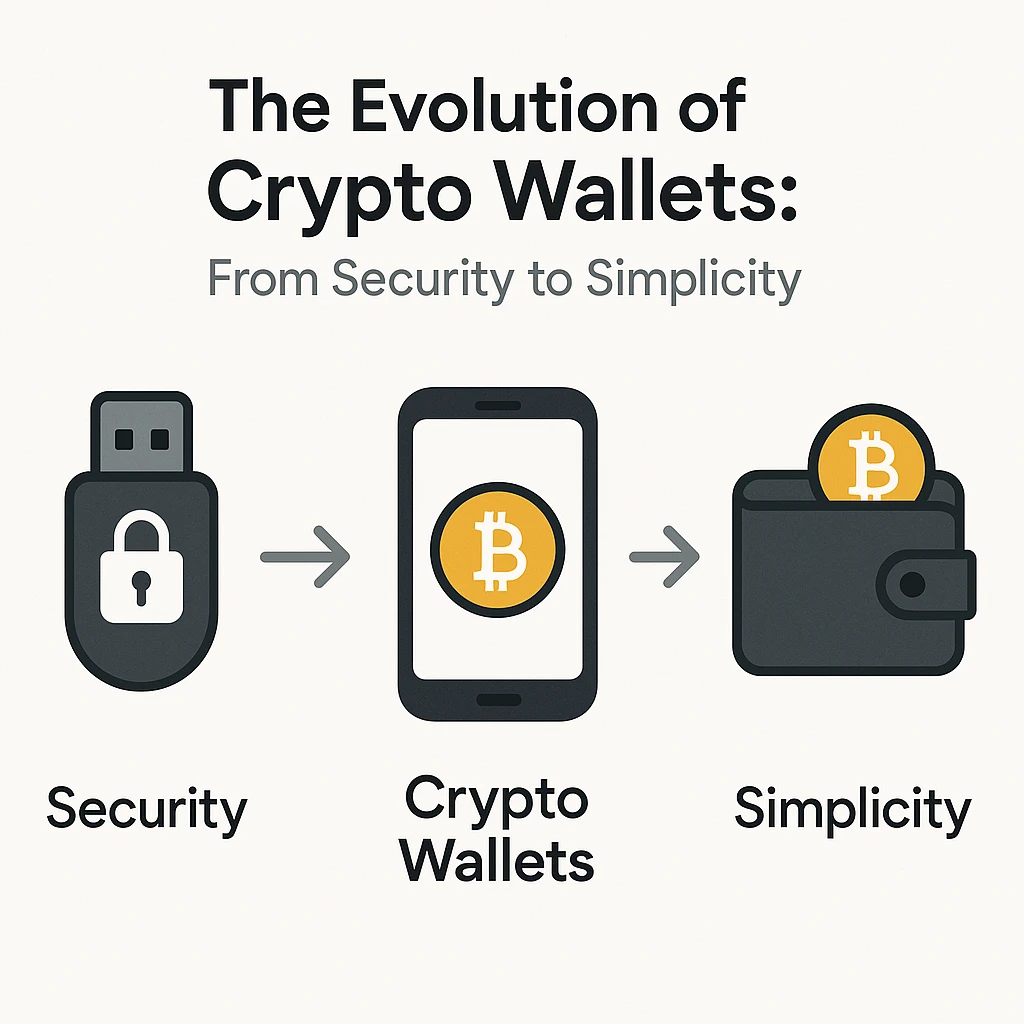
Introduction: The Gateway to the Blockchain World
Most people start their bitcoin journey by downloading a wallet rather than purchasing Bitcoin or learning about blockchain.
The secret to joining the digital economy is a cryptocurrency wallet. They act as your own portal to Web3, store your assets, and link you to decentralized apps. However, their tale is one of remarkable evolution: from arcane software created by programmers for programmers to slick, mobile-first experiences intended for the general public.
Crypto wallets have evolved over the last ten years from strictly technical security-focused solutions to user-focused ecosystems that prioritize ease of use, accessibility, and integration.
The development of cryptocurrency wallets is similar to that of cryptocurrency itself in many aspects, ranging from specialized technology to widespread adoption.
This blog examines that journey, including the development of cryptocurrency wallets, the difficulties they have faced, and their future prospects.
1. The Birth of the Crypto Wallet: Security Above All
When Bitcoin launched in 2009, wallets weren’t apps — they were pieces of code.
The Bitcoin Core software had to be compiled, cryptographic keys had to be generated, and wallet.dat files had to be manually maintained by early adopters. Everything would be permanently lost if you lost your PC or forgot your backup.
The original principles of Bitcoin—security and self-governance—were mirrored in these early wallets. No customer service, no third parties, and no password resets were present. Your money was your private key; if you lost it, it would be lost forever.
Even tech-savvy individuals found the experience daunting. However, the purity of decentralized ownership was hidden in that complexity.
Security wasn’t just a feature — it was the philosophy.
2. From Code to GUI: The Rise of Usable Crypto Wallets
As Bitcoin gained traction, developers realized that adoption required usability.
One of the first graphical wallet management interfaces was released by Electrum in 2011, enabling users to create and restore wallets without using command lines. Soon after, wallets with user interfaces, such as Multibit and Armory, made cryptocurrency a little more accessible.
These were still desktop wallets, though, which were limited to a single device and frequently perplexing to non-technical users.
Mobile wallets, which enable users store and send cryptocurrency via cellphones, were the next big advancement. Apps like Blockchain.info and Mycelium have assisted in bridging the gap between regular customers and ardent cryptocurrency enthusiasts.
For the first time, people could carry their digital wealth in their pocket — literally.
Still, one challenge remained: how to balance convenience with control.
3. The Hardware Revolution: Cold Storage and Maximum Security
The stakes increased along with the price of cryptocurrencies. The risks associated with online wallets were revealed via exchange breaches, phishing scams, and hacking.
The solution? Keep your keys offline.
The first hardware wallets—devices that safely kept private keys away from the internet—were introduced by Ledger and Trezor in 2014. These tiny, USB-like devices rose to prominence in the field of cryptocurrency security.
Users might sign transactions offline with hardware wallets, thwarting remote attacks. Your cryptocurrency was secure even if your PC was compromised.
This was the age of cold storage — where security once again took center stage.
Hardware wallets were not flawless, though. They were daunting for novices and difficult for regular transactions. The UI frequently resembled router configuration rather than money management.
The lesson became clear: security was essential, but simplicity was the future.
4. Enter the Multichain Era: One Wallet for Everything
The cryptocurrency scene broke up as Ethereum and other blockchains appeared. Users now have access to DeFi platforms, Ether, ERC-20 tokens, and NFTs in addition to Bitcoin.
Managing multiple wallets and chains became overwhelming.
In 2016, MetaMask changed everything.
A browser plugin wallet that served as a conduit between users and decentralized applications (dApps) was introduced by MetaMask. For the first time, you could:
-
Store ETH and tokens.
-
Interact directly with DeFi protocols.
-
Connect to decentralized exchanges and games.
This breakthrough made Web3 available to millions of people and made MetaMask a well-known cryptocurrency brand.
However, it also brought up new issues: How can security be upheld in a society where connectedness is essential?
5. The UX Revolution: Making Crypto Human-Friendly
Crypto wallets were initially created by developers for developers. However, design and user experience (UX) became crucial as mainstream acceptance increased.
Simple onboarding, mobile connectivity, and straightforward design were key features of new wallets like Trust Wallet, Rainbow, and Phantom.
Features like:
-
QR scanning for payments
-
Biometric authentication
-
Seed phrase backups with cloud encryption
-
Portfolio tracking dashboards
…transformed wallets into consumer apps, not just crypto vaults.
Hardware wallets also changed: Trezor Suite and Ledger Live introduced smooth DeFi protocol communication and sophisticated user interfaces.
"How do I protect my coins?" was no longer the main topic of discussion. to "How can I use them safely and easily?"
Because a confused user is a vulnerable user, simplicity has emerged as the new frontier of security.
6. Custodial vs. Non-Custodial: The Battle for Control
Every crypto wallet must answer one fundamental question:
Who controls the keys?
-
Convenient but centralized, custodial wallets (such as those offered by exchanges like Binance or Coinbase) handle your private keys on your behalf.
-
You have complete control with non-custodial wallets like Ledger or MetaMask, which is empowering yet dangerous if you lose access.
For years, the crypto community debated this trade-off.
But now, a new middle ground is emerging: smart contract wallets and social recovery systems.
The need to commit seed words to memory is eliminated by platforms like Argent, Safe (previously Gnosis Safe), and ZenGo, which enable users to regain access via trusted contacts or devices.
This development is indicative of a developing cryptocurrency ecosystem that recognizes that human error is its greatest weakness.
7. Web3 Wallets: Beyond Storage
In the Web3 era, wallets are no longer just for storing assets. They’re digital identities.
A Web3 wallet can:
-
Log you into decentralized platforms
-
Verify your identity without revealing personal data
-
Store NFTs, tickets, and memberships
-
Manage decentralized governance (DAOs)
In this sense, wallets are becoming passports to the decentralized internet.
Your wallet address isn’t just an account — it’s your on-chain reputation.
As the metaverse expands, your wallet may come to symbolize your whole digital identity, including all of your assets, accomplishments, credentials, and past, all of which are linked to a single cryptographic identity.
8. The Shift Toward Simplicity: Abstracting Complexity
The next major leap in wallet evolution is happening quietly — through account abstraction.
Gas costs and private keys must be manually managed by users of traditional wallets. This is made easier by account abstraction, which lets smart contracts handle wallet functionality.
With account abstraction, wallets can offer:
-
Passwordless logins
-
Automatic fee payments (in any token)
-
Batch transactions
-
Multi-signature security without complexity
This change is being led by wallets like Safe, Argent, and Coinbase Smart Wallet. The objective? to maintain decentralization while making cryptocurrency feel as easy to use as any conventional program.
The complexity of the blockchain is essentially hidden by the upcoming generation of wallets, making cryptocurrency accessible yet undetectable.
9. The Future: Wallets as AI-Powered Financial Companions
Looking ahead, the future of crypto wallets will be defined by intelligence and interoperability.
Imagine a wallet that doesn’t just hold assets but helps you manage them — powered by AI.
-
It could suggest optimal staking opportunities.
-
Warn you about suspicious transactions.
-
Diversify your portfolio automatically.
-
Manage gas fees efficiently across networks.
Additionally, wallets will probably incorporate cross-chain functionality, enabling users to transfer assets between blockchains without encountering any technological difficulties.
Wallets will become universal financial dashboards that handle anything from digital currencies to tokenized equities, NFTs, and physical assets as cryptocurrency and traditional finance (TradFi) converge.
The line between “crypto wallet” and “digital bank” will fade.
10. Balancing the Triangle: Security, Simplicity, and Sovereignty
The evolution of crypto wallets can be summed up as a constant struggle to balance three forces:
-
Security – Protecting assets from loss or theft.
-
Simplicity – Making the experience intuitive and accessible.
-
Sovereignty – Ensuring users maintain true ownership.
Initially, wallets put security ahead of usefulness. Then simplicity emerged, spurring widespread acceptance. Achieving both without compromising is now the difficult part.
The ideal wallet of the future will be:
-
Self-custodial but easy to recover
-
Secure yet invisible in operation
-
Decentralized but deeply user-centric
When that balance is achieved, crypto will no longer feel like “technology.” It will simply feel like life.
Conclusion: From Vaults to Portals
The story of crypto wallets isn’t just about technology — it’s about trust and evolution.
The voyage shows how far cryptocurrency has progressed in its quest for widespread adoption, from the early days of command-line wallets to slick smartphone apps and AI-assisted smart wallets.
In the end, wallets are more than storage tools — they’re portals to financial freedom.
Wallets will become the most intimate aspect of our digital lives as the blockchain industry grows into new domains like identification, governance, and digital ownership.
They’ll be not just where we keep our crypto, but where we live our digital lives.
The transition from security to simplicity is an attitude rather than a destination.
Because those who create the most secure tools won't own the future of cryptocurrency; rather, it will belong to those who make security accessible to all.




Leave a Reply