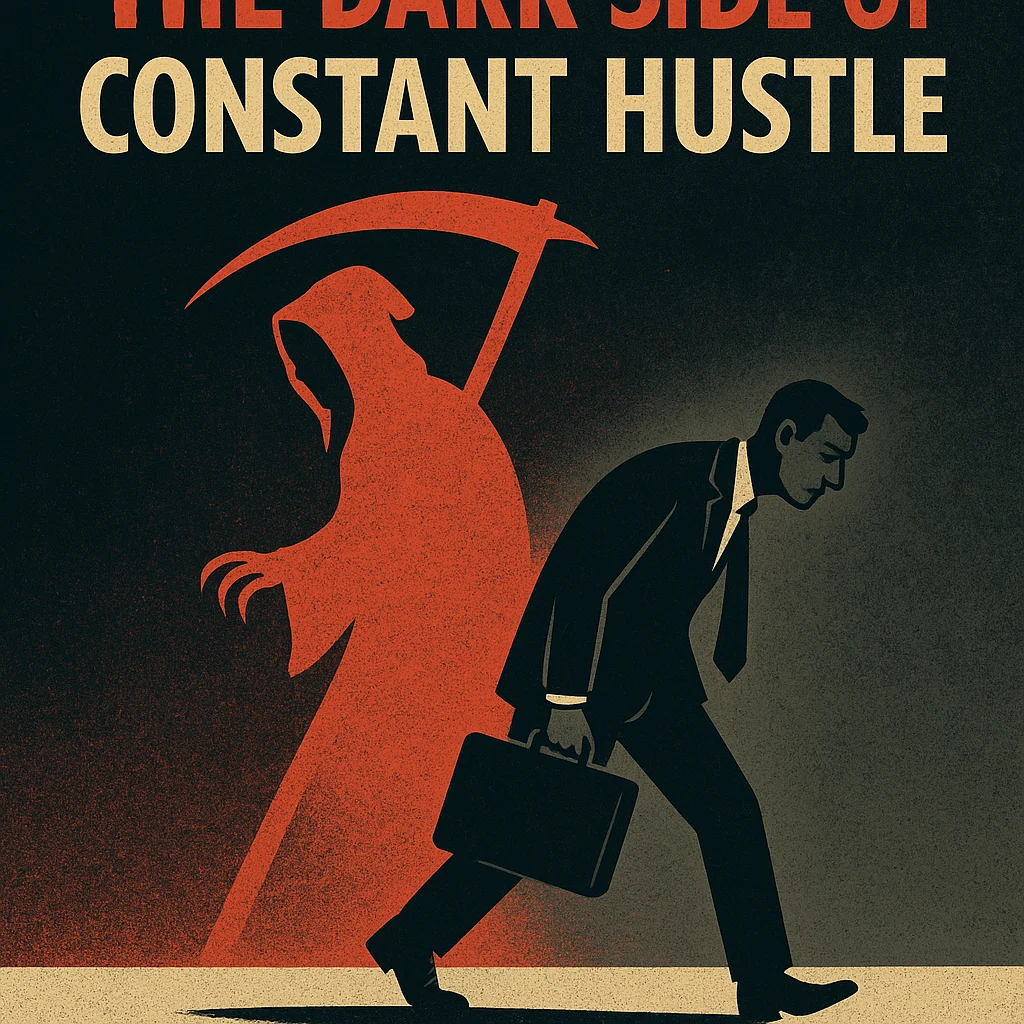
The hustle has become a religion in our day and age. People wear the motto "sleep when you're dead" as a badge of honor. We look up to people who get up early, work through fatigue, and forgo sleep in order to achieve their goals.
Social media, podcasts, and inspirational posters all spread the same message: If you're not working hard, you're lagging behind.
However, there is a darker reality hidden beneath the glossy exterior of "grind culture." Not only does the never-ending hustle sap your vitality, but it also subtly undermines your creativity, sense of purpose, and general well-being.
The irony? The relentless pursuit of success often destroys the very success it’s supposed to create.
Let's dissect hustle culture and examine why doing less, not more, may be the best course of action for your development, contentment, and longevity.
1. The Illusion of Endless Productivity
Productivity is revered in modern society. Every minute needs to be maximized. Every hour needs to "count." Tasks finished, emails sent, and hours worked are how we gauge our value.
But here’s the uncomfortable truth: productivity without purpose is just busyness.
You can be incredibly productive at the wrong things.
The hustle mentality deceives us into thinking that progress is synonymous with movement. However, you frequently find yourself going in circles when you're always moving without stopping to think.
Doing what matters is what true productivity is all about, not doing more. You are distracted from this distinction by your constant hustle. Motion addiction causes you to lose your sense of direction.
2. Burnout: The Hidden Epidemic
The unavoidable consequence of hustle culture is burnout.
It's more than just physical tiredness; it's also emotional exhaustion, a lack of drive, and an increasing feeling that your efforts are never sufficient.
Burnout is now understood to be a workplace syndrome brought on by ongoing stress, according to the World Health Organization. It shows up as exhaustion, cynicism, and decreased efficacy.
The alarming thing is how commonplace it has become.
We view burnout as a transient annoyance rather than a warning indication. We persuade ourselves that fatigue is a necessary component of ambition, so we increase our coffee consumption, make new plans, and keep going.
However, burnout is a sign of disengagement rather than dedication. You've lost awareness of the boundaries of your body, the demands of your mind, and the beat of your soul.
The darker side of hustle is not just tiredness—it’s emptiness.
3. The Psychological Toll: When Self-Worth Becomes Performance
Identity distortion is one of the most harmful consequences of constant hustle.
You begin to think of yourself as your productivity when your sense of value is based on your accomplishments.
Only when you're creating, accomplishing, or making progress do you feel valuable. You experience anxiety, guilt, or a sense of worthlessness the instant you stop.
This kind of thinking makes rest a moral failure.
It feels weak to take a break. It feels like procrastination to relax. You start judging success, happiness, and love solely on output.
This internalized pressure eventually results in self-criticism, perfectionism, and chronic stress. Because hustle culture teaches you that "enough" doesn't exist, you're never content.
It’s a treadmill that never stops, and the faster you run, the more you lose yourself.
4. The Physical Consequences of Overdrive
Constant hustle has a high cost to the body. Cortisol and adrenaline, which are chemicals designed for brief moments of danger rather than for constant life, are released into your system when you experience chronic stress.
Long-term overwork can lead to:
-
Sleep deprivation – the foundation of mental and physical decline.
-
Weakened immunity – making you more vulnerable to illness.
-
Heart disease and hypertension – from sustained stress.
-
Digestive and hormonal imbalance – due to cortisol overload.
Ironically, your brain becomes less efficient the more you exert yourself. Research indicates a significant drop in productivity after 50–60 hours of work per week. It completely collapses after 70 hours.
You think you’re getting ahead—but your body is quietly falling apart.
Hustle may help you earn money, but it often costs your most irreplaceable asset: your health.
5. The Disconnection from Purpose and Joy
You lose sight of your motivation when you're in hustle mode. You begin pursuing achievement for its own sake.
What used to have meaning turns into a machine. Work becomes a race rather than a craft. Even though you may attain outward milestones like recognition, money, and promotions, on the inside you feel empty.
You stop celebrating wins. You stop feeling wonder. You lose the joy of the process because you’re fixated on the finish line.
Psychologists refer to this detachment as anhedonia, or the incapacity to feel pleasure. You don't feel successful, even when you "succeed." You're too worn out, too nervous, and too preoccupied with finding the next thing.
The dark side of hustle isn’t just exhaustion—it’s emotional numbness.
6. The Social Cost of Constant Hustle
Hustle affects every aspect of your life; it doesn't just happen in one place.
Relationships suffer. You stop being as present with your loved ones. Because your thoughts are constantly elsewhere, conversations become transactional.
Loneliness, a silent epidemic among high achievers, is eventually brought on by this disconnection. Your relationships are based on practicality rather than intimacy, so even though you are surrounded by people, you may feel totally alone.
Even worse, sacrifice is frequently romanticized in hustle culture. As if that were the cost of greatness, we exalt tales of businesspeople who worked through illness, skipped weddings, and missed vacations.
But greatness that costs your humanity isn’t success—it’s tragedy disguised as ambition.
7. The Hustle Trap: Fear Disguised as Ambition
What drives constant hustle? Often, it’s not ambition—it’s fear.
Fear of falling behind.
Fear of irrelevance.
Fear of not being enough.
Through success, hustle turns into a coping strategy—a means of stifling insecurity.
However, motivation based on fear is not sustainable. It doesn't burn for very long. It exacerbates impostor syndrome, comparison anxiety, and anxiety.
On the other hand, genuine ambition stems from a sense of purpose and vision. Running in the right direction, at the right pace, and for the right reasons is more important than running faster.
When fear drives you, you hustle endlessly and feel empty.
When purpose drives you, you move intentionally and feel fulfilled.
8. The Myth of “Someday”
Many hustlers live in the illusion of “someday.”
Someday, when I make it, I’ll rest.
Someday, when I hit this goal, I’ll spend more time with my family.
Someday, when I’m successful, I’ll finally feel at peace.
But because hustle is an addiction, "someday" never arrives. The finish line continues to move. Every accomplishment sets a new goal.
The tragedy of this mindset is that you sacrifice today for a future that never arrives.
And in doing so, you miss life itself.
Success should add to your life, not replace it.
9. Redefining Success in a Post-Hustle World
Conscious productivity, not laziness, is the antidote to hustle culture. Success is being redefined as presence, depth, and balance rather than just output.
Real success is determined by alignment—with your humanity, your health, and your values—rather than by speed or accumulation.
Here’s what that looks like in practice:
-
Rest as a strategy, not a reward.
-
Slowness as clarity, not weakness.
-
Boundaries as discipline, not disinterest.
-
Fulfillment as the ultimate goal, not fame or fortune.
When you create from wholeness instead of depletion, your work becomes not just successful—but meaningful.
10. How to Step Off the Hustle Treadmill
Escaping hustle culture doesn’t mean giving up ambition—it means channeling it wisely.
Here are a few principles to start with:
-
Prioritize what truly matters. Identify the 20% of activities that bring 80% of results and fulfillment.
-
Schedule rest like meetings. Protect your downtime as fiercely as your deadlines.
-
Practice mindfulness. Be fully present in what you do—work or rest.
-
Set boundaries. Learn to say no without guilt.
-
Reflect regularly. Ask yourself, “Am I moving closer to what I value—or just moving?”
Remember: rest is not the opposite of work; it’s part of the work.
Conclusion: Choose Depth Over Speed
Disconnection from oneself is the dark side of constant hustle, in addition to exhaustion. It's feeling lost all the time and living in constant motion.
You gain perspective when you slow down instead of losing progress. You rediscover the power of concentration, the joy of mastery, and the depth of life beyond success.
The most successful people aren’t those who never stop—they’re those who know when to stop.
Because in the end, success isn’t about how fast you go, but how fully you live.


Leave a Reply