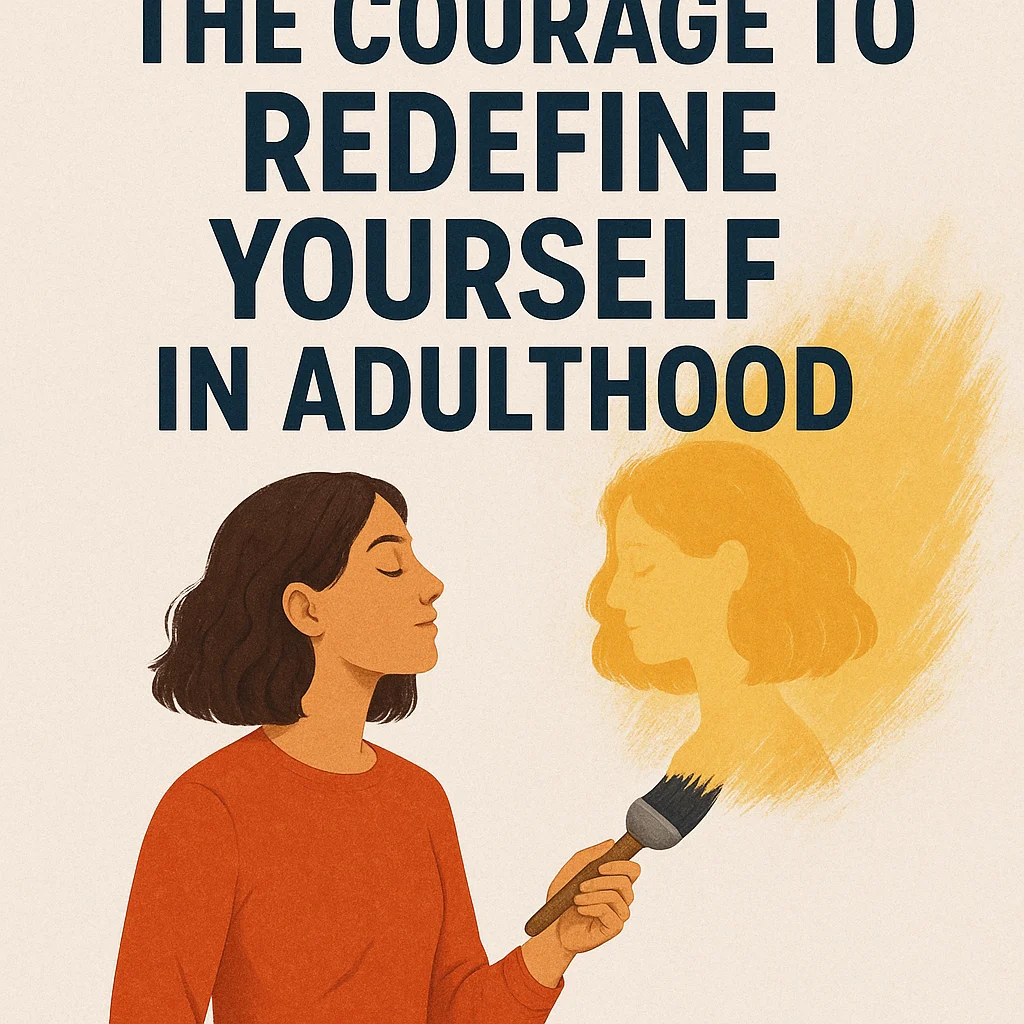
Many people view adulthood as a stable stage of life, when the big questions of direction, identity, and purpose have supposedly been resolved. You have established your values, picked a profession, created a family or community, and established a routine for your everyday life. Many adults, however, experience an inner pull beneath this regimented exterior: What if I'm not who I thought I was? What happens if I decide to start over?
Redefining oneself as an adult is an act of bravery, not a crisis. It's about taking charge of your own development, letting go of previous incarnations of yourself and embracing the person you're becoming. Despite its challenges, this journey has the potential to be one of the most significant life changes you will ever experience.
1. The Myth of a Fixed Identity
As if our personalities, careers, and passions should remain constant after a certain age, society frequently pushes us to believe that identity is something that must be discovered once and for all. However, we humans are rivers, not monuments. We evolve as a result of relationships, experience, and even time.
Our decisions in our early adult years are frequently influenced by outside forces, such as what our parents support, what our peers find admirable, and what society values. However, as we age, life becomes more complicated, and we begin to recognize when those options are no longer appropriate.
Therefore, redefinition does not indicate failure. It's an indication of progress. It's the realization that your identity is a continuous process rather than a final product.
2. When the Old Story Stops Working
Many adults eventually experience the subtle but unnerving sensation that their current life no longer accurately represents who they really are. Perhaps you've realized your long-held dreams, only to discover that they feel empty. Your values may have changed. Or maybe you've experienced disillusionment, burnout, or loss that has robbed you of the appearance of stability.
Recognizing that the narrative you have been living does not fit is where courage starts.
Outgrowing your past is more important than rejecting it.
Consider it akin to skin shedding. You were once protected by the old layers, but they are now too tight. Allowing something new to emerge, something more liberated, is what it means to redefine yourself.
It can hurt to go through this process. It frequently entails letting go of personas that other people find admirable or rely on. It might encourage condemnation, perplexity, or even isolation. But at its core, saying, "This is no longer me," is a sacred act of speaking the truth.
3. The Fear of Starting Over
Because it challenges the appearance of certainty, starting over as an adult can be intimidating. What will people think, you ask? What if I don't succeed? Am I too old to start over?
In actuality, though, fear frequently passes for pragmatism. It implies that ease is preferable to genuineness. However, fulfillment is rarely the result of safety.
Courage is the ability to move forward in the face of fear, not the absence of it. From artists who switched careers to entrepreneurs who made last-minute moves, everyone who has reinvented themselves has experienced this same fear.
Their willingness to live authentically rather than comfortably sets them apart from those who stay stuck, not skill or luck.
You may not know where the path leads, but you trust that stagnation is a greater risk than change.
4. Letting Go of External Validation
Breaking free from other people's expectations is one of the most difficult aspects of redefining oneself as an adult. Our society is fixated on labels, such as financial milestones, relationship statuses, and career titles, all of which are used to define success.
Reinvention, however, seems unattainable when your self-worth is dependent on approval. If you're afraid of disappointing people, you can't start over.
You have to take back control of your story in order to redefine yourself.
This entails changing your attention from what other people think you should do to what you feel is true.
To pursue art, some people may have to leave a prestigious job. Others may find it means ending a relationship that no longer reflects their values. Or it might just entail redefining success as peace rather than wealth.
True freedom begins the moment you stop performing for approval and start living for alignment.
5. The Role of Self-Reflection
Redefinition is an introspective process rather than an impulse. It invites you to stop and hear your inner voice, the one that is muffled by noise and bustle.
Ask yourself:
-
What parts of me feel alive, and which feel heavy?
-
What dreams have I silenced because they seemed impractical?
-
What would I choose if no one were watching?
These truths can be discovered through journaling, therapy, meditation, or even travel.
Rediscovery can sometimes mean going back to the things you once loved, such as pastimes, locations, or people who make you feel like yourself. In other cases, it entails accepting the unknown and rediscovering your intuition.
Redefining yourself is not about becoming someone new; it’s about becoming more you.
6. The Slow Art of Transformation
Transformation is frequently misinterpreted in a society that is dependent on quick fixes. Redefinition occurs gradually, like the dawn, and doesn't happen all at once. One step forward and two steps back is acceptable. You might question your decisions. You might miss the previous you.
But every stage is part of the process.
The confusion, the hesitation, the loneliness — they are not signs of failure but of rebirth.
Consider the transformation of a butterfly, where the caterpillar briefly vanishes into nothingness before reshaping itself. Human transformation is no different. Though uncomfortable, the transitional period is the beginning of new life.
Be patient with yourself. You are not late. You are in progress.
7. The Power of Small Shifts
Redefining yourself doesn’t always require dramatic reinvention. Sometimes, it starts with small, consistent acts of alignment.
-
Choosing honesty over people-pleasing.
-
Saying no to things that drain you.
-
Starting a project that excites you.
-
Spending time with people who challenge and support your growth.
Over time, these minor changes add up and progressively change who you are. They generate momentum, demonstrating that even modest, silent steps can bring about change.
Courage is not only in grand gestures; it lives in everyday choices.
8. Embracing Uncertainty as Freedom
Learning to live with uncertainty is a necessary part of redefining yourself. The unpredictable nature of the future is part of its vitality.
You open yourself up to countless possibilities when you stop adhering to rigid definitions. You come to understand that your identity is something you continuously choose rather than something you "find" once.
Freedom arises when you begin to become the person your soul desires to be and quit attempting to be the person the world expects you to be.
9. Redefinition as a Lifelong Practice
Throughout your life, you must reinvent yourself numerous times. Every chapter offers fresh insights, and every iteration of yourself carries the knowledge from the previous one.
After experiencing heartbreak, success, loss, or just realizing that happiness is found elsewhere, you may decide to redefine yourself. The objective is to stay open, inquisitive, and courageous enough to change repeatedly rather than to arrive at a final version.
Redefinition, in the end, is the art of staying awake to your own becoming.
Conclusion: Becoming the Author of Your Life
The courage to live authentically is the courage to reinvent oneself as an adult. It entails viewing your life as something you actively create rather than as something that just happens to you.
Indeed, it requires courage to doubt your course when everyone else seems to be on it. However, the payoff is significant: living a life that feels genuine rather than merely acceptable.
Your past choices do not have to limit you. You are free to alter your mind, change your course, and start over with a different story.
Because consciousness—the readiness to face each season of life with open eyes, open hands, and an open heart—is the true test of a life well-lived, not consistency.




Leave a Reply