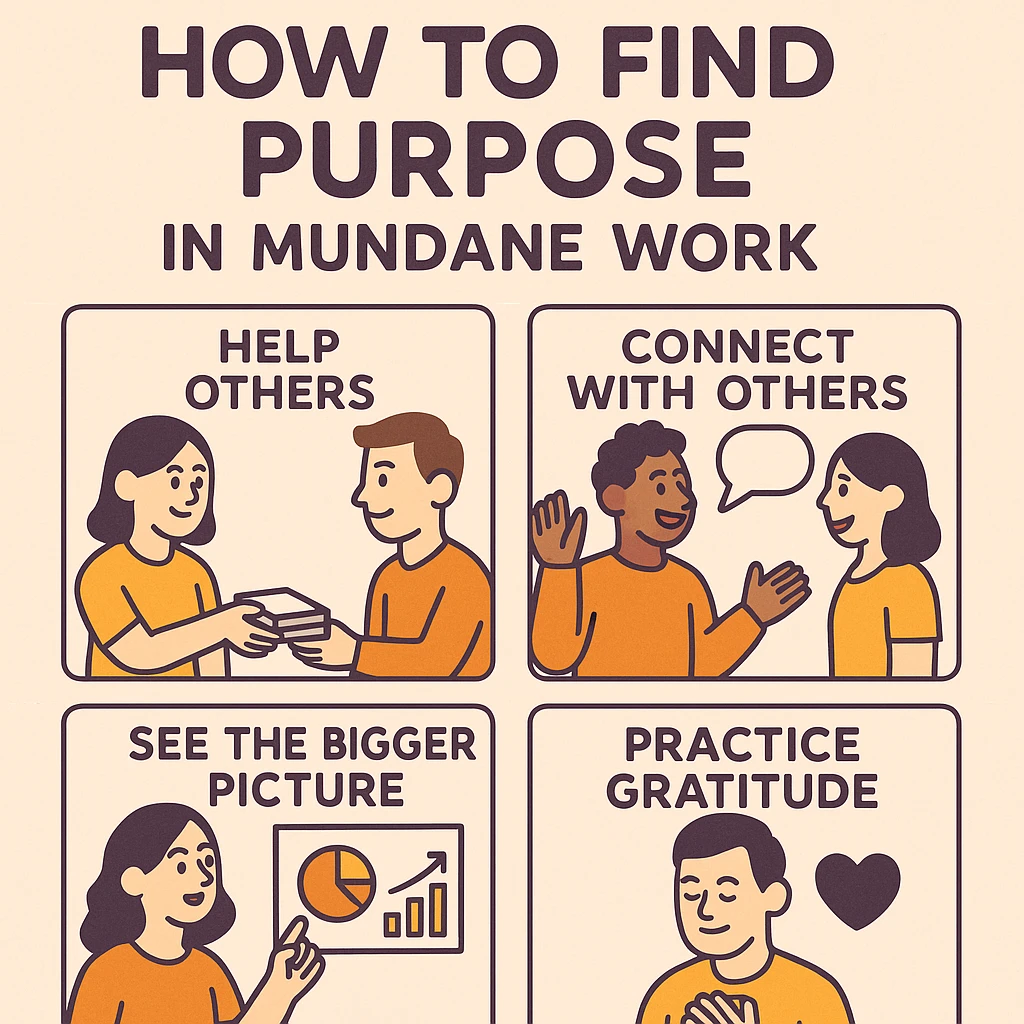
How to Find Purpose in Mundane Work
Not all jobs are motivating. On certain days, the routine seems never-ending—emails, reports, meetings, and seemingly pointless duties. For many, work becomes into a cycle of creating rather than connecting, of doing rather than being. However, there is a silent opportunity to find meaning where others perceive monotony, even in the most routine roles.
A sense of purpose is not exclusive to leaders, entrepreneurs, or artists. It’s not found only in world-changing occupations. Even seemingly routine, administrative, or inconspicuous activity can have a purpose. The key is in how you see your actions.
The Myth That Purpose Requires Passion
Passion-driven work is highly valued in our society. “Do what you love,” people advise, as if meaning automatically develops when your career fits your desires. But the truth is, hardly everyone gets to transform their passion into a profession—and even those who do eventually find routine in it.
Although they are related, passion and purpose are not the same. What thrills you is what passion is all about. What gives your life significance is your purpose. A passion can cause you to lose interest, but a purpose keeps you going through both boredom and excitement.
Even the smallest actions, like assisting someone in solving an issue, upholding order, or making things easier for others, can have meaning. Simplicity frequently conceals purpose, just waiting to be discovered.
Why Mundane Work Feels Meaningless
Before discovering purpose, it helps to understand why work can feel meaningless in the first place.
-
Repetition dulls perception.When you do the same thing every day, your mind switches to autopilot. You lose awareness of the results of your work.
-
Lack of visibility.There are numerous behind-the-scenes roles. It's simple to feel undervalued or cut off from a greater purpose when outcomes aren't immediately apparent.
-
Misaligned expectations.Frustration arises when you think your work should be rewarding yet it isn't. Instead of questioning your viewpoint, you may question your path.
-
External validation trap.Many people look to recognition—titles, promotions, or accolades—for a sense of purpose. They believe their effort is meaningless when these are missing.
The truth is, meaning isn’t something work gives you. It’s something you bring to the work.
Reframing the Mundane: The Power of Perspective
A person's mindset is frequently what distinguishes meaningful work from useless labor. By redefining your role, you can change your experience.
1. See the Ripple Effect of Your Efforts
No matter how tiny the task, it all adds up to something bigger. A hospital is kept safe by a janitor. A data entry clerk keeps systems organized. In a fast-paced society, a cashier fosters human connection.
Try this exercise: Trace your daily work to its end user. Who gains from your actions, either directly or indirectly? Even seemingly insignificant jobs gain significance when you relate your efforts to human impact.
2. Shift from “Have To” to “Get To”
Our emotions are influenced by the words we use. It sounds burdensome to say, "I have to do this." "I get to do this" seems like a chance.
Gratitude alters the emotional energy you bring to your work, even if you don't love every aspect of it. Every task becomes an opportunity to exercise excellence, patience, or discipline—qualities that go beyond work itself.
3. Find Mastery in Repetition
Repetition need not equate to stagnation. Consider athletes, musicians, or artisans; they practice their skill every day by repeating moves. You have the same option.
How can I do this task more effectively today than I did yesterday? When you focus on mastery, even the everyday becomes art.
4. Anchor to Your Values
If you value progress, precision, creativity, or service, discover ways to convey those via your work. Effort is contextualized by values.
For instance, responding to consumer emails is more than just correspondence if you appreciate customer service; it's making someone's day. If you value honesty, fulfilling deadlines becomes a manner of keeping your word.
Work becomes a reflection of who you are, not just what you do, when daily responsibilities are in line with personal values.
Practicing Mindfulness in Routine Tasks
Approaching routine tasks with mindfulness is one of the most straightforward yet powerful ways to discover meaning in them. By transforming doing into being present while doing, mindfulness converts autopilot into awareness.
Here’s how:
-
Focus on the process, not just the outcome.Take note of your workflow's structure, the rhythm of your actions, and the little things you miss when you're rushing.
-
Breathe between transitions.Breathe deeply before moving on to another task. Reset. This keeps you grounded in the present and keeps you from burning out.
-
Engage your senses.When you pay attention to the little things, like the sound of typing, the smell of coffee, or the feel of paper, these can help you stay grounded.
Mindfulness converts even repeated activity into meditation. You start to view every task as an opportunity to cultivate presence, calmness, and focus.
Creating Meaning Through Connection
Relationships give work meaning. People are naturally drawn to connections and a sense of belonging to something greater than themselves.
1. Connect with Colleagues
An ordinary day's energy can be transformed with a simple smile, a kind remark, or shared laughter. Collaboration and empathy serve as a reminder that you are a member of a live system of individuals working together, not just someone finishing duties.
2. Connect with the Mission
Every company has a goal, whether it is to solve issues, create goods, or serve customers. Bring that mission closer if it seems far away. Find out how your role contributes to it. Make inquiries. Examine how your contribution fits into the overall scheme of things.
3. Connect with Yourself
Sometimes the goal is not the work itself, but rather the person you become while doing it. Character is shaped by work. It imparts resilience, humility, and patience.
Even ordinary days become significant stages in your development when you view your work as a training ground for personal development.
Turning Routine into Ritual
Intention is what distinguishes ritual from routine. Routine is a mechanical process. Ritual is thoughtful.
Try transforming small work habits into personal rituals:
-
Before you check in, take a moment to express gratitude for the day.
-
During lunch, take five minutes to stretch or breathe.
-
Write down one accomplishment or lesson you learnt at the end of each day.
These little deeds transform work from monotony to significance and serve as a reminder that every day, no matter how routine, offers chances for introspection and personal development.
The Role of Service in Finding Purpose
Turn your attention from what you receive to what you provide when your work seems uninspired. One of the most dependable routes to purpose is service.
Ask: Who benefits from my effort today?
Your work probably benefits someone else—your team, your clients, or your community—even if it seems monotonous. Understanding that influence transforms responsibility into a contribution.
Grand service is not necessary. It might be as easy as performing your work to the highest standard, showing compassion during a stressful situation, or making someone's job easier. Every act of service enhances the world in an imperceptible way.
Growing Beyond the Task
When you use routine labor as a platform for growth, meaning also expands. Every work requires transferable qualities, such as empathy, organization, communication, and discipline.
Even routine days can become stepping stones toward greater expertise if you view your workplace as a learning environment.
Try setting micro-goals like:
-
Improving how you prioritize tasks
-
Enhancing your attention to detail
-
Practicing emotional regulation in stressful moments
Growth brings purpose because it transforms stagnation into progress.
When Purpose Feels Out of Reach
Sometimes, no matter how hard you try, the work still seems pointless. If so, it may be an indication to pay attention rather than to give up right away.
Ask yourself:
-
Is this really the ideal setting for me?
-
Am I ignoring a more profound purpose or principle?
-
What tiny actions could help me get closer to a job that reflects who I really am?
Occasionally, ordinary work is the source of purpose rather than the other way around. You are now ready for the next chapter thanks to the discipline, perseverance, and resilience you develop.
The Bigger Picture
Finding meaning in routine labor ultimately comes down to regaining agency. Although you might not have complete control over your work, you do have power over how you present yourself.
Through awareness, attitude, and action, purpose is produced rather than found. It's in the way you interact with others, hone your skills, and overcome obstacles.
Everything changes when you put meaning into your work rather than expecting for it to give you purpose.
Final Thoughts
Every profession has the ability to have a purpose, regardless of how straightforward or monotonous it is. Routine becomes meaningful when you approach even the smallest chore with integrity, thankfulness, and presence.
A dream career is not necessary to lead a meaningful life. All you have to do is take a closer look to realize that every action, no matter how routine, can serve as a window into your identity and values.
Because in the end, purpose is more about how you do things than what you do. Additionally, you never feel like a part of your life is squandered when you discover purpose in the everyday.




Leave a Reply