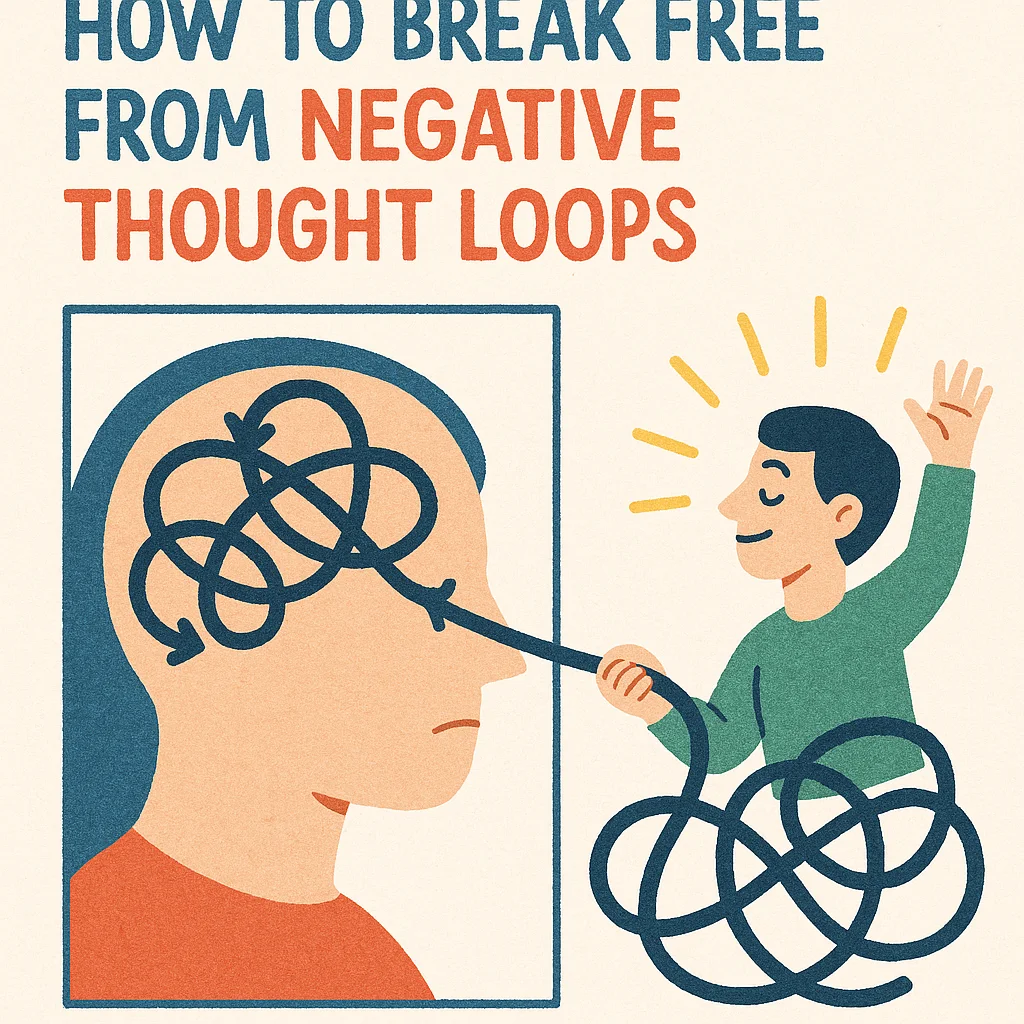
Those recurrent thoughts that keep us mired in regret, anxiety, or self-doubt are something we've all experienced. You repeatedly play back a mistake. You become fixated on a discussion. You are afraid of an unrealized future. These tendencies are referred to as negative thought loops, and they can seem unbreakable.
But here’s the truth: You can break free.
You don't have to let negative thought patterns rule your life. You can break the cycle and make room for serenity, clarity, and confidence by comprehending their causes, identifying their patterns, and using useful tools.
We'll discuss negative thought loops in this blog, including what they are, why they occur, and—above all—how to permanently overcome them.
What Are Negative Thought Loops?
A negative thought loop is a repetitive cycle of pessimistic or unhelpful thinking that your brain keeps returning to. These loops often revolve around:
-
Regret over past events (“Why did I say that?”)
-
Anxiety about the future (“What if everything goes wrong?”)
-
Harsh self-judgment (“I’m not good enough.”)
-
Catastrophizing (“This is a disaster.”)
These thoughts seem uncontrollable and automatic. Like a mental rut your mind keeps getting into, they get stronger the more you interact with them.
Why Do We Get Stuck in Thought Loops?
Our brains are designed to keep us safe. In contemporary life, the fight-or-flight response, which is meant to protect us from harm, frequently fails. We run from perceived dangers like failure or shame rather than from untamed animals.
Negative thought loops can be triggered by:
-
Stress or trauma
-
Low self-esteem
-
Perfectionism
-
Unresolved conflict
-
Chronic anxiety or depression
You feel like you're solving a problem when you're in these loops. But most of the time, you're just running in place, mentally draining yourself without coming up with a workable solution.
1. Recognize the Loop
The first step to breaking free is to identify when you’re caught in a loop.
Ask yourself:
-
Am I replaying the same thought over and over?
-
Is this helping me, or just making me feel worse?
-
Am I ruminating on something I can’t change?
Label the loop as soon as you see it. "I'm trapped in a negative thought pattern," you tell yourself. You and the thought are psychologically separated by this small action.
2. Pause and Breathe
Before diving into fixing the thought, take a moment to pause.
Use deep breathing to calm your nervous system:
-
Inhale for 4 seconds
-
Hold for 4 seconds
-
Exhale for 6 seconds
Repeat this a few times.
Breathing more slowly helps you access the prefrontal cortex, the logical part of your mind, which is not controlled by emotion or fear. It also lessens the alarm signals sent by your brain.
3. Practice Thought Defusion (Not Suppression)
Pushing thoughts away is a common strategy used by people to break out of thought loops. Regretfully, this frequently backfires. What you oppose endures.
Instead, use thought defusion—a technique from Acceptance and Commitment Therapy (ACT). Here’s how:
Example:
Instead of thinking “I’m a failure,” try saying:
“I’m having the thought that I’m a failure.”
This makes room. You are the thought's observer, not the thought itself. This small change lessens the thought's influence over you.
4. Challenge and Reframe the Thought
Not all negative thoughts are true. In fact, many are based on faulty beliefs or outdated assumptions.
Ask yourself:
-
Is this 100% true?
-
What’s the evidence for and against this thought?
-
How would I view this if a friend were going through it?
Then reframe the thought.
Example:
-
Negative loop: “I always mess things up.”
-
Reframe: “I’ve made mistakes, but I’ve also succeeded. I’m learning like everyone else.”
Reframing isn't lying to yourself—it's seeing the situation with balance and clarity.
5. Use the “Name It to Tame It” Technique
Dr. Daniel Siegel, a neuropsychiatrist, developed this brain-based strategy. Your brain's fear center, the amygdala, is calmed and the prefrontal cortex is activated when you name your emotions.
Try saying:
-
“I’m feeling anxious right now.”
-
“This is fear talking.”
-
“I’m experiencing shame.”
You can stop feeding the loop by acknowledging your feelings. It enables you to respond instead of react and keeps you rooted in the here and now.
6. Get Physically Unstuck
Negative thought loops are mental, but they often need a physical solution.
Try:
-
Going for a walk
-
Doing 10 jumping jacks
-
Stretching or yoga
-
Taking a cold shower
-
Washing your face
Your nervous system is reset and the loop is broken by movement. Additionally, it causes your attention to change from internal chatter to physical sensations.
7. Limit Overthinking Triggers
Certain behaviors can fuel negative loops:
-
Scrolling social media excessively
-
Comparing yourself to others
-
Listening to sad or dramatic music on repeat
-
Isolating yourself
Set boundaries and be conscious of what draws you further into loops. Substitute healthy inputs for these triggers:
-
Uplifting music
-
Inspirational podcasts
-
Time in nature
-
Talking to a supportive friend
8. Journal to Get the Thoughts Out
Writing facilitates the externalization of your ideas, which facilitates their analysis and release. Journaling transforms confusion into clarity and removes mental clutter.
Try prompts like:
-
What am I looping about?
-
What do I fear will happen?
-
What’s another way to view this?
-
What can I control right now?
Often, simply getting it all on paper relieves the pressure and gives your mind a break.
9. Practice Mindfulness
You can avoid the loop by practicing mindfulness, which keeps you in the here and now. Your mind cannot wander to regrets from the past or anxieties about the future when you are rooted in the present.
Try:
-
5 minutes of mindful breathing
-
Observing your surroundings without judgment
-
A body scan meditation
-
Apps like Headspace or Insight Timer
Being mindful helps you relate to your thoughts in a different way, but it doesn't stop them. Your brain eventually learns to be more present and calm than reactive.
10. Seek Professional Support
Don't be afraid to get help if your negative thought patterns are severe, frequent, or connected to anxiety or depression. A counselor or therapist can:
-
Help identify patterns and root causes
-
Teach cognitive behavioral tools
-
Provide emotional support
-
Guide you toward healing
There’s no shame in getting support. Breaking free from thought loops is easier when you're not doing it alone.
Real-Life Example: From Looping to Living
The 28-year-old marketing manager, Sarah, was always thinking about her mistakes at work. She worried that she sounded "incompetent" or "stupid," so she would mentally rerun meetings every evening. It affected her relationships, self-esteem, and sleep.
She started journaling and practicing mindfulness after learning about negative thought loops. She also reframed her thoughts, telling herself, "I'm learning to communicate better, and one awkward moment doesn't define me," rather than, "I sounded dumb."
In a few weeks, the loops began to lose power. Sarah didn’t stop having negative thoughts—but she stopped believing them.
Final Thoughts: You Are Not Your Thoughts
Negative thought loops can feel all-consuming—but they are not permanent. They are patterns, and patterns can be changed.
You can take back control of your mind by becoming conscious, making room, and selecting alternative answers. The loops eventually weaken, leaving behind a more peaceful, compassionate, and capable mind.
Remember: you are not your thoughts. You are the awareness behind them. And that awareness is free.




Leave a Reply