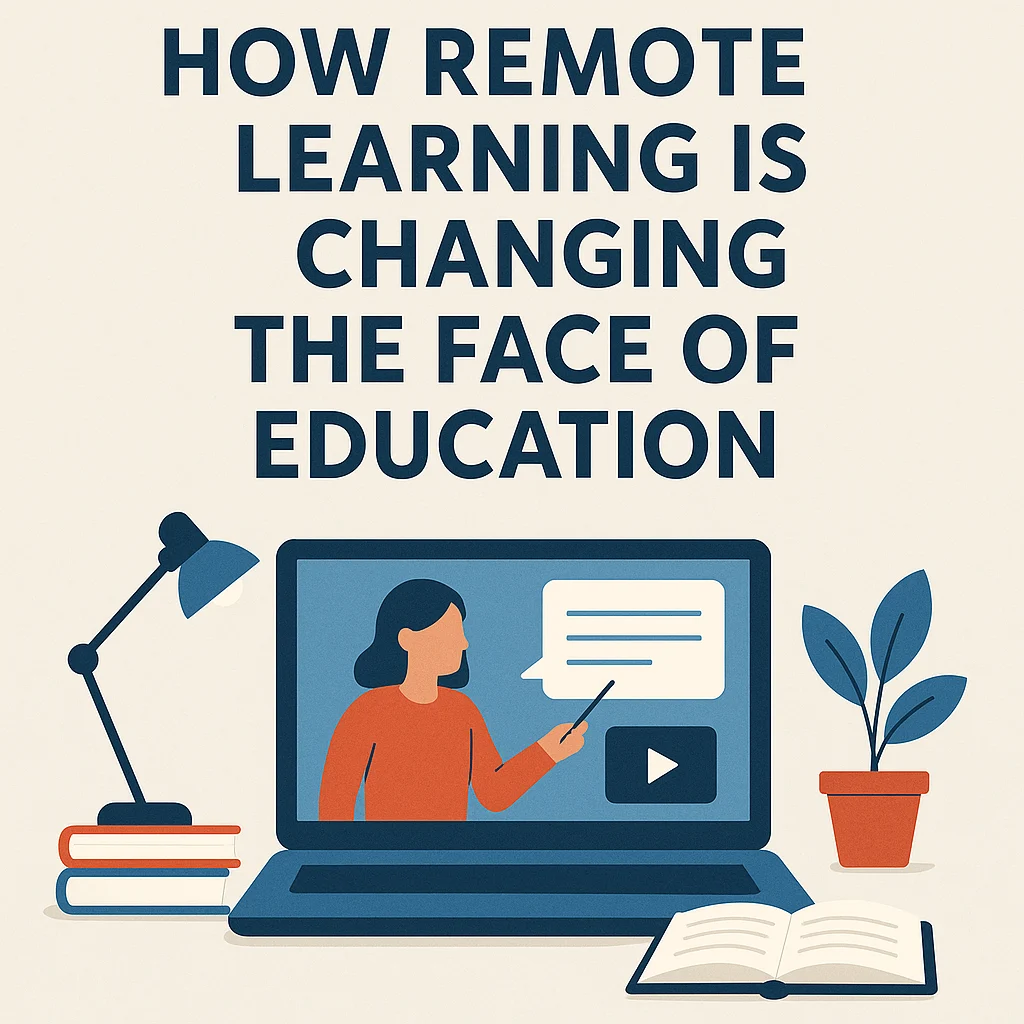
Introduction: The New Normal of Learning
Education used to consist of classrooms with desks, chalkboards, and actual textbooks. Students took notes and waited for grades to be posted as teachers gave lectures in front of the class. However, the educational scene has undergone unrecognizable transformation over the past ten years, particularly after the COVID-19 pandemic.
Once a specialized choice for distant learners or working adults, remote learning is now widely accepted. Millions of students now receive education in ways that were unthinkable only a century ago, whether via Zoom lectures, digital whiteboards, or AI-powered learning systems.
What started out as a crisis response has developed into a long-term change in the value, accessibility, and delivery of knowledge. In addition to technology, new expectations around flexibility, accessibility, and what it means to actually learn are changing the face of education.
The Rise of Remote Learning: From Option to Necessity
Prior to 2020, online learning was expanding but was frequently seen as a convenient addition to traditional education. A few online courses were offered by universities, and independent learners were catered to by sites like Coursera, Udemy, and Khan Academy.
Then the worldwide pandemic struck. Over 1.6 billion students in 190 countries were compelled to transition to online education very immediately. Schools, universities, and businesses had to rethink how they provided instruction and training.
Although this abrupt change wasn't easy, it demonstrated something crucial: learning could go on without actual classrooms. Students connected across time zones, teachers adjusted to new technologies, and entire courses moved online.
What began as emergency remote instruction quickly developed into a technological and pedagogical revolution. The world realized that education could be international, scalable, and adaptable.
The Technological Backbone: Tools That Made It Possible
A variety of digital tools that allowed professors and students to communicate in real time drove the growth of remote learning. In addition to simulating the classroom setting, these tools improved it in ways that were before unattainable.
-
Video conferencing platforms (Zoom, Google Meet, Microsoft Teams) became the new lecture halls.
-
Learning Management Systems (LMS) like Moodle, Canvas, and Blackboard centralized assignments, grades, and discussions.
-
Collaboration tools (Slack, Notion, Miro) enabled group projects beyond physical limitations.
-
AI-driven tools such as ChatGPT, Grammarly, and personalized learning assistants supported writing, research, and self-paced study.
-
Virtual and augmented reality (VR/AR) began simulating laboratories, museums, and even historical events for immersive learning experiences.
When combined, these technologies broke down the traditional barriers between life and education by transforming houses into classrooms.
Redefining Accessibility: Education Without Borders
The ability of remote learning to democratize education has been one of its most significant benefits. Students are no longer required to pay for relocation or reside close to elite universities. Harvard courses are available to teenagers in Kenya. In India, a working parent can complete a master's degree at night.
This global access is especially transformative for:
-
Rural and remote communities without nearby educational institutions.
-
Students with disabilities who face mobility or sensory challenges.
-
Working professionals balancing education with employment.
-
Women and caregivers in regions where attending in-person classes may be difficult due to social or cultural constraints.
Remote learning has opened doors that traditional education had long closed by removing economic and geographic restrictions.
The digital divide, or the difference between people with dependable gadgets and internet and those without, has been brought to light by this accessibility. One of the most pressing issues of the remote learning era is still addressing this disparity.
New Pedagogies for a Digital Age
Rethinking how people learn is the goal of remote learning, which goes beyond simply moving lectures online. Teachers are no longer constrained by static textbooks or strict schedules. Rather, they are experimenting with new pedagogical approaches that emphasize participation, independence, and teamwork.
-
Flipped Classrooms:
Students use live sessions for discussion and application after seeing lectures on tape at their own speed. -
Asynchronous Learning:
In order to promote independence and accommodate various time zones and life circumstances, learners finish the contents on their own schedule. -
Project-Based Learning:
Teams work together online to solve real-world issues while honing useful abilities like digital communication and cooperation. -
Gamification and Interactive Content:
To increase student engagement, platforms employ incentives, progress monitoring, and simulation-based learning.
Students are increasingly active learners rather than just passive consumers of information.
The Human Element: Connection Beyond the Screen
To some extent, critics of remote learning are correct when they claim that it lacks the community and social connection of traditional classroom settings. Lack of in-person interactions can lead to feelings of exhaustion and loneliness.
However, teachers are coming up with innovative techniques to make online learning more relatable. Peer discussion forums, live mentorship sessions, and virtual breakout rooms have become indispensable. Cross-border digital communities are emerging where students exchange resources, culture, and support.
Furthermore, a key discovery made by remote learning is that connection is about intention rather than proximity. Today's students connect with mentors and classmates hundreds of miles away, something that was rarely possible in traditional classrooms.
The Rise of Hybrid Education Models
The practical experience required in professions like medical, engineering, or the arts cannot be replaced by remote learning, despite its flexibility. Hybrid learning, which combines online and in-person experiences, is the developing solution.
-
These days, universities provide modular programs that allow students to finish both on-campus practical training and online theoretical coursework.
-
Corporations conduct virtual onboarding followed by in-person collaboration retreats.
-
Digital tools are used by schools to extend learning outside of the classroom, making education flexible and ongoing.
The benefits of both worlds—digital freedom and human connection—are embodied in hybrid models. They are rapidly becoming as the favored framework for education in the future.
Challenges and Inequalities in Remote Learning
Despite its advantages, remote learning has exposed deep structural inequalities.
-
The Digital Divide:
Millions of pupils don't have dependable gadgets or the internet. This disparity could lead to the emergence of a new type of educational inequality in developing countries. -
Motivation and Mental Health:
The lack of structure and social interaction can lead to disengagement, burnout, and anxiety. -
Assessment and Integrity:
Online exams present challenges in maintaining academic honesty and fair evaluation. -
Teacher Preparedness:
Not all teachers are qualified to provide captivating online courses. Many were forced to teach remotely without sufficient assistance.
Systemic investment is needed to address these problems, not just in infrastructure but also in equitable policy formulation, training, and support.
The Economic Impact: Redefining Educational Models
The economics of education have been completely upended by the move to remote learning. Institutions that previously relied on physical infrastructure are increasingly reconsidering their funding streams and tuition strategies.
-
Online courses are cheaper to scale, reaching thousands of students worldwide.
-
Micro-credentials and short courses offer faster, affordable alternatives to traditional degrees.
-
Corporate learning platforms are partnering with universities to deliver professional upskilling programs.
The distinction between formal education and lifetime learning is becoming more hazy as a result of this development. One course or certification at a time, people will likely continue to learn throughout their lives under a modular, continuous, and career-aligned educational system in the future.
AI and Personalization: The Future of Remote Learning
By customizing learning experiences, artificial intelligence is advancing remote education. AI systems are able to evaluate a student's progress and modify the content in response, such as providing additional practice, recommending resources, or adjusting the pace of lessons.
Imagine a classroom where:
-
Lessons adjust automatically to your strengths and weaknesses.
-
Virtual tutors provide 24/7 feedback.
-
AI mentors help you plan your career path based on your skills and interests.
This is real; it's not science fiction. Adaptive learning technologies are used by platforms such as Khan Academy, Coursera, and Duolingo to tailor education for millions of students worldwide.
The Cultural Shift: Redefining What “Education” Means
The way society currently perceives education is arguably the biggest shift. Learning is now fluid, lifelong, and international, whereas it was formerly limited to physical institutions and sequential stages (school, college, work).
-
Employers increasingly value skills and portfolios over traditional degrees.
-
Learners curate their education from multiple platforms and sources.
-
Teachers act as facilitators and mentors rather than sole authorities.
Education is becoming a global, participatory ecosystem rather than a luxury due to the democratization of knowledge.
Conclusion: Education Without Walls
Beyond simply moving classrooms online, remote learning has completely changed the definition of education. Millions of people now have the opportunity to learn on their own terms thanks to the dismantling of obstacles based on geography, class, and tradition.
However, this change also entails responsibilities. We must close the digital divide, assist educators, and create systems that integrate human empathy with technical innovation if we want to guarantee an equal future for education.
Future classrooms won't be constrained by walls or timetables. It will be vibrant, welcoming, and open to everyone who is curious and connected.
In this way, remote learning is a conceptual change as well as a technological one. It teaches the world that education is a journey rather than a destination.




Leave a Reply