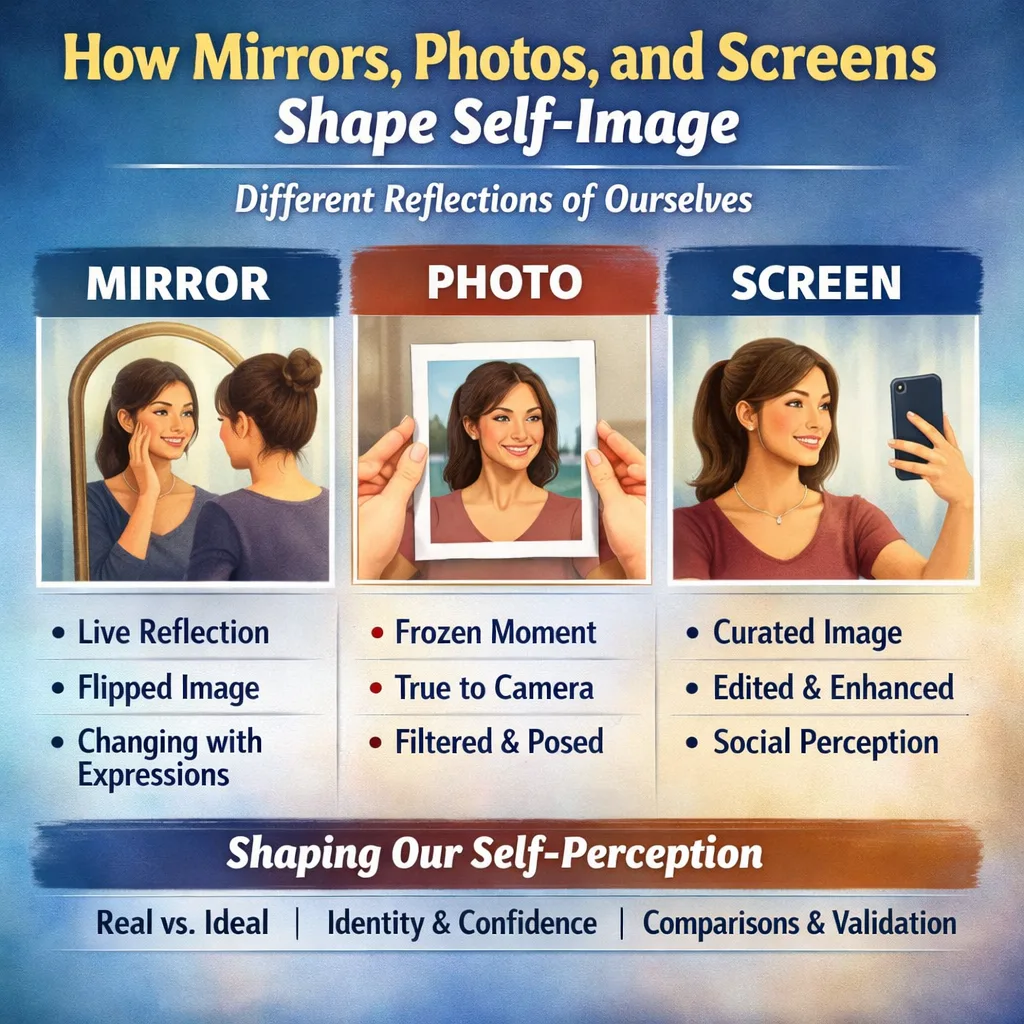
We see ourselves reflected in mirrors, photographed, and shown on screens every day. These pictures subtly influence our perceptions of our value, identity, and attractiveness. They eventually affect our sense of self-worth, how we evaluate ourselves against others, and how we perceive ourselves. A large portion of our self-image is actually shaped by how we see ourselves, despite the fact that we frequently believe it originates from internal thoughts or social feedback.
Our relationship with our own image has grown more complicated, frequent, and emotionally charged in a world full with mirrors, cameras, and digital displays. We can become more conscious, empathetic, and rooted in our sense of self by comprehending how mirrors, pictures, and screens influence our perception of ourselves.
The First Mirror: How We Learn to See Ourselves
Mirrors are essential to the growth of self-awareness. A significant turning point in human psychological development occurs when we learn as youngsters to identify our reflection as ourselves. The fundamental feeling of identity is formed in part by this awareness. But the mirror does more than just reflect an actual image. It turns become a quiet arbiter, friend, and point of reference.
The mirror eventually begins to be associated with assessment. We evaluate its appearance, posture, emotion, and perceived imperfections while standing in front of it. Mirrors produce an ongoing cycle of self-observation since they reflect us in real time. Self-image is shaped by this continuous visual feedback, which reinforces preconceived notions about our appearance and ideal appearance.
Mirrors are frequently linked to comparison, particularly in societies that place a high value on perfection, beauty standards, and ideal bodies. The mirror ceases to be a neutral instrument and turns into an emotional trigger when people compare themselves to these standards on a regular basis.
The Emotional Weight of the Mirror
Mirrors have a wide range of emotional effects. Mirrors provide self-connection and confidence for certain people. Others experience self-criticism, embarrassment, or discontent as a result. Past experiences, cultural influences, social input, and individual beliefs all contribute to this disparity.
A more neutral or positive mirror relationship may emerge in people who are complimented on their appearance. Negative mirror relationships can arise in people who are subjected to bullying, criticism, or unattainable beauty standards. Confidence, self-worth, and emotional health are all impacted by this interaction over time.
✔ Mirrors can reinforce self-acceptance
✔ Mirrors can trigger self-criticism
✔ Emotional history shapes mirror response
✔ Repeated self-evaluation affects self-image
Photos: Capturing Moments or Capturing Identity?
A distinct psychological dynamic is introduced by photographs. Photos, in contrast to mirrors, capture a single instant in time. They capture a certain lighting, context, viewpoint, and expression. Nonetheless, people frequently view pictures as complete portrayals of who they are.
Even though the picture just captures a single instant, someone may believe, "This is how I really look," after viewing an ugly photo. On the other hand, someone may cling to a flattering snapshot as evidence of their value or beauty. Self-image can be distorted by this emotional attachment to static visuals.
Images also encourage comparison. Images that have been deliberately selected, altered, and filtered abound on social media platforms. Unrealistic self-evaluations result from people comparing their everyday appearance to the greatest moments of others. Body image issues, insecurity, and discontent are exacerbated by this comparison culture.
Why Photos Feel More “True” Than Mirrors
Because they seem objective, photographs can have a more realistic psychological impact than mirrors. A mirror displays a reflection that varies according to emotion, illumination, and movement. On the other hand, a photo seems permanent and fixed. This gives the impression that "the truth" regarding looks is shown in the picture.
Photos are also frequently shared, liked, commented on, and saved. The image's emotional impact is strengthened by this societal acceptance or rejection. While a picture with few likes may cause self-doubt, one with many likes may increase self-esteem. The relationship between self-worth and image is reinforced by this social feedback loop.
Screens and the Digital Self
Self-image is given a new dimension via screens. We construct digital representations of ourselves through social media profiles, online avatars, video conversations, and selfies. These digital identities frequently acquire psychological significance comparable to that of our bodily identities.
People can alter, filter, crop, modify, and curate their appearance on screens. This allows us creative control, but it also separates representation from reality. People may eventually start to identify more with their digital picture than with their actual physique. Emotional tension, identity uncertainty, and dissatisfaction can result from this connection.
Self-observation is also enhanced by screens. People rarely see their own faces when speaking during in-person talks, but this is the case during video chats. Self-consciousness rises and natural emotional expression decreases as a result of this ongoing self-monitoring.
✔ Screens increase self-observation
✔ Digital images are often edited or curated
✔ Comparison becomes constant and unavoidable
✔ Self-worth becomes tied to visual feedback
The Psychological Cost of Constant Self-Viewing
The human brain was not meant to be used for continuous self-examination. People used to infrequently see their reflection. People now view themselves on screens, photographs, mirrors, and cameras several times a day. Self-awareness rises unnaturally as a result of this ongoing exposure.
Hypercritical thinking, body dissatisfaction, anxiety, and diminished emotional presence are all consequences of excessive self-focus. People become observers of themselves within experiences rather than actively participating in them. This causes the focus to change from living to assessing.
How Comparison Distorts Self-Image
One of the most powerful factors influencing one's self-image is comparison. There are countless opportunities for comparison using mirrors, pictures, and screens. Individuals make comparisons between their identities, bodies, appearances, expressions, and lifestyles.
These comparisons are rarely fair, though. Individuals contrast their private lives with those of others in public. They contrast raw moments with photos that have been altered. Everyday existence is compared to highlight reels. This leads to a skewed understanding of success and normalcy.
Over time, comparison promotes unattainable ideals, lowers self-esteem, and creates discontent.
The Role of Emotional Memory in Self-Image
Visuals are not the only factors that shape one's self-image. Emotional memory shapes it. People's perceptions are influenced by their prior experiences with acceptance, rejection, criticism, and praise.
A person sees more than simply a face when they gaze into the mirror. They perceive emotional connections, memories, and judgments. When someone looks at a picture, they see more than just an image. They perceive emotional history, meaning, and identity.
Self-image is extremely personal and psychologically complex due to this emotional overlay.
Why Self-Image Is Not the Same as Self-Worth
The divide between self-image and self-worth is one of the most significant in psychology. Our perception of ourselves is referred to as our self-image. How we esteem ourselves is referred to as self-worth. Self-worth should be based on character, values, activities, relationships, and humanity, whereas self-image is shaped by appearance.
But this distinction is frequently blurred in contemporary visual culture. People start using likes, attractiveness, beauty standards, and online reviews to gauge their value. This leads to emotional fragility, particularly at times of transition, aging, disease, or emotional hardship.
Emotional resilience and mental health are strengthened when self-worth is reestablished in relation to inner ideals rather than outward appearance.
Rebuilding a Healthier Relationship with Reflection
It takes consciousness, empathy, and deliberate boundaries to have a better connection with mirrors, pictures, and screens.
✔ Reduce unnecessary self-viewing
✔ Practice self-talk that is kind and realistic
✔ Limit comparison on social media
✔ Focus on internal qualities over external appearance
These techniques aid in changing focus from performance to presence, from judgment to acceptance, and from appearance to experience.
Authenticity Over Perfection
Being authentic doesn't mean having a flawless appearance. It has to do with being authentic. Real bodies are subject to change. Emotion is expressed on real faces. Real lives are complicated, imperfect, and full of defects. People's self-image becomes more solid and empathetic when they accept themselves for who they are rather than how they believe they should appear.
Screens, mirrors, and pictures don't have to vanish from existence. All they have to do is put them in perspective. They are not facts; they are instruments. They are not identities; they are representations.
Conclusion: Seeing Yourself with Clearer Eyes
By reflecting, freezing, and projecting images of ourselves, mirrors, pictures, and screens help to shape our perception of ourselves. These pictures have an impact on our thoughts, emotions, and self-perception. Self-image has grown more brittle, external, and comparison-driven in a society where visuals abound.
Reflection does not, however, have to govern one's self-image. People can recover their relationship with their own appearance by comprehending the psychological effects of visual self-exposure. They have the option to prioritize authenticity over perfection, presence over performance, and compassion over criticism.
In the end, you can't find the most accurate representation of yourself in a mirror, a picture, or a screen. It can be found in your humanity, resilience, relationships, values, and behavior.




Leave a Reply