Introduction: The Invisible Forces Shaping How We Feel
Many people believe that motivation and mood are products of personality, attitude, or life circumstances. Although these elements are significant, they are simply one aspect of the narrative. A potent biochemical system that constantly influences our feelings, ideas, and behaviors is hidden beneath our conscious thoughts and emotional responses. The body's chemical messengers, hormones, move through the bloodstream and have modest but significant effects on tissues, organs, and brain function.
Hormonal activity affects our emotional landscape, from the rush of anticipation before a significant event to the weight of fatigue following extended stress. Hormonal balance is also closely linked to motivation, whether it takes the form of ambition, curiosity, persistence, or apathy. Energy levels, reward processing, stress response, sleep, appetite, social bonding, and emotional resilience are all regulated by these chemical signals.
We can better understand our inner experiences, create healthier coping mechanisms, and foster more emotional stability when we comprehend how hormones affect motivation and mood. We can see emotional swings as a component of a sophisticated biological system that helps us adjust to our surroundings rather than as personal shortcomings or failures.
The Hormonal Communication System and the Brain
Hormones serve as intermediaries between the body and the brain. The brain, pituitary, adrenal glands, thyroid, pancreas, and gonads are examples of endocrine glands that release them. Hormones cause physiological and psychological reactions when they attach to particular receptors in target tissues after being released into the bloodstream.
In this process, the brain is crucial. It is extremely sensitive to hormonal signals and controls the production of hormones. Numerous hormones alter neurotransmitter systems that control mood, motivation, attention, and emotional processing by either indirectly influencing neuronal activity or crossing the blood-brain barrier.
A feedback loop is produced by this two-way connection. Hormone levels are influenced by behavior, stress, and emotional events, and hormonal changes affect motivation, emotional perception, and cognitive performance. This dynamic relationship explains why mental well-being can be greatly impacted by changes in physical health, sleep, diet, or life circumstances, as well as why emotional states are rarely static.
✔️ Hormones act as chemical messengers between the brain and body
✔️ The brain both regulates and responds to hormonal signals
✔️ Emotional states and hormones continuously influence one another
Understanding this interconnectedness enables us to comprehend why physical health and physiological balance are inextricably linked to motivation and mood.
Dopamine and the Chemistry of Motivation
Although dopamine is more correctly described as the brain's "reward hormone," it actually serves as a signal for learning and motivation. It is essential to goal-directed behavior because it rewards activity that produces favorable results. When dopamine levels rise, we experience enhanced focus, drive, anticipation, and joy associated with achievement.
Dopamine drives us to pursue rewards rather than just providing pleasure. It fosters curiosity, tenacity, and the determination to exert effort. For this reason, whether we work toward our objectives, pick up new abilities, or look forward to pleasant events, dopamine levels rise. People are more likely to feel interested, motivated, and able to exert continuous effort when dopamine signaling is in balance.
Motivation may decrease when dopamine levels are disturbed. Low dopamine activity is related with apathy, weariness, trouble concentrating, and diminished enjoyment. Conversely, excessive dopamine activation may be linked to risk-taking, impulsivity, or addictive behaviors.
✔️ Dopamine drives goal-directed behavior and motivation
✔️ Balanced dopamine supports focus, persistence, and reward learning
✔️ Dysregulated dopamine can contribute to apathy or impulsivity
Understanding dopamine’s role highlights why motivation is not simply a matter of willpower, but also of neurochemical balance.
Serotonin and Emotional Stability
Emotional stability, well-being, and mood management are all strongly linked to serotonin. Sleep, hunger, digestion, pain perception, and emotional fortitude are all impacted. Despite being referred to as the "happiness hormone," serotonin's main function is to maintain emotional equilibrium and stabilize mood rather than produce pleasure.
Calm, contentment, and emotional stability are all influenced by adequate serotonin levels. It helps moderate anxiety, anger, and impulsivity, enabling more considered and balanced answers to life’s difficulties. People may experience mood swings, irritability, anxiety, depression, and disturbed sleep when their serotonin levels are low.
Additionally, serotonin indirectly affects motivation through interactions with hormones and other neurotransmitters. While emotional dysregulation can reduce motivation by raising stress, self-doubt, or emotional exhaustion, emotional stability promotes persistent effort.
✔️ Serotonin supports emotional balance and mood stability
✔️ Balanced serotonin reduces anxiety and impulsivity
✔️ Low serotonin is linked to mood disorders and emotional dysregulation
Through its stabilizing influence, serotonin provides the emotional foundation upon which motivation and goal pursuit can thrive.
Cortisol and the Stress Response
Although cortisol is frequently referred to as the "stress hormone," its functions go much beyond stress. It is crucial for controlling energy, blood sugar, immunological function, and metabolism. By boosting attention, focus, and energy availability, cortisol helps mobilize resources during perceived threats, readying the body for action.
Cortisol promotes motivation in the short term by improving focus, setting priorities, and boosting action readiness. For a brief period, acute stress can improve resilience, focus, and performance. Throughout human development, this adaptive stress response has been crucial for survival.
On the other hand, prolonged elevation of cortisol might impair motivation and mood. Fatigue, impatience, anxiety, emotional numbness, memory loss, and decreased motivation are all linked to chronic stress. Long-term exposure to cortisol can also disrupt serotonin and dopamine signaling, further impairing motivation and emotional health.
✔️ Cortisol supports short-term focus and energy during stress
✔️ Chronic cortisol elevation disrupts mood and motivation
✔️ Balanced stress response supports emotional resilience
Understanding cortisol's dual function helps explain why stress can occasionally improve performance but can become detrimental when it persists or becomes too much.
Oxytocin, Connection, and Emotional Motivation
Because of its function in social attachment, trust, empathy, and emotional connection, oxytocin is frequently referred to as the "bonding hormone" or "love hormone." Social interactions, physical contact, nurturing activities, and emotional intimacy all release it. Oxytocin increases emotional openness, fosters a sense of safety, and fortifies social ties.
From a motivational standpoint, oxytocin affects the drive to interact, collaborate, and take care of others. It encourages emotional closeness, prosocial behavior, and the want to keep up relationships. Social connection itself is a potent motivator, influencing mental health, resilience, and general life happiness.
Feelings of loneliness, isolation, and emotional retreat can be exacerbated by low oxytocin activity or poor social bonding, which can lower motivation, vitality, and involvement with life.
✔️ Oxytocin strengthens emotional bonds and social trust
✔️ Social connection enhances emotional well-being and motivation
✔️ Emotional isolation can reduce energy, drive, and resilience
Oxytocin demonstrates that motivation is not solely individualistic; it is deeply shaped by relationships and social environments.
Hormonal Changes Across the Lifespan
The impact of hormones on motivation and mood is dynamic and varies throughout life. Puberty, reproductive years, pregnancy, postpartum periods, perimenopause, menopause, and aging all include significant hormonal variations that affect emotional experience and motivational behaviors.
Hormonal changes during adolescence lead to increased emotional sensitivity, curiosity, and identity exploration. Although stress, lifestyle choices, and medical problems can change this balance, hormonal stability in adulthood frequently supports emotional regulation and sustained drive. Hormonal changes can affect mood, energy, motivation, and cognitive function during reproductive transitions like pregnancy or menopause.
Comprehending these trends aids in normalizing fluctuations in motivation and emotions throughout life. These changes can be understood as physically driven transitions that call for self-compassion, support, and adaptation rather than as personal failings.
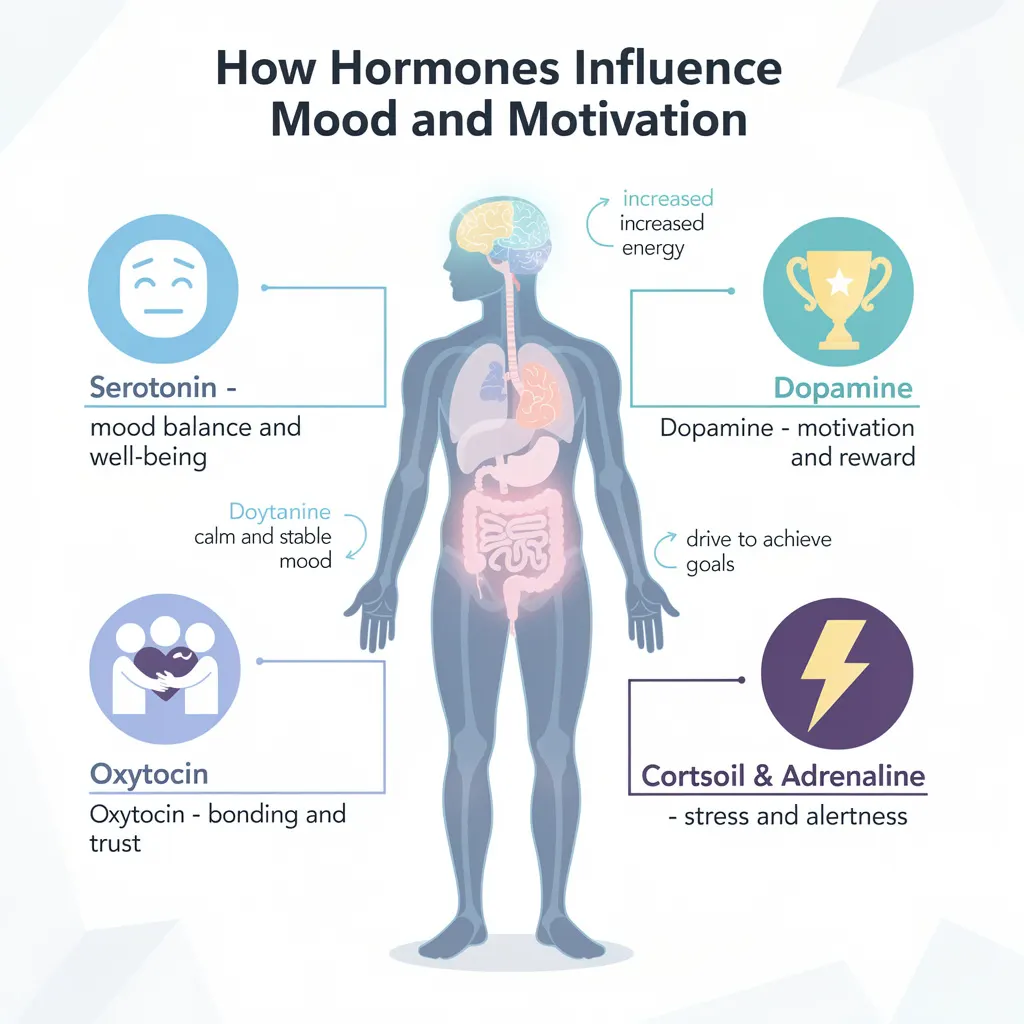
Key Hormonal Influences on Mood and Motivation
-
Dopamine regulates motivation, reward, and goal-directed behavior.
-
Serotonin stabilizes mood, emotional balance, and impulse control.
-
Cortisol governs the stress response and energy mobilization.
-
Oxytocin supports social bonding, trust, and emotional connection.
-
Hormonal changes across the lifespan shape emotional and motivational patterns.
These interrelated systems show that motivation and mood are not the result of a single chemical or mental process, but rather of a complicated biological network.
Lifestyle Factors That Influence Hormonal Balance
Lifestyle factors, such as sleep, diet, exercise, stress reduction, and social interaction, have a significant impact on hormone balance. Lack of sleep throws off the balance of cortisol, dopamine, and serotonin, which lowers motivation and mood. Chronic stress changes hormonal rhythms, reducing emotional resilience and energy levels. Hormonal signaling, brain function, and neurotransmitter production can all be impacted by nutritional deficits.
By controlling stress hormones, increasing dopamine and serotonin synthesis, and boosting insulin sensitivity, physical activity promotes hormonal balance. Social interaction increases the release of oxytocin, which boosts motivation and emotional health. By lowering chronic cortisol increase, mindfulness, relaxation, and emotional regulation techniques promote long-term mental health.
It is more accurate to think of hormones as responding to everyday routines, surroundings, and emotional experiences rather than as fixed or uncontrollable. Hormonal balance, motivation, and mood can all significantly improve with little, regular lifestyle adjustments.
Conclusion: Understanding the Biology Behind Emotion and Drive
Our emotions, thoughts, and behaviors are significantly influenced by hormones. Through intricate interactions with the brain and neurological system, they affect mood, motivation, energy, resilience, and emotional connection. Oxytocin promotes connection and emotional security, cortisol controls stress and energy, dopamine drives motivation and reward, and serotonin regulates mood.
These chemical messengers function within a dynamic system molded by genetics, environment, lifestyle, relationships, and life stage. Emotional fluctuations and motivational shifts are not evidence of weakness or failure, but reflections of a complicated biological system responding to internal and external situations.
People can better understand their emotional experiences, cultivate self-compassion, and support their mental health by learning how hormones affect motivation and mood. The objective shifts to balance, resilience, and adaptation within the rhythms of human biology instead of aiming for perpetual bliss or uninterrupted motivation.
In this light, emotional health is not about managing sentiments, but about understanding their biological basis and nourishing the conditions that allow well-being to emerge organically.




Leave a Reply