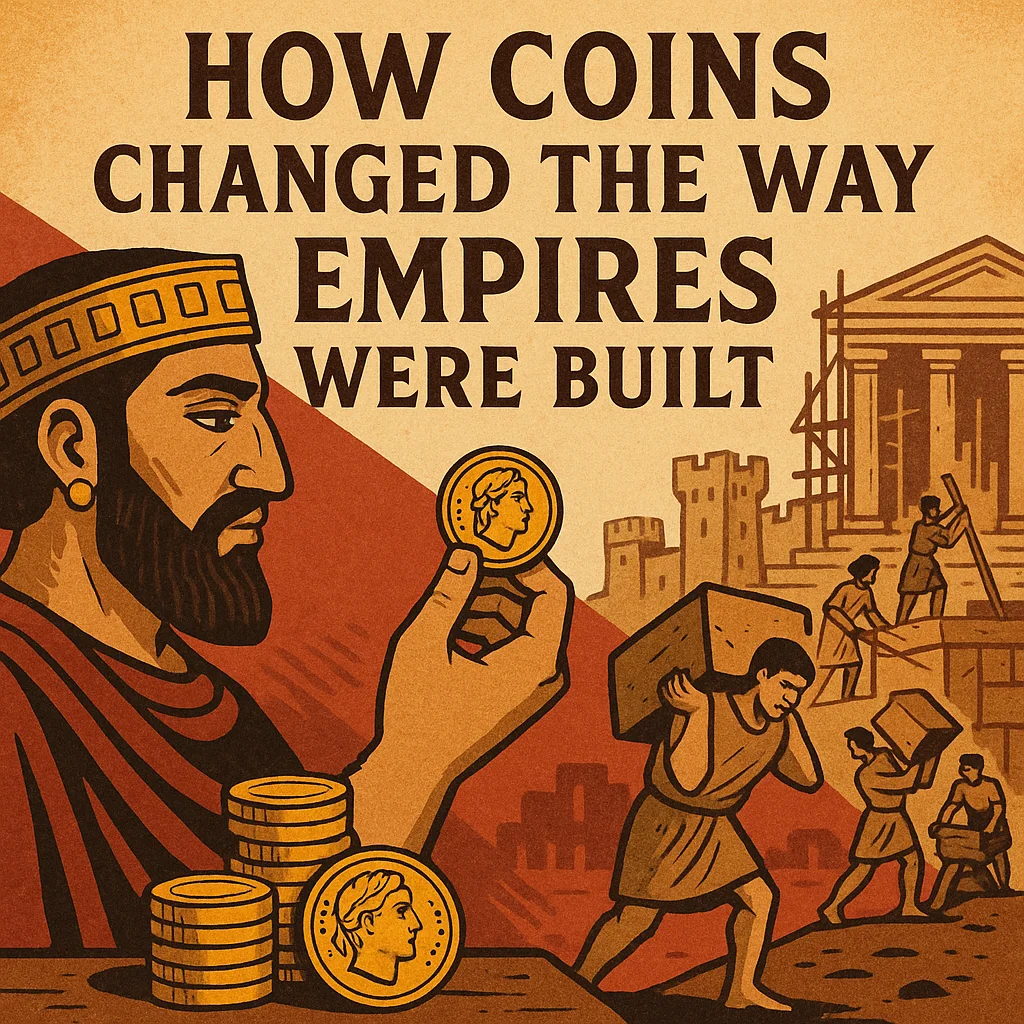
How Coins Changed the Way Empires Were Built
A coin is more than just a piece of metal; it's a narrative. An account of how people transformed basic metal disks into effective instruments for trade, propaganda, and the establishment of empires.
Even while coins appear commonplace today, their creation over 2,500 years ago was one of the most momentous periods in human history. They transformed economies, united regions, and were the lifeblood of empires in addition to making commerce easier.
Coins changed how armies fought, how emperors ruled, and how cultures interacted from ancient Lydia to the Roman Empire and beyond. This is the tale of how microscopic metal fragments altered the course of entire countries.
The Birth of Coinage: From Barter to Metal Money
The globe relied on barter and bulk commodities prior to the invention of coins. Grain, animals, salt, or metals were traded by weight. Although this was effective locally, it turned into a nightmare for large-scale commerce. How could an Egyptian merchant determine the precise worth of silk from China or tin from Anatolia?
The missing component was standardization, which first appeared in the Kingdom of Lydia (modern-day Turkey) in the seventh century BCE.
The Lydians started applying royal seals to tiny fragments of electrum, a naturally occurring gold and silver alloy. There was no need to weigh metal with each transaction because each stamped piece certified its weight and purity.
This was a groundbreaking invention. Money has a government-backed official guarantee for the first time. People trusted the stamp rather than the merchant.
That simple act turned metal into money, and money into power.
Coins as Trust in Metal Form
Coinage's genius lay in faith, not in the metal. The issuing authority guaranteed the value of a coin, making it a symbol of a promise.
Money could travel thanks to this trust. An Egyptian farmer, a Persian merchant, or a Greek soldier might all identify the authority behind a coin's symbol. It produced a universal language of worth.
This system solved several problems at once:
-
Standardization: Coins replaced clunky weighing systems.
-
Portability: Metal coins were easy to carry and durable.
-
Trust: The royal image guaranteed authenticity.
-
Taxation: Rulers could collect and redistribute standardized wealth.
The world's earliest monetary economies appeared as coinage gained traction, bringing with them the means to establish empires.
The Greek Experiment: Coins as Identity
The Greeks took Lydia’s invention and turned it into an art form—and a political weapon.
Each Greek city-state produced its own coins, which frequently featured images of the city's pride or patron deities. Sparta, a notoriously austere city, utilized heavy iron bars to deter avarice; Corinth featured Pegasus, the winged horse; and Athens produced silver coins embossed with the owl of Athena.
These designs weren’t decoration—they were declarations of identity and power.
Coins served as the city's ambassadors, bringing its influence and culture with them wherever they went. Coins served as antiquated propaganda in a world without mass media.
The popularity of Athens' coins was a key factor in the city's commercial success. One of the most reliable and extensively used currencies in antiquity was the Athenian "owl" drachma. The power of the Athenian economy and navy was mirrored in its reputation.
When people accepted Athenian coins, they were also, indirectly, accepting Athenian dominance.
Persia: The First Monetary Empire
The Persians used coinage to establish an empire that spanned the entire continent, whereas the Greeks used them to represent identity.
The daric, a gold coin with the image of the ruler as an archer, was first issued by ruler Darius I of Persia in the sixth century BCE. It became the foundation of the Persian economy together with the silver siglos.
The Persian Empire was too big to rely on barter or regional money, spanning from the Indus Valley to Egypt. Darius accomplished something remarkable by unifying coinage throughout this vast territory:
-
He unified the empire’s economy under one currency.
-
He simplified tax collection and army payments.
-
He fostered long-distance trade across Asia, Africa, and Europe.
The daric represented both imperial power and wealth. When someone utilized Persian coinage, they were taking part in the Great King's economic system.
As a medium that connected villages, marketplaces, and armies under a common standard, coins emerged as the empire's most powerful unifying force.
Rome: The Empire That Minted Its Own Power
No civilization wielded coinage more effectively than Rome.
Coins were already commonplace throughout the Mediterranean by the time Rome became the dominant power. However, currency was raised to an art of empire management by the Romans.
Roman coins weren’t just currency—they were tools of propaganda and instruments of control.
1. Financing Conquest
Large quantities of money were needed for every Roman campaign in order to reward allies, purchase supplies, and pay soldiers. This was made feasible by coins. Rome could instantly turn conquest into cash flow by using seized silver and gold to print money close to battlefronts.
The emperor's image appeared on the coins used to pay soldiers, guaranteeing that the army was accompanied by the face of authority.
2. Symbols of Authority
Coins were used as little billboards by Roman emperors. To convey power and legitimacy, they displayed catchphrases, triumphs, or holy symbols.
For instance, coins produced under Augustus declared "Pax Romana" (Roman Peace), enhancing his reputation as the person who would provide stability following a civil war. More quickly than any messenger, coins disseminate messages.
3. Economic Integration
Rome's extensive system of provinces, ports, and roadways depended on stable monetary policy. Roman coinage offered a common language for trade, whether in Egypt, Britain, or Gaul.
This monetary unity helped sustain the empire for centuries, even as its political structures evolved.
Coins were not just money—they were the arteries through which the empire’s lifeblood flowed.
The Ripple Effect: Coins Beyond Empire
The influence of coinage didn’t stop with Greece, Persia, or Rome.
-
Punch-marked coins were used by the Mauryan Empire in India under Chandragupta and Ashoka to control commerce and unify their enormous lands.
-
The Qin and Han dynasties in China standardized round coins with square holes to symbolize the harmony of earth (square) and heaven (circular).
-
One of the most reliable and frequently used monetary systems of the Middle Ages was established in the Islamic Caliphates, where gold dinars and silver dirhams had inscriptions of faith rather than pictures.
Coins became symbols of legitimacy in all cultures. Declaring sovereignty meant minting currency. Without money, a king wasn't really a ruler.
Coins as Tools of Propaganda and Power
Coins served as the ancient world's media in addition to their economic function. They conveyed imperial pride, religious convictions, and political statements.
-
Alexander the Great’s coins featured his image as Heracles, implying divine ancestry.
-
Caesar’s portrait on coins symbolized the shift from republic to personal rule—a bold move that asserted his supremacy.
-
Byzantine coins replaced emperors’ faces with Christian crosses, signaling a new era of faith-based rule.
Every coin told a story: who ruled, what was valued, and what the empire stood for.
Their coins survived the fall of civilizations. Roman and Persian coins are still found by archaeologists thousands of kilometers from their original mint, a silent witness to the extent of those empires' influence in antiquity.
The Economic Revolution: From Barter to Monetary Policy
Coinage didn’t just change how people traded—it changed how governments governed.
The supply of money was under the control of kings once they started minting coins. By altering the metal content or creating new coins, they might increase or decrease its value, control interest rates, and finance wars.
This was the birth of monetary policy, the invisible lever that still shapes economies today.
For instance:
-
Emperors decreased the amount of silver in coins, so inflating the currency, when Rome was experiencing financial difficulties.
-
Stable currency increased trade and tax receipts during successful periods by enhancing public confidence.
Through coins, empires learned to control economies not by decree—but by design.
The Fall and Legacy of Coin-Based Empires
Maintaining confidence in currency became more difficult as empires grew. Confidence was damaged by corruption, inflation, and counterfeiting.
For instance, there was a significant devaluation of money during the collapse of Rome. The size, purity, and trustworthiness of coins decreased. Local barter systems resurfaced as trade decreased.
Coinage, however, never went out of style. Through Renaissance florins, medieval silver pennies, and contemporary nation-state currencies, it evolved.
The first imprinted piece of metal in ancient Lydia is the source of all contemporary coins, including the Indian rupee and the US quarter.
Coins and the Modern World
Coins continue to be emblems of national identity even in the era of digital payments and cryptocurrencies. They honor historical figures, historical sites, and leaders.
They serve as a reminder that money is more than just a tool for commerce; it is a cultural relic that tells a tale about our identity and values.
The idea behind modern digital currencies is somewhat similar to that of old coins: they establish a standard, guarantee trust, and facilitate transaction. Although the medium has evolved, the idea has not.
Conclusion: The Empire in Your Pocket
Beyond only facilitating trade, coins altered the structure of communities. They made it possible for governments to levy taxes effectively, pay soldiers, and promote cross-continental trade.
They allowed monarchs to convey their identity and authority over large areas. They also imparted one of humanity's most timeless lessons: the worth is not in the metal but in our faith in it.
The coin persisted despite the rise and fall of empires, serving as little reminders that civilizations are built on belief rather than money.
Today, holding a coin is more than just having money. The very base that empires were built upon is in your hands.




Leave a Reply