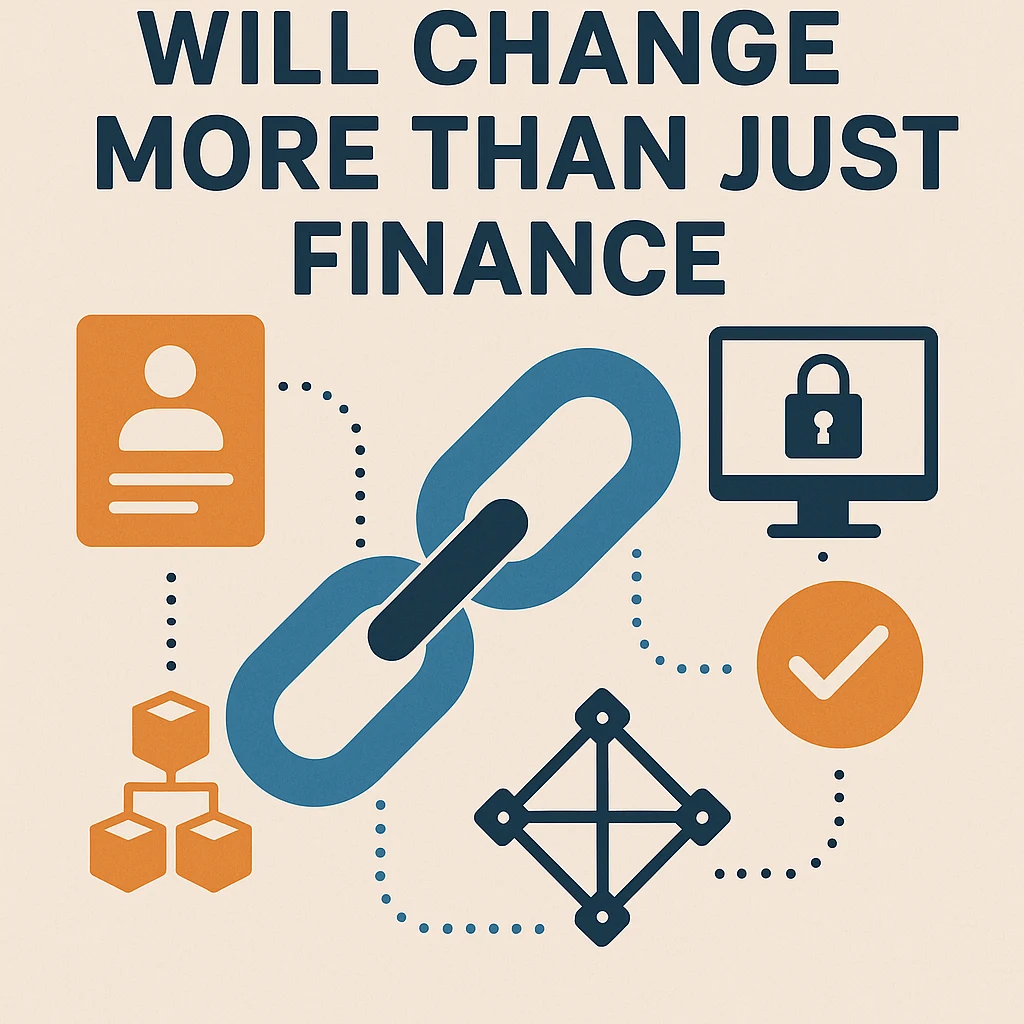
The majority of people instinctively associate "blockchain" with cryptocurrencies like Bitcoin. This relationship has shaped the public perception of the technology for many years. However, blockchain—the fundamental technology that enables Bitcoin—was never intended to be limited to virtual money. It signifies a paradigm change in the way ownership, trust, and data are handled in the digital realm.
As more sectors investigate blockchain's potential outside of banking, it's becoming evident that we're just getting started. Blockchain's decentralized structure provides answers to persistent problems like corruption, inefficiency, and lack of transparency in a variety of fields, including healthcare, education, supply chains, real estate, and governance.
This is the tale of how blockchain technology will change not only how we manage money but also how we govern the entire world.
1. Understanding Blockchain’s Core Strength: Decentralized Trust
Blockchain is fundamentally a distributed ledger that keeps track of transactions over a computer network. Multiple individuals verify each entry, or "block," making it transparent and unchangeable. This removes the need for middlemen, like as banks, governments, and businesses, to confirm transactions or uphold confidence.
What makes that so potent?
Because trust has always been costly. The main purpose of institutions, intermediaries, and bureaucratic procedures is to guarantee transaction integrity. Blockchain modifies that. Because trust is ingrained in the code itself, systems can operate securely and transparently without centralized monitoring.
Because of this fundamental feature, blockchain can be used in practically any business where data integrity and trust are essential.
2. Revolutionizing Supply Chains: From Factory to Consumer
Global supply chains are one of the few industries that suffers from opacity. Customers are rarely aware of the origins of their goods, whether their coffee is sourced ethically or whether their medication is fake. Traceability is a radical solution provided by blockchain.
Blockchain-based supply management solutions allow for the recording and verification of every stage, from the procurement of raw materials to the final delivery. Blockchain logistics is already being used by companies like IBM and Maersk to track products in real time. Better accountability, less delays, and less fraud are the outcomes.
Imagine being able to instantaneously view the complete production process—factory locations, material sources, and environmental impact—by scanning a barcode on your trainers. That degree of openness has the power to change both corporate accountability and consumer behavior.
3. Reinventing Healthcare: Ownership of Medical Data
Data silos, antiquated record systems, and privacy concerns have long plagued the healthcare industry. Blockchain has the potential to change that story.
Patients can manage who has access to their medical records while maintaining accuracy and confidentiality by storing them on a secure blockchain. Consistent, validated information is accessible to physicians, hospitals, and insurers without requiring redundant work or jeopardizing privacy.
By granting patients data ownership and streamlining healthcare interoperability, initiatives like MedRec and BurstIQ are leading the way in blockchain-based healthcare solutions. This can lower administrative expenses, stop medical mistakes, and give people more control over their health data.
In the future, you may maintain control of your digital health identity while it moves easily across clinics, insurance companies, and even nations.
4. Transforming Education: Credentials That Can’t Be Faked
Fake degrees and unreliable certifications are becoming more common, making academic fraud a global issue. Blockchain's tamper-proof educational records provide a sophisticated solution.
Diplomas, transcripts, and certifications can be issued by institutions as privately owned but publicly verifiable blockchain entries. Without the need for drawn-out verification procedures, employers may immediately verify a candidate's qualifications.
For example, graduates of the MIT Media Lab already receive blockchain-based degrees. Blockchain can democratize access to authentic credentials, enabling millions of people to demonstrate their education and abilities in poor countries where paper records are readily lost or falsified.
5. Real Estate: Transparency and Trust in Property Transactions
Fraud, corruption, and inefficiency are major problems in the real estate sector. Long paperwork, conflicting ownership claims, and title issues hold down transactions and foster mistrust. Blockchain has the ability to protect ownership records and expedite property transfers.
To guarantee unchangeable property records, nations like Georgia and Sweden have started experimenting with blockchain land registries. Instantaneous ownership verification by buyers and sellers eliminates the need for middlemen and guards against record-keeping malfeasance.
Imagine a future without tedious paperwork, uncertainty, or middlemen where you could purchase real estate across borders with just a few verified blockchain transactions. That's what blockchain technology promises for the real estate industry.
6. Governance and Democracy: Restoring Trust in Systems
Governance is one of blockchain's most revolutionary potentials. Institutional mistrust is at an all-time high worldwide. Public spending transparency, election integrity, and leadership accountability are frequently questioned by the public.
Blockchain's transparent governance technologies have the potential to rebuild trust in democratic regimes. Blockchain-based voting systems, for instance, can make elections impenetrable by recording votes in an unchangeable manner and counting them instantly. In a similar vein, governments can monitor public expenditure using blockchain technology to guarantee that money reaches its intended locations without bureaucratic leakage.
Blockchain is already being used for citizen services in Estonia, a forerunner in digital governance, including digital IDs and medical records. A new era of digital democracy, where technology makes institutions more responsible, transparent, and efficient, may emerge as more countries investigate such systems.
7. Intellectual Property and the Creative Economy
It has always been difficult for writers, musicians, and artists to safeguard their intellectual property and get just recompense. Blockchain uses smart contracts and tokenization to present the concept of digital ownership.
Without depending on centralized systems, creators can issue works as NFTs (Non-Fungible Tokens) to demonstrate ownership and validity. Smart contracts can automate royalties, guaranteeing that artists are paid promptly and openly whenever their creations are used or sold.
This change opens the door for a more just digital economy by enabling creators and artists to take back ownership of their works.
8. Energy and Sustainability: Decentralized Power Grids
Blockchain has an impact on energy management as well. Imagine a community where solar-powered homeowners use a blockchain-based system to sell extra electricity to nearby residents directly, eliminating the need for a utility company.
These kinds of decentralized electricity systems are already being explored in nations like the Netherlands and Germany. Smart contracts manage supply and demand, while blockchain guarantees safe, automated transactions. This strategy could lessen reliance on centralized power networks and hasten the world's transition to renewable energy.
Blockchain can also assist businesses in fulfilling their environmental obligations by facilitating transparency in sustainability reporting and carbon credits.
9. Challenges Ahead: Scalability, Regulation, and Ethics
Blockchain has significant obstacles despite its potential. Scalability is still a big issue because public blockchains frequently have trouble processing large amounts of transactions. Environmental concerns are raised by energy use, especially with earlier proof-of-work systems. Furthermore, widespread adoption is hampered by regulatory ambiguity.
The ethical conundrum is that although decentralization eliminates conventional gatekeepers, it also lessens monitoring. When a decentralized system malfunctions or is abused, who is in charge?
The answers are still unclear. However, it is clear that in order to create systems that value both innovation and integrity, blockchain's development will necessitate cooperation between engineers, legislators, and global citizens.
10. The Road Ahead: A World Rewired by Trustless Systems
Blockchain's universality is what makes it so beautiful. It is an architectural breakthrough for reconstructing systems around truth, transparency, and autonomy rather than only a financial tool.
Blockchain has the potential to transform trust in the same way that the internet transformed communication. We'll probably see hybrid systems in the next years that combine conventional frameworks with transparency enabled by blockchain technology. This transition to a future that is both trustless and trustworthy will involve individuals, corporations, and governments.
The goal is to enable human institutions to function more fairly, effectively, and accountably rather than to replace them.
Conclusion: A New Paradigm for the Digital Age
Blockchain started off as a financial experiment. However, its true legacy might be found in something much deeper: a future in which individuals, not organizations, own data. A world in which the truth is confirmed rather than just asserted.
Blockchain is changing the social contract between people and systems in a number of areas, including supply chains, healthcare, government, and sustainability. Although it won't happen right away, the change has already started.
Decentralized money is not the only thing of the future.
It has to do with decentralized trust.




Leave a Reply