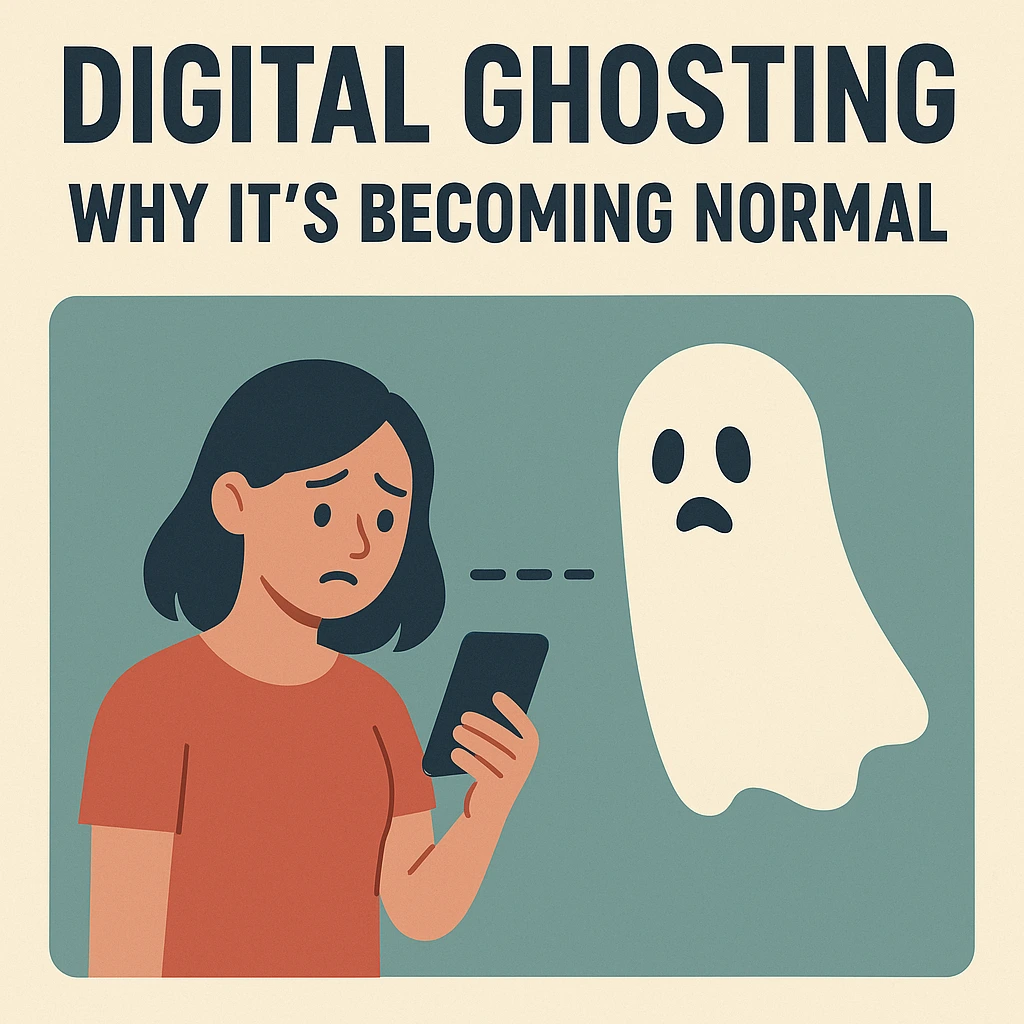
One would think that communication would be simpler than ever in the era of instant messaging, continuous notifications, and an always-online lifestyle. Ironically, though, the development of technology has made it possible to vanish from someone's life with only a single click. This practice, sometimes referred to as "digital ghosting," is becoming a prevalent and oddly accepted aspect of contemporary communication.
Although ghosting is not new, its prevalence, magnitude, and normalcy have all significantly increased. Silence is increasingly preferred over confrontation in friendships, dating, the business, and even consumer transactions. The "seen" indication without a response, the unanswered message, and the unopened text have all become commonplace in the digital world.
But why is ghosting so widespread? Why do individuals disappear so quickly rather than interacting honestly? What does this change indicate about contemporary relationships and emotional behaviors?
Let's examine the underlying causes of the phenomenon of digital ghosting and the reasons it has subtly become a common occurrence in the 2020s.
1. Technology Makes Disappearing Too Easy
Ghosting is now easy thanks to technology, which is typically the most compelling excuse. Disappearing in real life necessitates avoidance, distance, and even awkward interactions. It takes seconds in the digital age.
Without conflict, you can ban someone, mute discussions, disable notifications, and ignore messages. Vanishing is not only feasible but also rather convenient thanks to the design of contemporary platforms.
Emotional distance is immediately created with a single tap. Additionally, a lot of people ghost due to habit, avoidance, or overwhelm rather than malice because it feels so simple.
2. Overstimulation Leads to Communication Fatigue
These days, there is constant communication. WhatsApp, Instagram, dating apps, email, direct messages, and more are all sources of messages. Cognitive overload results from the continuous flow. People frequently react to feeling overburdened by entirely unplugging.
Some of the most common internal struggles include:
-
Feeling mentally drained
-
Not knowing how to respond
-
Forgetting due to multiple apps
This starts a vicious cycle in which being silent, rather than being impolite, becomes a means of survival. Ghosting seems like the only way to deal with excessive digital noise, thus it might not seem like a cruel decision.
3. Fear of Confrontation and Emotional Discomfort
We are now more adept at expressing ourselves digitally thanks to modern technology, though not always emotionally. Many people find it difficult to be honest, have tough talks, or simply say "no." One of the main causes of ghosting is the fear of confrontation.
When quitting a relationship or rejecting someone seems embarrassing, ghosting becomes the “easier” escape. People prefer to remain silent rather than express their emotions.
Some ghost because they worry about:
-
Hurting the other person
-
Being judged
-
Being misunderstood
Ironically, the pain of silence is frequently more greater than that of a polite message. Avoidance, however, feels safer emotionally at the time.
4. Attention Spans and Fast-Paced Social Interactions
Digital communication is fast. In a week, users meet dozens of new people, swipe left, scroll endlessly, and switch between chats. Attention spans have drastically decreased due to this continual action.
Friendships and romantic relationships are becoming more ephemeral. People move on as quickly as they connect when their attention wanes. Furthermore, the speed at which digital interactions develop makes ghosting an inevitable consequence.
Another factor is the plethora of possibilities. People feel less pressure to continue discussions or make an attempt to politely end them when they have so many options.
5. Emotional Detachment in the Online World
A feeling of emotional detachment is frequently produced by the digital world. Interactions happen behind screens rather than in person. People may become detached as a result, forgetting that usernames and profile photos conceal genuine feelings.
Ghosting seems less damaging when communication is perceived as less "real." Many ghosters convince themselves that the other person won't care or be harmed in order to justify their silence. This distancing normalizes the act and reduces empathy.
Emotional numbness eventually permeates online culture. As a result, ghosting becomes not only typical but also anticipated.
6. The Shift Toward Self-Preservation and Boundary Setting
Ghosting is a common way for people to safeguard their mental health. Ghosting can become more than just avoidance in some situations. Ghosting seems like the fastest way to get rid of negativity in someone's life when they feel threatened, exhausted, under pressure, or disrespectful.
Ghosting turns as a coping mechanism in this way. It enables people to maintain their tranquility without having to defend or explain themselves.
This is also a reflection of a larger cultural change: the growing consciousness of mental health. Even if it means ending talks, more people put their own needs ahead of those of others.
7. The Culture of Instant Gratification and Replaceability
Fast rewards—likes, swipes, answers, matches, and instant entertainment—are promoted by digital platforms. Instant connection is what people want, but they also get bored easily. Older discussions feel less significant, especially when someone fresh shows up with a single swipe in dating apps.
Many psychologists refer to this as the "culture of replaceability." Commitment wanes in partnerships that seem interchangeable. Individuals cease making significant investments and leave without hesitation.
"If this doesn't work, I'll find someone else" becomes the mentality.
In such a culture, disappearance becomes normalized.
8. The Rise of “Soft Ghosting” and Silent Fading
Ghosting is not always severe or sudden. Nowadays, a lot of individuals "soft ghost," which entails gradually cutting back on communication until it vanishes on its own. They may take longer to answer, send shorter messages, or use emoticons in place of words.
Soft ghosting adheres to the same principle—pulling away without giving a reason—but it feels less harsh.
This pattern demonstrates how commonplace ghosting has become. Nowadays, withdrawing subtly is seen as a legitimate method of ending a conversation.
9. Ghosting Isn’t Always About Disrespect—Sometimes It’s Emotional Conflict
Although it's simple to characterize ghosters as callous or heartless, the reality is more nuanced. Ghosters frequently have emotional difficulties. These could be:
-
Confused about their feelings
-
Dealing with personal issues
-
Unable to express themselves
-
Trying to avoid creating conflict
Ghosting frequently results from emotional perplexity rather than cruelty. Although the habit is unhealthy, the individual exhibiting it might be overburdened.
Knowing this helps to explain why ghosting is becoming more and more common, but it does not justify it.
10. Why Ghosting Feels “Normal” Today
Digital ghosting has become normal for several reasons:
-
Technology enables instant disappearance
-
Emotional confrontation feels harder
-
People are overwhelmed and overstimulated
-
The digital world reduces empathy
-
Modern relationships move quickly
-
Boundaries and mental health are prioritized
-
Replaceability and instant gratification shape behavior
Together, these elements give the impression that ghosting is a socially acceptable behavior, even whether it results in hurt, uncertainty, or problems with emotional closure.
Conclusion: Ghosting Reflects a Deeper Cultural Shift
Digital ghosting is a reflection of how modern living has altered our ability to connect, empathize, and engage; it is not merely a communication issue. It highlights the conflict between the fast-paced digital environment we live in and our emotional needs.
People ghost because it's so simple. Fear is the reason why people ghost. People who are overburdened tend to ghost. Additionally, people ghost because emotional shortcuts have become commonplace in our online surroundings.
Ghosting forces us to reconsider communication in the digital age as it continues to proliferate. Convenience and kindness, self-preservation and clarity, and digital habits and emotional responsibility must all be balanced.
Ghosting might be typical today—but with understanding and empathy, it doesn’t have to be the future.




Leave a Reply