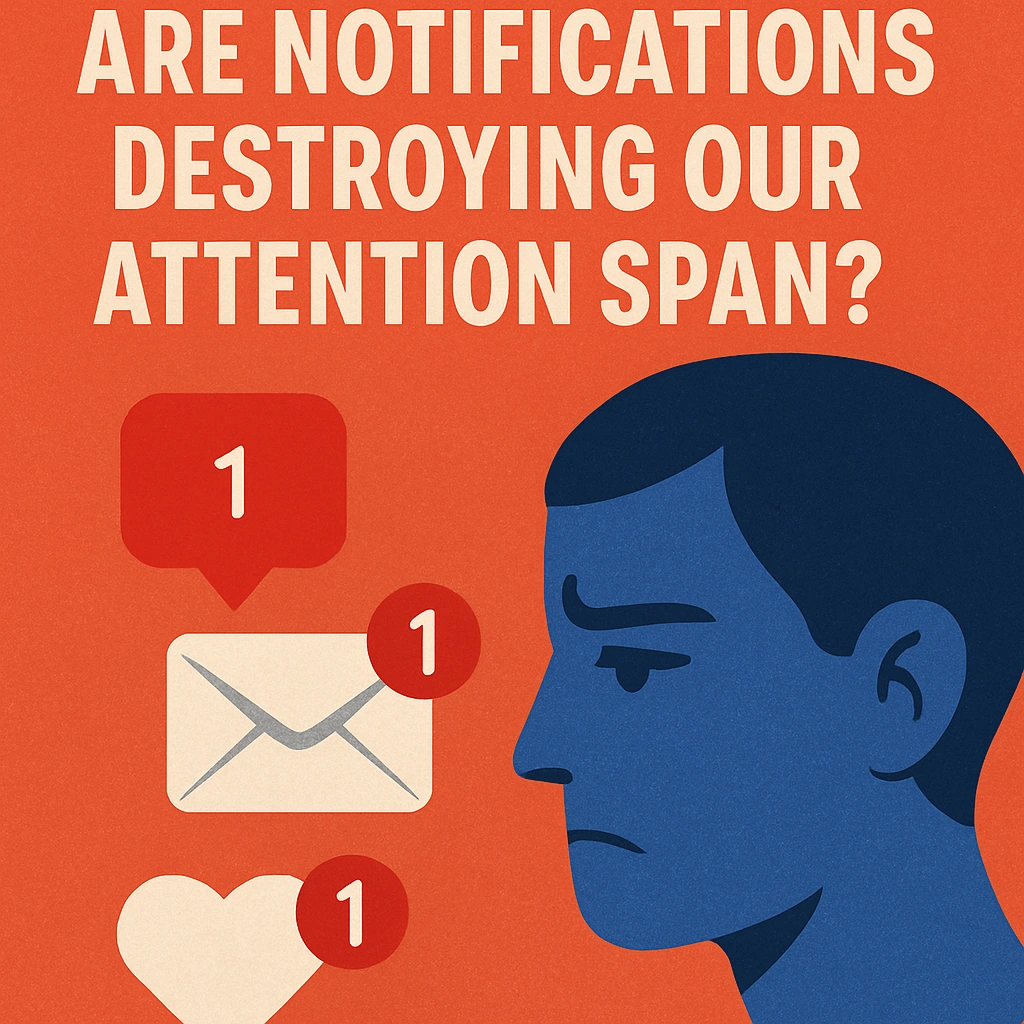
Ding! Buzz! Pop-up!
It's likely that your phone has attempted to get your attention before you've even finished reading this phrase. We live in a world where notifications are meant to continuously disturb us, disrupting our focus and diverting our attention.
Every notice feels important, whether it's a text message, a news update, a social network like, or a promotional alert, but the majority are completely pointless. Nevertheless, we examine them. We respond right away. Additionally, our brains gradually grow wired to be distracted.
Therefore, the crucial question is: Do notifications shorten our attention spans?
Let’s find out.
📉 How Notifications Are Affecting Our Attention Span
Recent lifestyle shifts reveal something alarming:
Our ability to focus is shrinking.
Studies reveal the average human attention span has reduced substantially due to digital disruptions. Each time a notification appears:
-
We stop what we’re doing
-
We shift focus to the device
-
We struggle to return to the previous task
The brain is worn out by this frequent switching, and it develops a habit of never being totally present.
🧠 The Neuroscience Behind Notification Distraction
Dopamine, a neurotransmitter associated with pleasure and reward, is activated by notifications. That "ping!" turns into a little excitement.
Our brain begins craving the next alert, which leads to:
-
Compulsive checking behavior
-
Reduced self-control
-
Shorter attention spans
-
Inability to tolerate boredom or silence
Our brains are being trained to anticipate stimulus every second, which makes long-form thinking more difficult.
Reading, studying, brainstorming, and deep work are the tasks that suffer the most.
🔔 “The Notification Trap” — A Cycle We Don’t Notice
Attention is required for every alarm. Your brain changes attention even if you don't open it. This is how the cycle appears:
1️⃣ Notification arrives
2️⃣ Curiosity spikes: “What if it’s important?”
3️⃣ You check it
4️⃣ Distraction leads to scrolling or replying
5️⃣ Productivity drops
6️⃣ Brain craves another alert
This loop keeps us distracted throughout the day — more than we realize.
📱 Types of Notifications That Hijack Our Focus Most
Not all alerts are equal. Here are the biggest culprits:
-
Social media likes, comments & tags
-
Messaging app buzzes
-
News updates with dramatic headlines
-
Promotional notifications
-
App badges with red alert icons
-
Email notification previews
Even though the majority of these are not urgent, they cause our brains to become urgent.
🏠 Notifications and Our Personal Lives
Notifications harm everyday routines and relationships in addition to interfering with work.
Many of us:
-
Check phones during meals
-
Look at screens while someone is talking
-
Wake up to alerts in the middle of the night
-
Scroll before falling asleep
Real-world connectivity is hampered by the physical device.
👶 Impact on Children and Teens
Younger brains are more susceptible. Children who grow up with beeping displays are:
-
Losing ability to focus in class
-
Struggling with delayed gratification
-
Developing anxiety from constant digital pressure
-
Becoming dependent on stimulation from devices
Alerts and applications vying for attention are taking the role of playtime and creativity.
😵 Notification Overload and Mental Health
Constant interruptions lead to:
-
Anxiety from expecting the next alert
-
FOMO (fear of missing out)
-
Lower self-esteem from social comparison
-
Poor sleep and screen addiction
-
Memory issues and mental fatigue
Because the next notification is always on the horizon, we seldom ever let our minds relax.
💻 Workplace Productivity and Focus Crisis
Workers lose important time recuperating from disruptions. Regaining complete focus after an interruption can take up to twenty-three minutes.
Notification-driven multitasking causes:
-
More mistakes
-
Lower creative output
-
Increased stress
-
Inefficient work patterns
Focus zones and notification-free hours for in-depth work are becoming more and more popular in workplaces.
💡 Signs Notifications Are Ruining Your Focus
You might notice:
-
You grab your phone even without alerts
-
You lose track of tasks frequently
-
You feel anxious when notifications are off
-
You scroll automatically in small time gaps
-
You struggle to read long text without checking your phone
Your focus is being attacked if this sounds familiar.
✔️ How to Take Back Control: Smart Notification Management
You don't need to give up your phone; just use it with awareness.
Here are some practical strategies for ending the cycle of distraction:
-
Disable notifications that are not necessary.
-
Turn off social media alert badges, particularly the red ones.
-
When working, studying, or sleeping, use Do Not Disturb.
-
Set up specific time to review apps.
-
Outside of the bedroom, charge your phone.
-
Limit the number of distracting apps.
-
Establish phone-free areas in your house
-
Instead of unlocking the phone, wear a watch to check the time.
-
When you need to concentrate a lot, switch to silence mode.
-
Take distracting apps off of the home screen.
Try making just two adjustments; you'll see a difference right away.
🙌 Digital Minimalism: A Healthier Tech Lifestyle
Conscious digital use, rather than perpetual access, is becoming more and more popular.
Digital minimalism encourages:
-
Fewer apps
-
Purposeful screen usage
-
More real-life experiences
-
Reconnecting with our surroundings
Instead than controlling our attention, technology ought to help us.
🧘 The Joy of Uninterrupted Focus
Reducing notifications yields the following benefits:
-
Increased focus
-
enhanced mental acuity
-
Better connections
-
Enhanced output
-
Increased originality
-
Calm mornings and deeper sleep
You resume living in the present.
Focus becomes a superpower.
🚀 The Future: Reclaiming Our Minds
Tech companies are slowly adding:
-
Focus modes
-
Screen-time controls
-
Notification summaries
-
Reduced interruptions
But we are the ones who need to make the largest shift.
We must create a world in which technology complements human experience rather than detracts from it.
📝 Final Thoughts
On their own, notifications are not harmful. Before they start making a lot of noise, they are helpful tools. Distraction is profitable in today's digital environment, and our brains suffer as a result.
We need to be mindful of how we use technology in order to preserve our mental health, creativity, and attention spans.
✨ You make the decision to regain concentration each time you decide to turn off an alarm.
✨You may take back control of your thoughts every time you are not receiving notifications.
It only takes one click, or rather, one fewer click, to live a more peaceful and aware existence.


Leave a Reply